
Africa’s economic picture for 2025 is no longer a single story of crisis or promise. Recent regional forecasts show steady recovery and pockets of rapid expansion driven by private investment, commodity cycles and renewed policy focus on industrialisation. Growth projections for the region have moved upward this year, and a growing number of countries are delivering above-average GDP gains that invite sectoral and geographic scrutiny.
Meanwhile, the continent’s young population, coupled with a rapid digital transformation, is giving rise to a generation of entrepreneurs who are building businesses with global relevance. Sectors once viewed as peripheral-renewable energy, fintech, agritech, creative industries, and logistics, are now driving measurable growth. Governments are beginning to respond with policies that favour innovation hubs, start-up ecosystems, and cross-border digital trade. The shift marks a pragmatic turn for Africa’s economic story: less about aid and extraction, more about knowledge, value, and ownership.
Nigeria, Kenya, Egypt, and South Africa remain the continent’s heavyweight economies, but the current wave of innovation runs deeper than national borders. In Lagos, Nairobi, Kigali, and Accra, small enterprises are becoming regional catalysts for technology and investment. Nigeria’s Iyinoluwa Aboyeji, co-founder of Andela and Flutterwave, represents this transition vividly. His venture capital firm, Future Africa, now funds dozens of early-stage founders tackling education, healthcare, and energy challenges across the continent. Similarly, Ethiopia’s Betelhem Dessie, founder of iCog Labs, is building Africa’s presence in artificial intelligence and robotics, while training young women in STEM, a clear signal of where Africa’s human capital is heading.
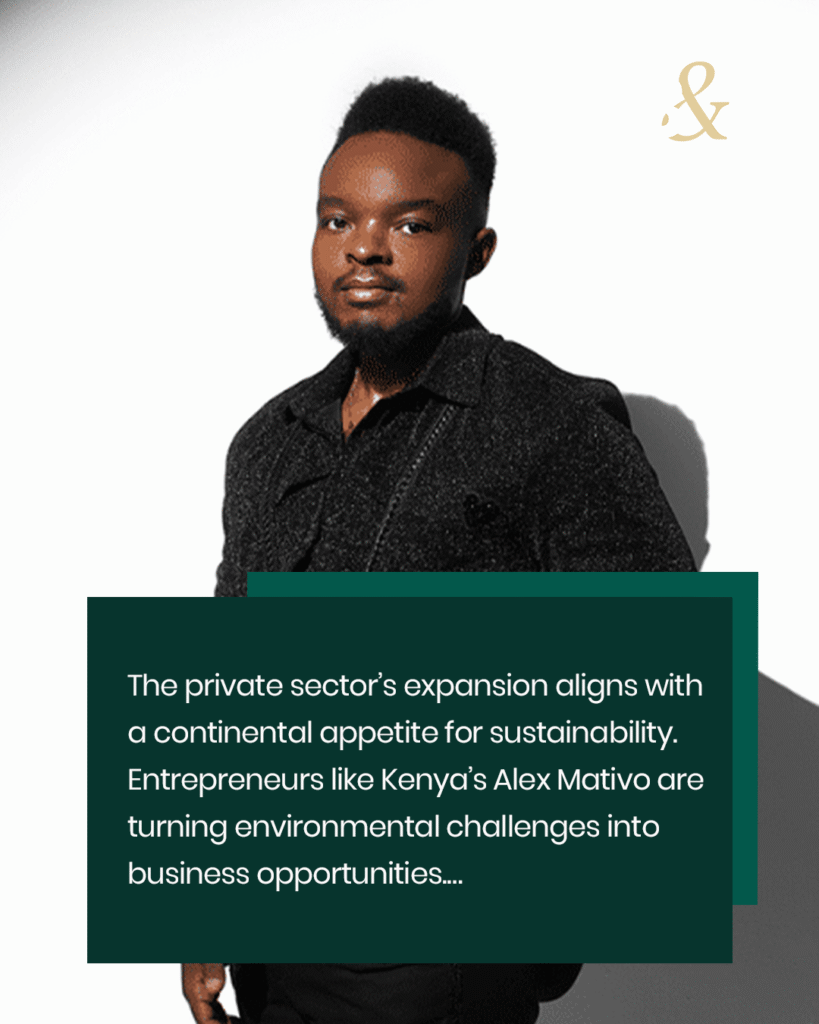
The private sector’s expansion aligns with a continental appetite for sustainability. Entrepreneurs like Kenya’s Alex Mativo are turning environmental challenges into business opportunities. His companies Duck and E-LAB are rethinking how technology and design can transform e-waste into functional materials. In Nigeria, Ifedayo Durosinmi-Etti’s Herconomy fintech platform has created a financial space tailored to women, offering savings, loans, and professional growth resources to a demographic too often excluded from formal finance. These ventures are not experiments; they are scaling models that redefine how inclusive economic systems can function across Africa’s cities.
Renewable energy remains one of the continent’s most promising investment fields. In Lagos, innovators such as Zimuzo Nwabueze Ofor of Eco-Green Solar Systems are expanding access to affordable power for small businesses and rural communities. His enterprise develops solar-powered gadgets and infrastructure that are helping households bypass unreliable grids. The focus on energy independence has broader implications for manufacturing, healthcare, and education, which all depend on stable electricity. When paired with supportive policies, such ventures demonstrate how climate-aware entrepreneurship can directly affect GDP and social welfare.
Across Africa’s new business corridors, a clear pattern is emerging: innovation thrives where infrastructure and policy are improving. Rwanda’s start-up act, Kenya’s fintech regulations, and Ghana’s push for creative economy financing have created frameworks that reward disciplined entrepreneurship. The African Continental Free Trade Area (AfCFTA) also gives founders new reach, allowing startups to scale across borders with fewer regulatory hurdles. From Lagos’ Yaba tech district to Cairo’s Knowledge City, small ventures are scaling into regional firms faster than ever before.
The creative economy is also expanding. Young Africans are monetising culture, storytelling, and design in ways that merge tradition with technology. The music and film industries, powered by digital streaming platforms, are becoming major contributors to national GDPs. Tech-enabled art marketplaces and digital fashion studios are now part of the broader conversation about value creation. This creativity fuels other sectors too, as digital branding, advertising, and cultural exports draw in foreign investment and global partnerships.
Africa’s next growth frontiers are anchored in youth, innovation, and adaptability. The continent’s young entrepreneurs are not waiting for permission to build; they are setting the pace for the next industrial chapter. Their ventures point toward a future where economic growth is not just measured in oil revenues or mineral exports, but in data, design, clean energy, and intellectual capital. With each venture launched and each partnership secured, Africa’s emerging generation is reshaping how the world views business from the continent, driven by skill, resilience, and an unrelenting belief in possibility.