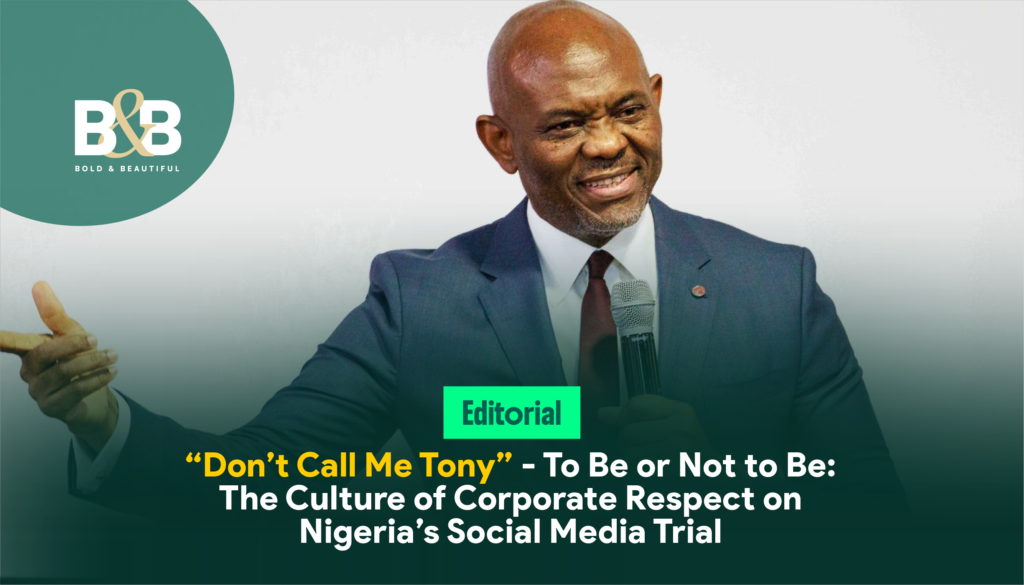
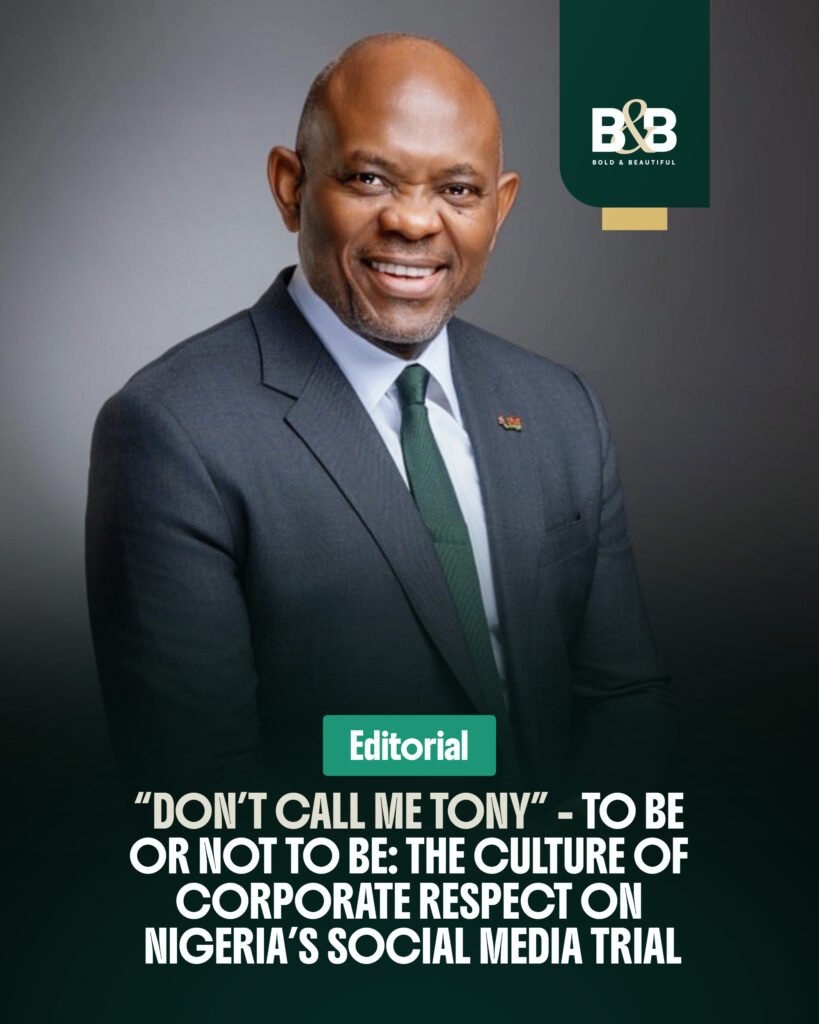
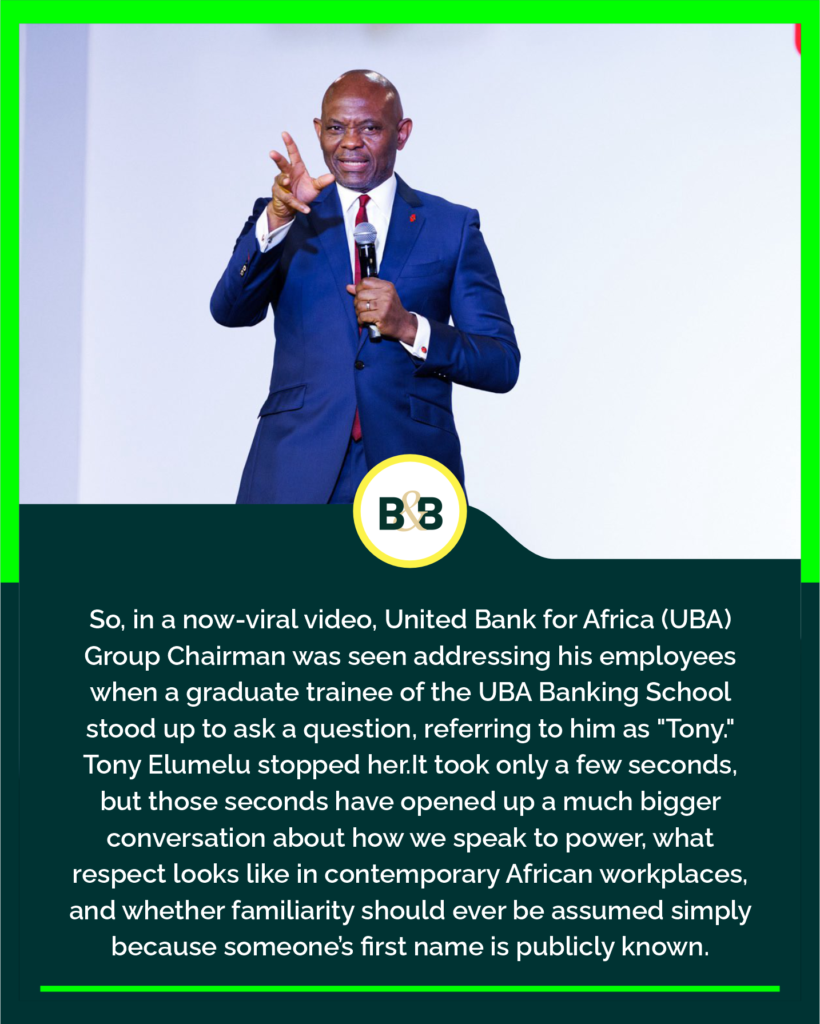
So, in a now-viral video, United Bank for Africa (UBA) Group Chairman was seen addressing his employees when a graduate trainee of the UBA Banking School stood up to ask a question, referring to him as “Tony.” Tony Elumelu stopped her.
It took only a few seconds, but those seconds have opened up a much bigger conversation about how we speak to power, what respect looks like in contemporary African workplaces, and whether familiarity should ever be assumed simply because someone’s first name is publicly known. In the now-viral exchange, the billionaire businessman and UBA chairman corrected a young graduate trainee who addressed him by his first name, asking instead to be called “Mr Elumelu”, “Chairman” or “TOE”.
The internet, predictably, has split into camps.
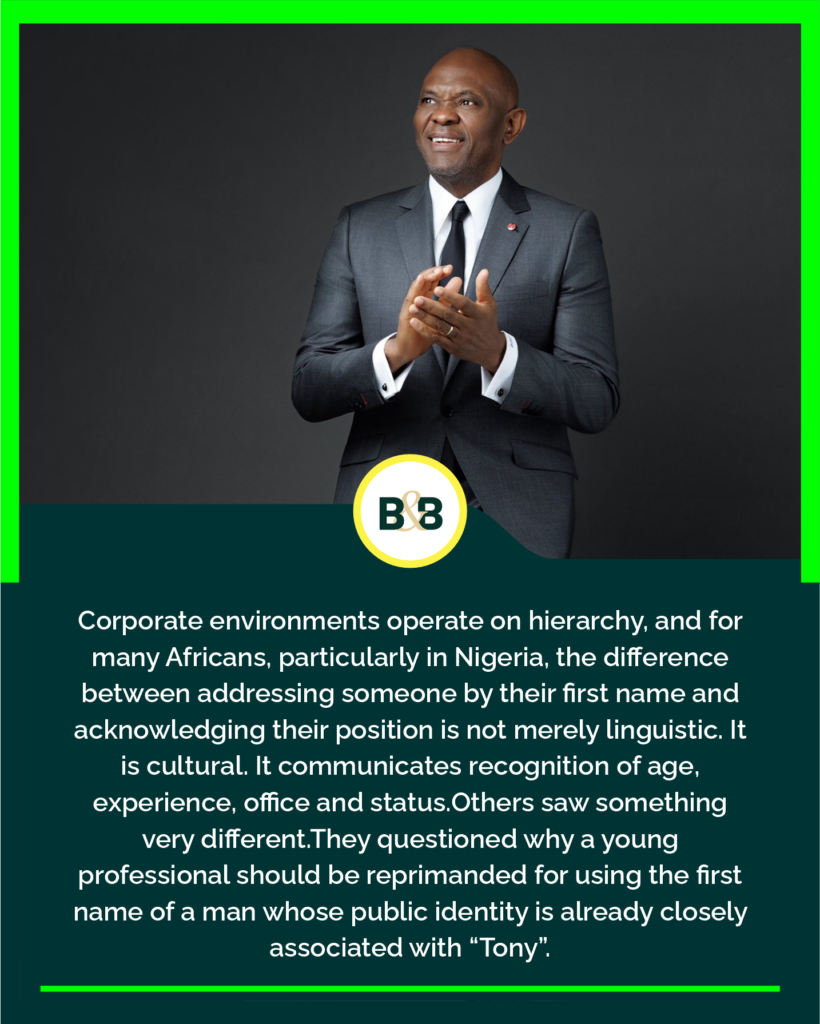
For some, Elumelu was simply setting a boundary. A person’s name may be public, but that does not automatically give everyone permission to use it in every setting. Corporate environments operate on hierarchy, and for many Africans, particularly in Nigeria, the difference between addressing someone by their first name and acknowledging their position is not merely linguistic. It is cultural. It communicates recognition of age, experience, office and status.
Others saw something very different.
They questioned why a young professional should be reprimanded for using the first name of a man whose public identity is already closely associated with “Tony”. To them, the exchange exposed an older corporate culture in which titles can become barriers between senior executives and younger employees. In a workplace increasingly shaped by younger generations, flatter structures and global professional culture, “Sir”, “Chairman” and “Mr Elumelu” can sound respectful to one person and unnecessarily formal to another.
And that is where the conversation becomes more interesting than the video itself.
Because perhaps the real disagreement is not about Tony.
It is about who gets to define familiarity.
There is a growing expectation among younger professionals that seniority should not automatically require distance. At the same time, there is an equally legitimate argument that respect cannot be reduced to whether a workplace has adopted Western-style first-name culture. African societies have long attached meaning to names, titles and forms of address. The language we use around elders, leaders and people in positions of responsibility can carry an entire social code.
Neither generation has a monopoly on the definition of respect.
What the Elumelu moment reveals is a workplace caught between two cultures of communication. One says: we are colleagues, so call me by my name. The other says: we may work together, but my position still deserves acknowledgement. Neither position is inherently absurd. The problem begins when one person’s preferred form of address is treated as an obvious universal rule.
There is also a lesson here for leaders.
If a senior executive wants to be addressed formally, that preference is his or hers to establish. But the way that boundary is communicated matters. A correction can teach without humiliating. It can preserve authority without creating fear. And that distinction becomes particularly important when the person being corrected is younger, less experienced and standing in front of a room full of people.

There is a lesson for younger professionals too.
Knowing someone’s first name is not the same thing as knowing how they wish to be addressed. A public personality may appear accessible online, speak casually in interviews and maintain a highly visible social-media presence, yet still expect a different level of formality in a professional setting. Asking, observing and understanding the culture of the room can save everyone an uncomfortable moment.
Perhaps that is why this seemingly tiny exchange has travelled so far.
It touches something Nigerians understand instinctively: the complicated relationship between respect and familiarity.
We want leaders who are approachable, but we also expect them to command authority. We want workplaces that feel human, but we still recognise hierarchy. Younger people want access without unnecessary barriers; older generations often see those barriers as part of the architecture of respect.
The conversation, then, should not end with “Tony was right” or “Tony was wrong.”
A better question is:
What should respect look like in the modern African workplace?
And perhaps even more importantly:
Can authority remain intact without making people afraid to speak?
That is a much bigger conversation than one name.
And it is one worth having.