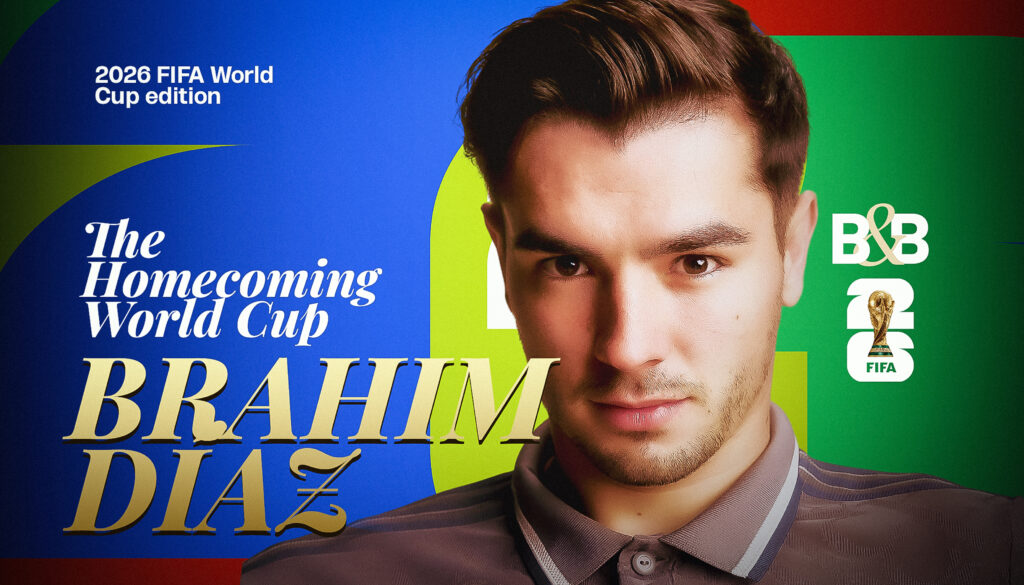
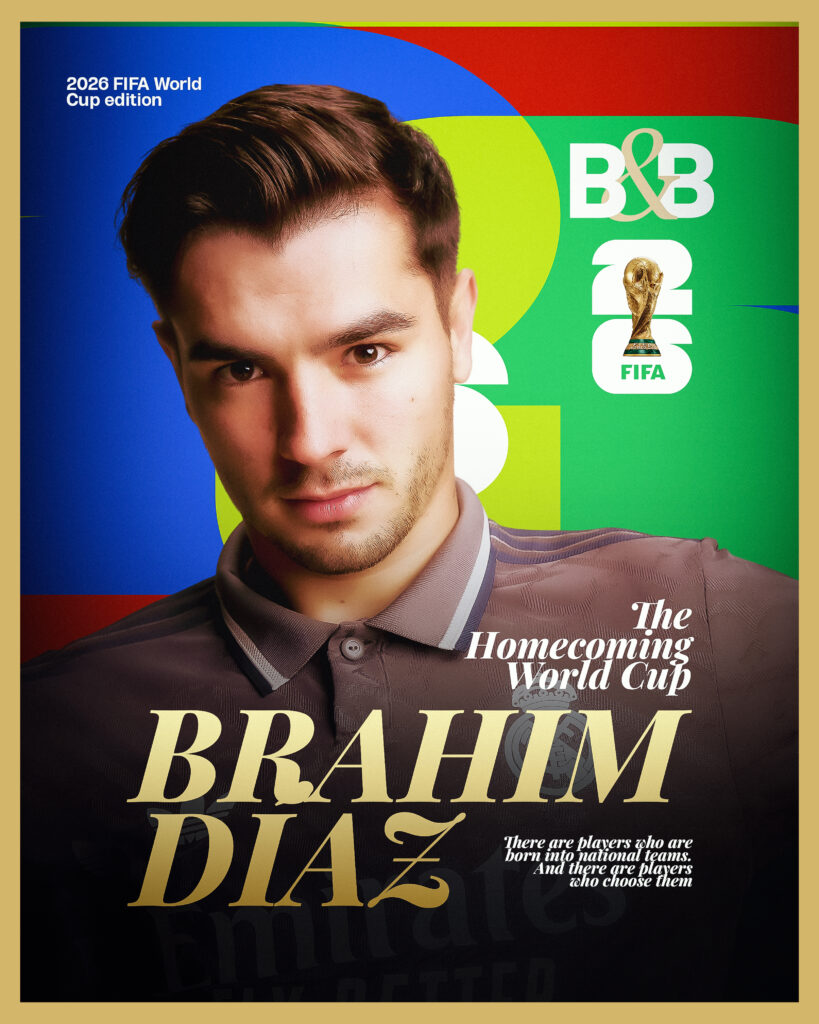
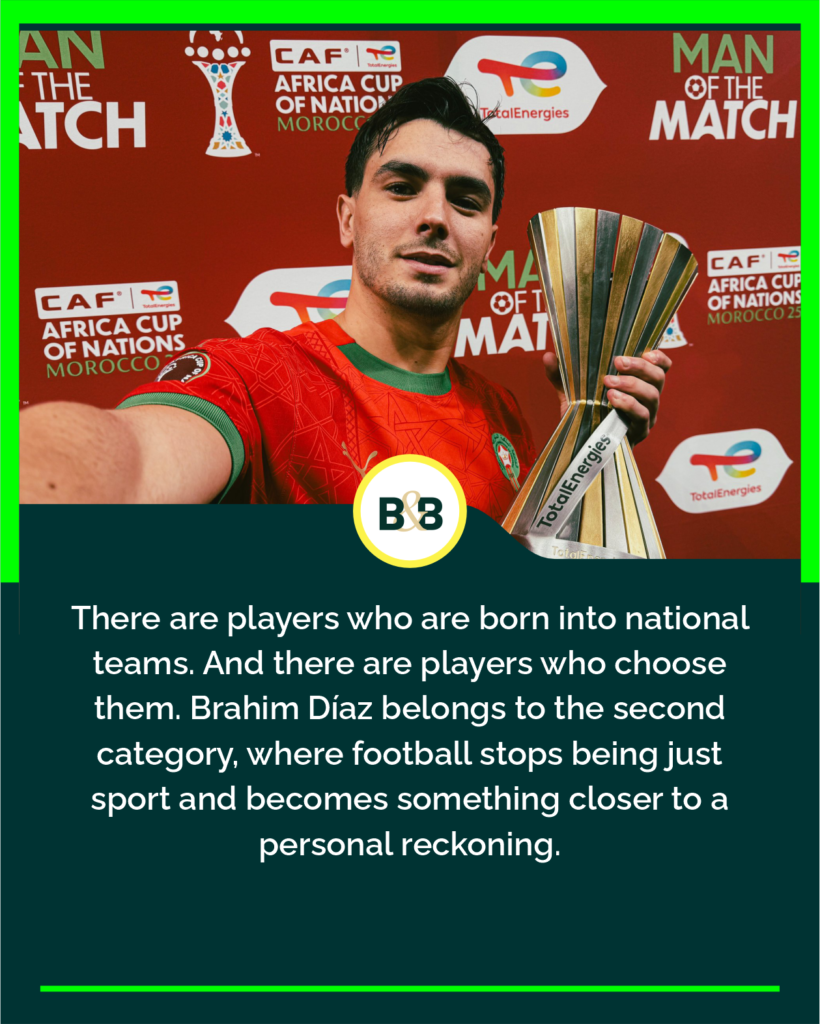
There are players who are born into national teams.
And there are players who choose them.
Brahim Díaz belongs to the second category, where football stops being just sport and becomes something closer to a personal reckoning.
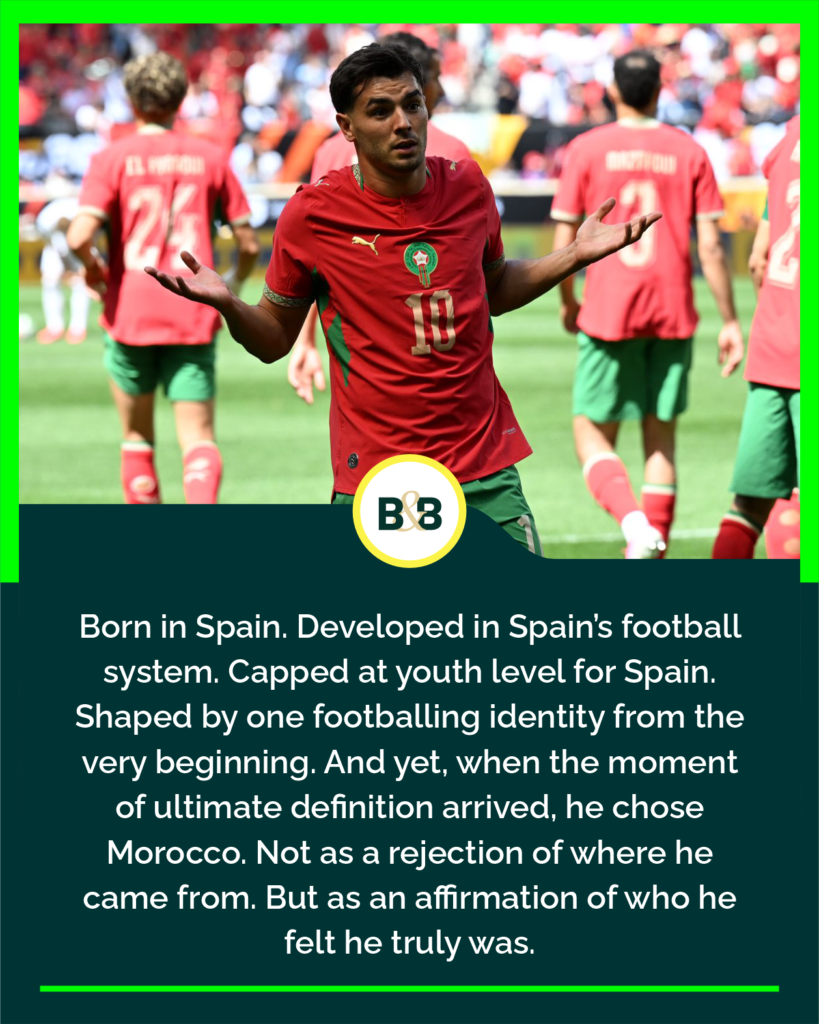
By the time the FIFA World Cup 2026 arrives, his journey will already have carried a rare complexity that few elite footballers ever experience. Born in Spain. Developed in Spain’s football system. Capped at youth level for Spain. Shaped by one footballing identity from the very beginning.
And yet, when the moment of ultimate definition arrived, he chose Morocco.
Not as a rejection of where he came from.
But as an affirmation of who he felt he truly was.
That decision is why this World Cup matters in a different way.
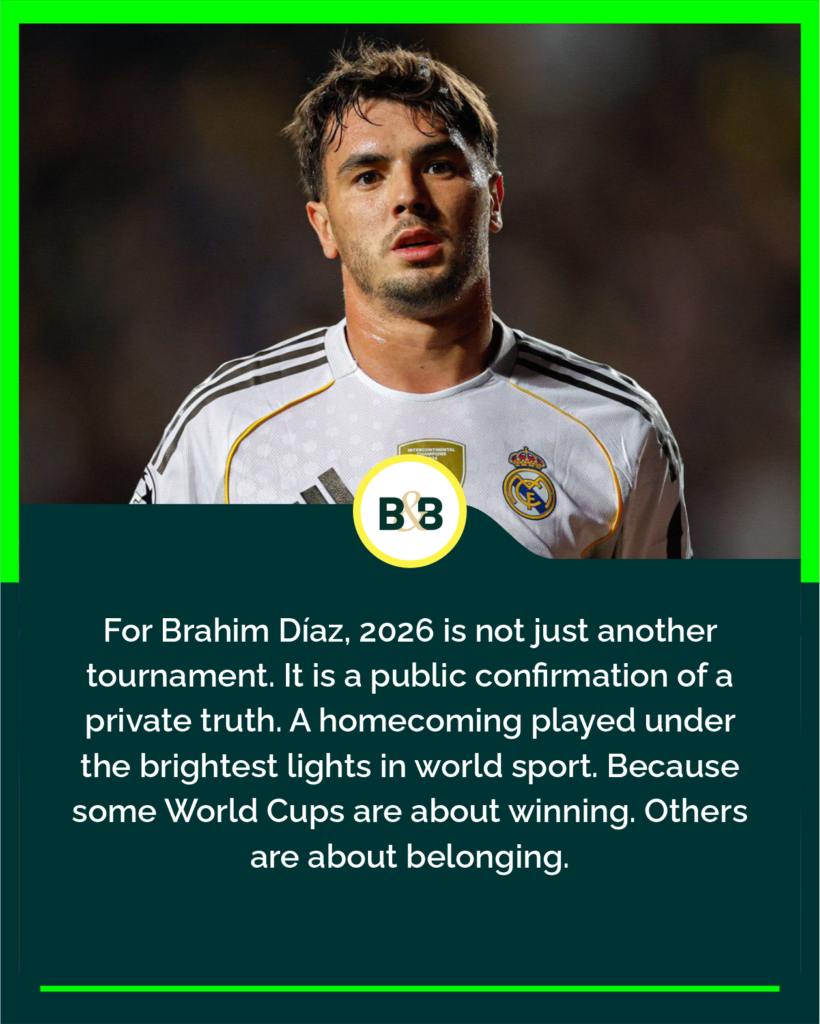
For Brahim Díaz, 2026 is not just another tournament.
It is a public confirmation of a private truth.
A homecoming played under the brightest lights in world sport.
Because some World Cups are about winning.
Others are about belonging.
And Morocco enters this tournament carrying one of the most compelling identity stories in modern football.
A nation that has already rewritten African football history with a World Cup semi final breakthrough.
A nation that has become a symbol of continental ambition meeting global execution.
A nation now asking a deeper question.
Can identity and excellence coexist without compromise?
Brahim Díaz arrives into this story at the exact point where that question becomes personal.
Every touch of the ball will be interpreted beyond tactics.
Every decision on the pitch will carry emotional resonance.
Every performance will be read as validation or doubt, affirmation or questioning.
Because this is what happens when football becomes identity made visible.
For years, Díaz represented Spain at youth level, part of a system that shapes some of the most technically refined players in world football. That early path suggested a familiar future, one aligned with Spain’s long tradition of creative midfield excellence.
But football careers are not only shaped by development.
They are shaped by belonging.
And at a certain point, he made a choice that redirected his entire narrative.
Morocco became not just an option, but a statement.
In that moment, he stepped into one of football’s most emotionally charged spaces.
The space where heritage, nationality, expectation and personal truth collide.
The World Cup is where that collision becomes visible to the world.
This is what makes 2026 the defining chapter of his international career.
It is not simply about performance under pressure.
It is about meaning under scrutiny.
Because for players like Brahim Díaz, the question is never only how well they play.
It is what their presence represents.
He carries the weight of a modern Moroccan football identity that has expanded far beyond geography.
A diaspora identity that stretches across continents.
A generation of young players negotiating multiple cultures, multiple influences, multiple definitions of belonging.
He represents the idea that national identity in football is no longer a fixed origin, but a chosen alignment.
That carries a different kind of burden.
Not expectation of success alone.
But expectation of authenticity.
The historical burden is subtle but powerful.
To prove that choosing Morocco was not symbolic, but substantive.
To demonstrate that identity decisions at the highest level of football can be both emotionally honest and competitively valid.
To ensure that belonging is not questioned through performance.
And yet, beyond the burden lies something more powerful.
A national dream evolving in real time.
Morocco is no longer a team trying to prove it belongs at the World Cup.
It is a team that now seeks to define what comes after belonging.
What does ambition look like when it is no longer limited by surprise or breakthrough status?
What does expectation feel like when history has already been rewritten?
Brahim Díaz steps directly into that evolution.
This is where his World Cup story becomes unique.
He is not arriving at the beginning of Morocco’s rise.
He is arriving in its consolidation phase.
A moment where the world no longer asks whether Morocco can compete.
But how far it can go.
And what role he will play in shaping that answer.
The unfinished business he brings is not about redemption in the traditional sense.
It is about alignment.
Aligning talent with identity.
Aligning choice with contribution.
Aligning personal conviction with collective ambition.
There is also a quieter question underneath it all.
What does it mean to choose a footballing home in an era where choices are global, complex, and deeply personal?
The answer will not be written in press conferences.
It will not be settled in narratives outside the pitch.
It will be decided in moments during matches where instinct takes over and identity becomes action.
That is why this World Cup carries such historical significance for him, even in a scenario where Morocco does not lift the trophy.
Because legacy in modern football is no longer measured only by silverware.
It is measured by impact on perception.
If Brahim Díaz helps shape a Morocco that plays with greater creative depth, technical confidence, and tactical unpredictability, his influence will extend beyond statistics.
If he becomes a symbol of successful identity transition at the highest level of international football, his story will resonate far beyond 2026.
And if he stands as proof that choosing a different national path can still lead to excellence on the world stage, his legacy becomes part of a wider global conversation about football and belonging.
This is why his World Cup story matters.
Not because it resolves the question of origin.
But because it expands the meaning of choice.
For Brahim Díaz, the 2026 World Cup is not the end of a debate.
It is the moment the debate becomes irrelevant through performance, presence, and participation.
A homecoming, not because he left anything behind.
But because he finally arrives fully inside a footballing identity he chose for himself.
And in that sense, every match becomes more than competition.
It becomes confirmation.
Not of where he comes from.
But of where he belongs.