
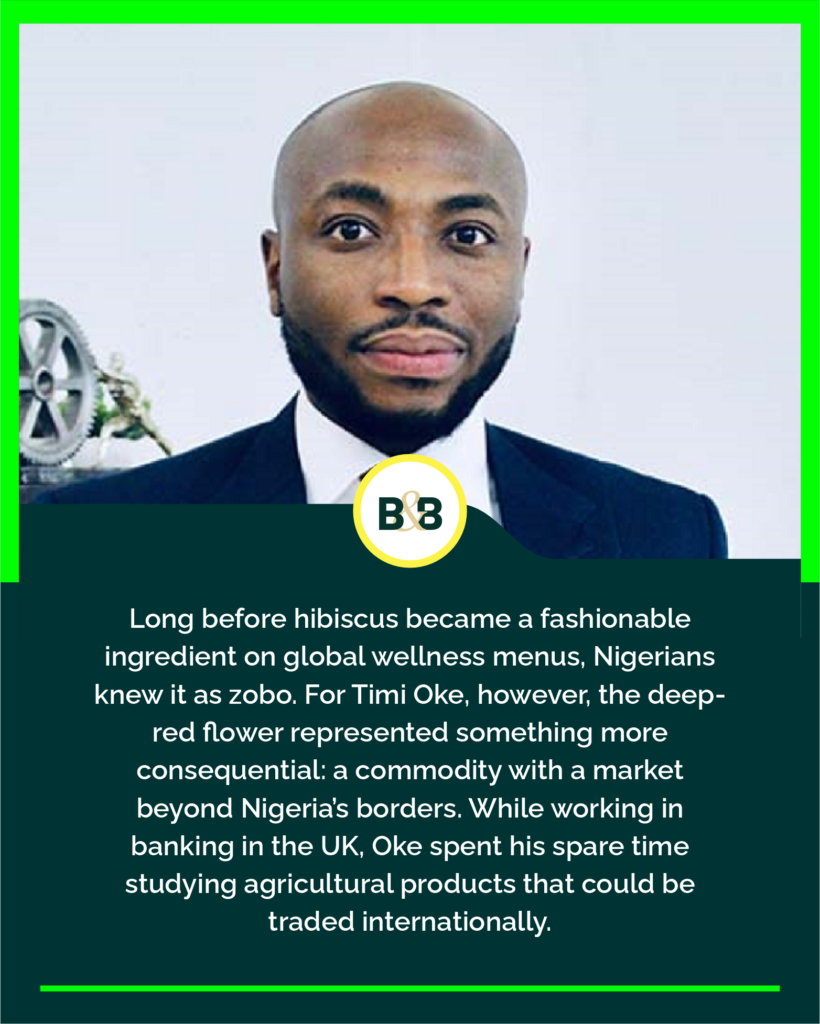
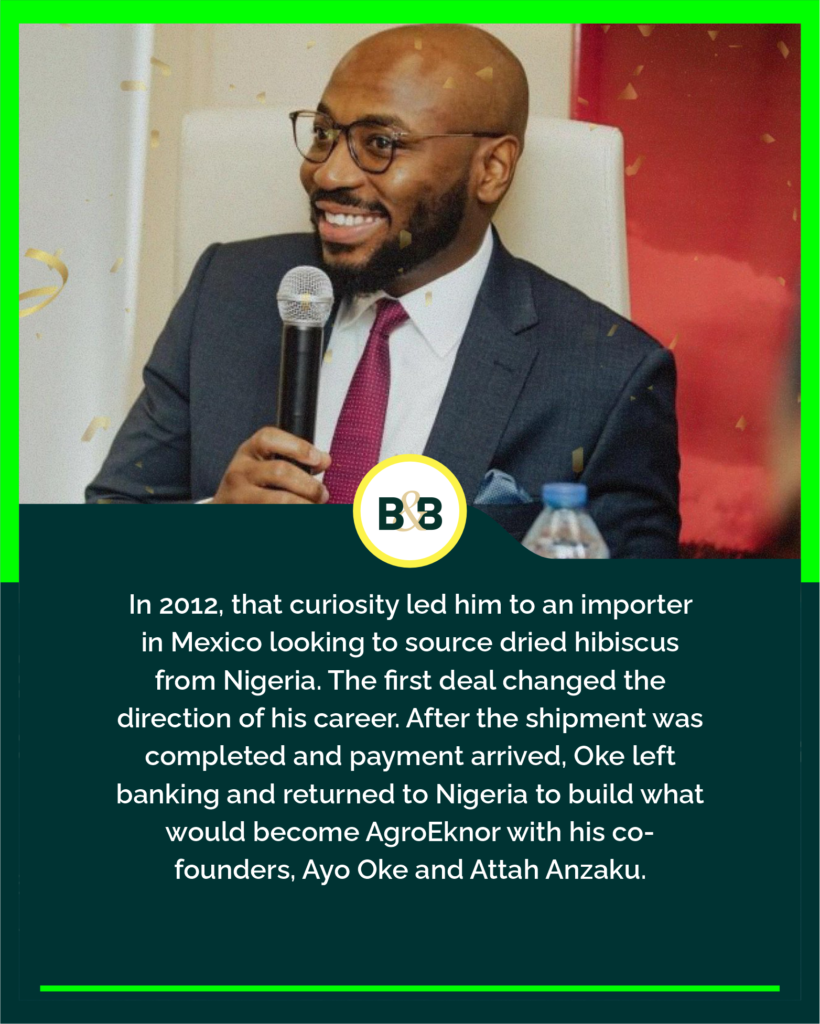
Long before hibiscus became a fashionable ingredient on global wellness menus, Nigerians knew it as zobo. For Timi Oke, however, the deep-red flower represented something more consequential: a commodity with a market beyond Nigeria’s borders. While working in banking in the UK, Oke spent his spare time studying agricultural products that could be traded internationally. In 2012, that curiosity led him to an importer in Mexico looking to source dried hibiscus from Nigeria. The first deal changed the direction of his career. After the shipment was completed and payment arrived, Oke left banking and returned to Nigeria to build what would become AgroEknor with his co-founders, Ayo Oke and Attah Anzaku.
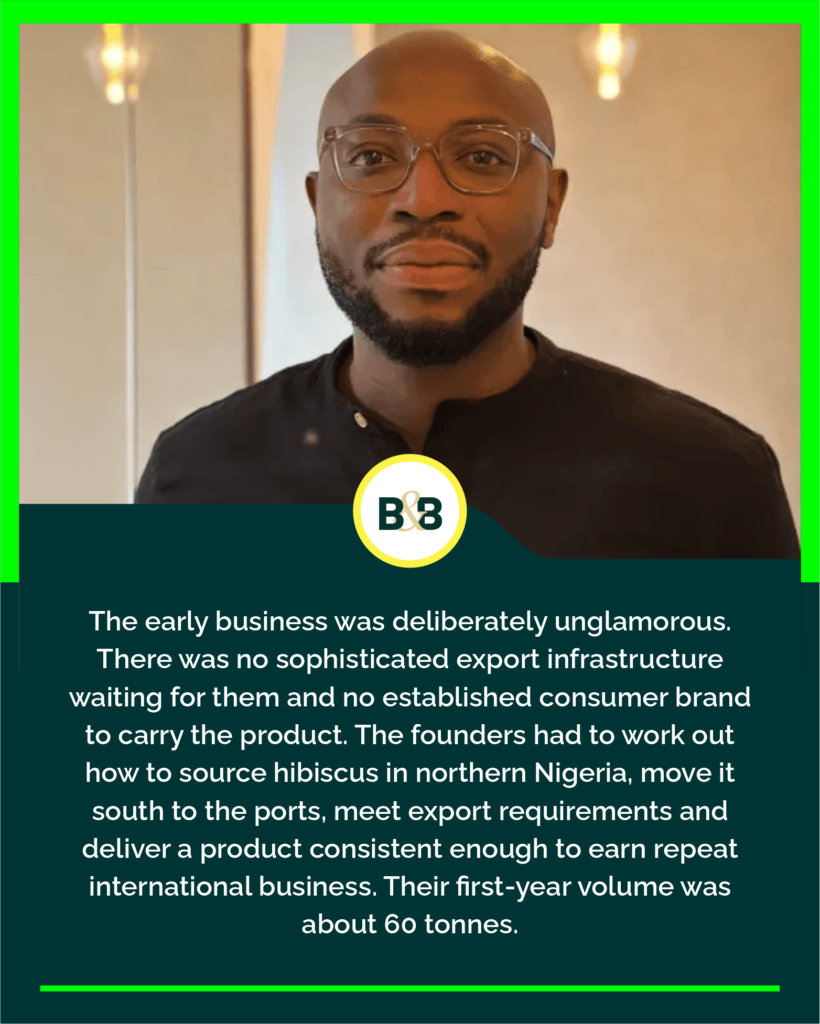
The early business was deliberately unglamorous. There was no sophisticated export infrastructure waiting for them and no established consumer brand to carry the product. The founders had to work out how to source hibiscus in northern Nigeria, move it south to the ports, meet export requirements and deliver a product consistent enough to earn repeat international business. Their first-year volume was about 60 tonnes. It rose to 120 tonnes in the second year and 540 tonnes in the third. Oke continued prospecting for customers through LinkedIn and trade fairs, while the company invested in the warehouse, supply-chain expertise and processing capabilities needed to move beyond one-off commodity transactions.
That distinction became central to AgroEknor’s growth. Instead of remaining a middleman between farmers and overseas buyers, the company began building deeper relationships with producers and investing across the value chain. Its model now spans farmer engagement, aggregation, processing, quality control and export, with technology used to improve traceability and supply consistency. AgroEknor says it has exported more than 15,000 tonnes of agricultural products and built a global network across Europe, Asia, North America and South America. Its YieldPro platform is designed to collect and manage farmer data, while its Farmers Education and Empowerment Programme provides agronomic and climate-smart training.
The scale of that model is measured less convincingly in containers than in people. Recent company and investor figures put the farmer network at more than 15,000 smallholder farming households, with women making up a significant majority. In a recent account of the business, Oke described an ecosystem involving farmers, processors, aggregators, exporters and distributors, reflecting a broader ambition to make agricultural value creation possible closer to where the crop is grown. That matters in a sector where Africa has historically exported too many commodities in raw or minimally processed form, leaving a substantial share of the final value elsewhere. AgroEknor’s proposition is different: strengthen the chain in Nigeria, then take the resulting product to international buyers.
Hibiscus remains the centre of that story, but Oke’s ambition has moved beyond selling dried flowers. AgroEknor has developed Madala, a hibiscus-based cordial positioned as a consumer expression of the same agricultural ecosystem, alongside its work with other crops including fonio. The shift is significant. Exporting a commodity and building a recognisable African food brand are two very different businesses. One depends largely on supply, specifications and contracts; the other requires product development, positioning, distribution and an understanding of consumers in different markets. Madala represents Oke’s attempt to capture more of that value while giving an ingredient deeply associated with Nigerian culture a form that can travel further.
Investors have begun to place institutional weight behind that strategy. AgroEknor secured strategic investment from Acumen in 2026, following earlier backing from Aruwa Capital Management, while the company has also used Nigeria’s debt capital markets to finance its expansion. Its Series 3 and Series 4 commercial papers raised ₦2 billion under a larger commercial paper programme, supporting sourcing, processing, export operations and consumer-product expansion. The significance goes beyond the financing itself. It signals that an African agribusiness built around farmers, processing and exports can be structured as a serious growth business rather than treated solely as a development project.
Oke’s most interesting achievement, then, may not be that he found foreign buyers for a Nigerian crop. It is that he recognised the difference between having something the world wants and having the systems required to sell it repeatedly at scale. From a LinkedIn conversation with a Mexican importer to a vertically integrated agricultural business with international markets, institutional investors, processing infrastructure and a consumer brand, the AgroEknor story offers a sharper lesson in African entrepreneurship: global relevance begins with local resources, but it is built through systems, quality, capital, relationships and the patience to develop the value chain around them. The red flower that Nigerians have long brewed into zobo has become, in Oke’s hands, a case study in how an overlooked African commodity can be repositioned for the world.