
Some arrive early. Some need time. Some peak late. And a rare few seem to have several primes.
There is a tendency to talk about sporting careers as though they follow a predictable timetable.
A young player breaks through, improves through his early twenties, reaches his prime somewhere around his mid-to-late twenties, then gradually declines as age catches up with him.
Football, however, has never been that simple.
For every teenage sensation who becomes a superstar, there is a player who spends years searching for his level before suddenly exploding into greatness. There are players whose finest work comes in their thirties, long after the conventional definition of a prime has supposedly passed. And then there are the extraordinary few who seem to stretch their peak across almost an entire career.
That is why a person’s career does not have one fixed trajectory.

It is a spectrum.
The six career curves below illustrate some of the different ways footballers can arrive at, sustain and move beyond greatness.
Peak Too Early
The career curve rises spectacularly, then struggles to reproduce that level.
These are the players who make an extraordinary impression before they have even reached what should traditionally be their best years.
Their early performances create a natural assumption: if they are this good now, imagine what they will become at 25, 28 or 30.
Sometimes that second act never arrives.
Injuries can intervene. Confidence can disappear. Circumstances can change. Development can stall. A player can simply struggle to reproduce the extraordinary level that once appeared almost effortless.
Michael Owen is one of football’s clearest examples. He announced himself as a teenage phenomenon, became a global star with Liverpool and won the Ballon d’Or at just 22. Yet the trajectory that seemed destined for even greater heights was disrupted, particularly by injuries, and he never again reached the extraordinary level suggested by his early career.
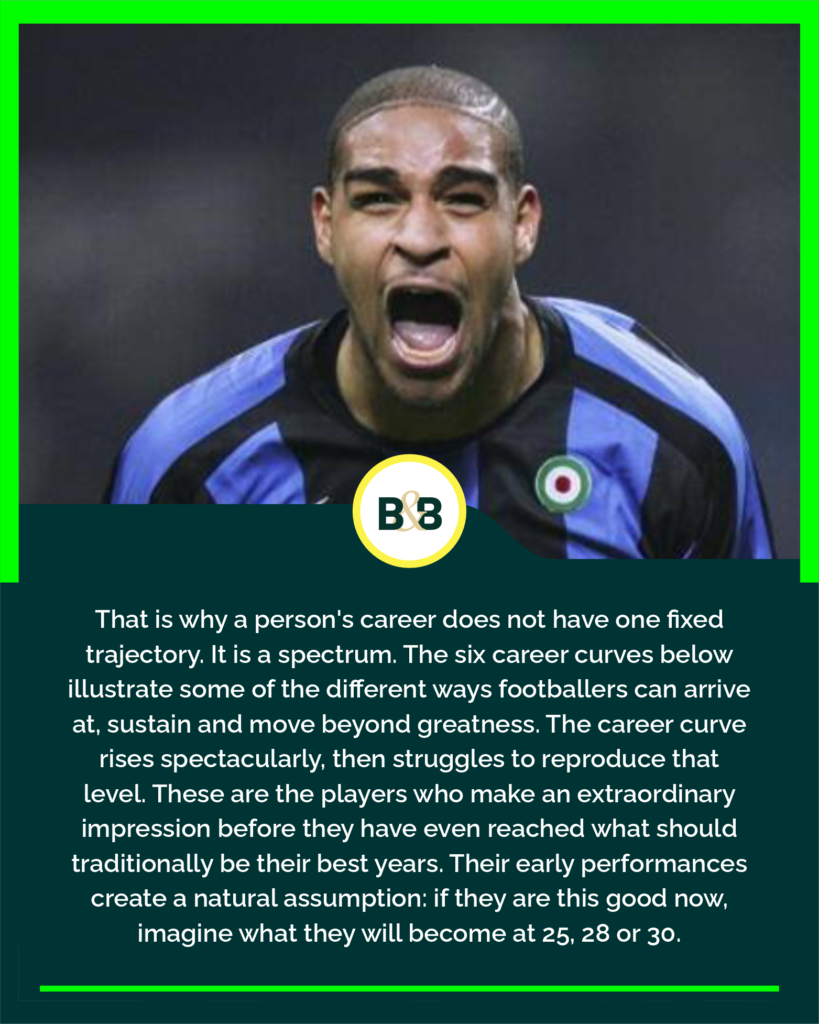
Adriano produced a similarly compelling early peak. At his best, the Brazilian forward possessed a combination of power, technique and finishing that made him one of the most frightening strikers in world football. His devastating performances in his early-to-mid twenties suggested a career that could become historic. Instead, his development stalled and the dominant version of Adriano disappeared far earlier than expected.
Robinho arrived at Real Madrid carrying enormous expectations after dazzling at Santos. There were flashes of brilliance and periods of spectacular football, but the sustained greatness many expected from one of Brazil’s most exciting young talents never fully materialised.
The lesson is uncomfortable but important:

An early peak creates expectations. It does not guarantee a higher second peak.
Mid-Career Prime
No teenage phenomenon. No late-career miracle. Greatness arrives when experience catches up with ability.
Not every great player looks destined for greatness at 17.
Some need time to develop physically. Others need to change position, find the right manager, adapt to a higher level of competition or simply understand their own game.
For these players, the most important version of their career emerges somewhere around their mid-to-late twenties, when experience begins working alongside physical ability and technical quality.
Didier Drogba followed this path. His rise was gradual rather than explosive, and his development continued through several stages of his career before he became one of the most formidable strikers in world football. By his late twenties, the combination of his physical presence, movement, finishing and mentality had produced an elite-level centre-forward.
Luis Suárez also took time to develop into the complete attacking force the world eventually came to know. His journey through Uruguay and the Netherlands preceded his arrival among Europe’s elite, with his most devastating years coming after the foundations of his game had already been built.
Mohamed Salah offers another example. His career passed through several stages before his transformation at Liverpool turned him into one of the defining forwards of his generation. The player who became a global superstar was considerably more complete than the talented young winger who had first emerged years earlier.
These careers demonstrate something often overlooked in the obsession with teenage prodigies:
Sometimes the player you become at 27 is more important than the player you were at 17.
Late Boomers
The world starts paying attention long after it expected them to.
Football can be particularly unforgiving about age.
Young players are labelled prospects. Players in their twenties are expected to establish themselves. By the time someone approaches 30, the assumption can become that their opportunity has already passed.
Then someone breaks the pattern.
Jamie Vardy spent much of his twenties playing outside the traditional elite pathway before his extraordinary rise eventually took him to the Premier League. He went on to win the Premier League title with Leicester City, become an England international and establish himself as one of English football’s most remarkable late developers.
Antonio Di Natale took time to become the prolific elite striker he eventually became. His greatest years in Serie A came later than the conventional breakthrough timeline, and he remained extraordinarily productive well into his thirties.
Luca Toni also travelled a long road before reaching the highest level. After years moving through Italian football’s lower divisions and less glamorous environments, he exploded into elite football in his late twenties. He subsequently won the European Golden Shoe and became a World Cup-winning Italian international.
Their stories challenge the idea that a slow beginning necessarily predicts a limited career.
A late start can still produce a remarkable finish.
Sustained Early Peak
They arrive early and somehow stay there.
Early greatness is impressive.
Maintaining it is considerably harder.
Teenage or early-twenties success can sometimes be mistaken for a guarantee of longevity. It is not. The real test begins when opponents understand the player, expectations become enormous and every season demands another level of consistency.
Lionel Messi became a global superstar in his early twenties and then sustained an extraordinary level of performance across an exceptionally long period. His career did not simply contain an early peak. It contained years of excellence after the world had already recognised how special he was.
Neymar announced himself as a major talent at Santos while still remarkably young before moving to Barcelona and eventually Paris Saint-Germain. His career was affected by injuries and other interruptions, but his elite attacking production and influence remained evident across multiple stages of his career.
Kylian Mbappé represents the modern version of the phenomenon. He announced himself on the biggest stage as a teenager, won the World Cup at 19 and rapidly established himself among the world’s elite forwards. His early arrival at the highest level has been followed by sustained excellence through his twenties.
The distinction matters.
The rarest form of early success is not arriving early.
It is making extraordinary standards look normal for years.
Sustained Late Peak
Their best version arrives later, then refuses to disappear.
There is another kind of longevity that deserves attention.
These are players whose careers continue improving after the age at which many footballers begin to decline. Their later years are not merely respectable extensions of what came before. In some cases, they represent the most accomplished period of their careers.
Karim Benzema is a powerful example. His development from a talented young striker into a complete attacking leader took years. His later career, particularly at Real Madrid, produced a level of influence, leadership and goalscoring that elevated him into the highest tier of his generation.
Robert Lewandowski similarly developed into one of football’s most devastating goalscorers over time. His late-twenties and thirties produced extraordinary numbers and sustained elite-level performance well beyond the point at which many forwards begin to decline.
Luka Modrić demonstrates how a player’s game can evolve with age. His greatest qualities were never dependent solely on explosive athleticism. As his career progressed, his technical ability, positional intelligence, decision-making and control became even more valuable. His most decorated period arrived well after his teenage years, and he continued performing at the highest level deep into his thirties.
Their careers reveal an important truth about ageing in sport.
Physical decline does not necessarily mean overall decline.
Age can take away physical advantages while giving back intelligence, positioning, timing and control.
The Complete Peak
Early brilliance. Mid-career dominance. Late-career excellence.
Then there is the rarest trajectory of all.
The complete peak belongs to players whose careers contain multiple versions of greatness.
They are exceptional when young. They become dominant during their traditional prime. And somehow, they remain capable of producing elite performances deep into the latter stages of their careers.
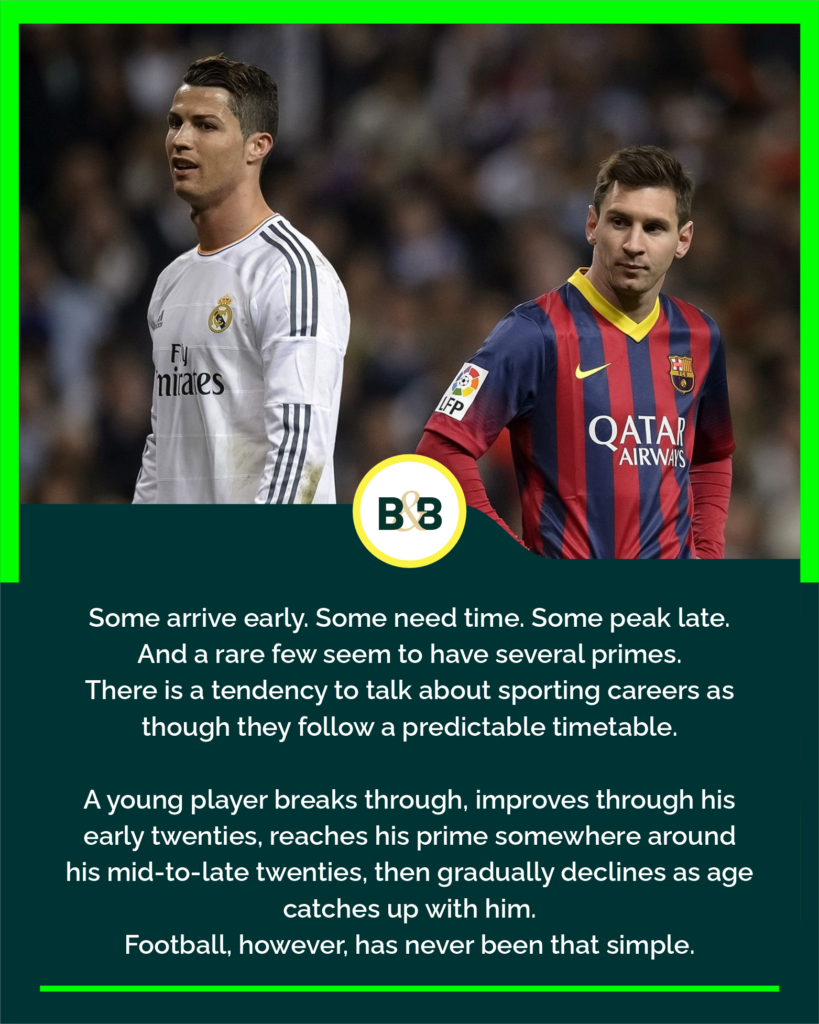
Cristiano Ronaldo & Messi are perhaps the clearest examples. The explosive young players at Manchester United and Barcelona evolved into a global superstars, then into two of the greatest goalscorers and footballers football has ever produced. Their game changed dramatically as they aged, but the level of their output remained extraordinary well into their late thirties.
Zinedine Zidane was already a world-class footballer in his twenties before reaching another level of influence around the turn of the millennium. His ability to control major matches remained evident deep into his career, culminating in some of the defining performances of his generation.
Andrés Iniesta followed a similarly remarkable curve. He emerged as a prodigious talent within Barcelona’s system, developed into one of the finest midfielders of his generation and continued producing moments of extraordinary technical quality deep into his career.
These are careers where the word “prime” becomes difficult to pin down.
There was no single moment when greatness arrived and then disappeared.
There were different versions of greatness, each shaped by the player’s age, experience, body, environment and understanding of the game.
The complete career is not about having one perfect age.
It is about having multiple versions of greatness.
There Is No Universal Career Clock
Football loves timelines.
The next wonderkid. The breakout season. The prime years. The decline.
But careers rarely respect such neat categories.
One player can be finished at 28.
Another can become world-class at 28.
Another can be better at 32 than he was at 22.
And another can spend so much of his career operating at an extraordinary level that the word “prime” becomes almost meaningless.
That is why judging a career purely by age can be misleading.
A young player’s brilliance does not automatically make him a future legend. A slow start does not make a player destined for mediocrity. A late peak does not make it less significant. And ageing does not always mean a player’s best football is behind him.
Timing is part of football career.
And the peak does not arrive at the same age for everyone.