
In the space of two finals at the Dakar 2026 Youth Olympic Games, Nigeria achieved something no country had managed before. Rosemary Nwankwo and Gift Bright won the women’s and men’s 100 metres titles on Sunday, 8 November, making Nigeria the first nation to claim both sprint crowns at the same edition of the Youth Olympics. Their victories gave the country two gold medals in a matter of minutes and brought Nigerian sprinting back into the centre of the international conversation.
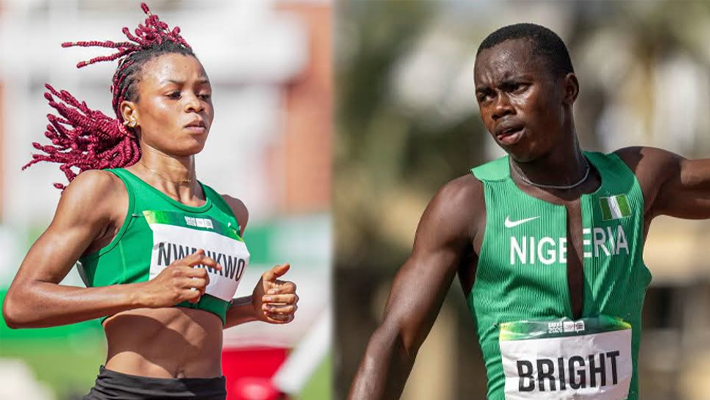
Nwankwo set the celebrations in motion in the women’s final at the Complexe Iba Mar Diop. She crossed the line in 11.16 seconds, finishing ahead of Arwa Ali of the United Arab Emirates, who clocked 11.41 seconds, and Qatar’s Dana Salem, who took bronze in 11.48 seconds. The 17-year-old had already signalled her intentions in the semi-finals, where she won her heat in 11.53 seconds, the fastest qualifying time across both races. Her final performance was wind-assisted, with a reading of +2.4 metres per second, above the legal limit for record purposes. It did not, however, diminish the significance of the gold medal.
Her victory also extended a distinct Nigerian record in the competition. Nwankwo became the third Nigerian woman to win the Youth Olympic 100m title, following Josephine Omaka, who triumphed at the inaugural Games in Singapore in 2010, and Rosemary Chukwuma, who won in Buenos Aires in 2018. The succession of champions gives Nigeria a rare continuity in an event that demands speed, composure and the ability to deliver under pressure. Nwankwo now has her own place in that history.
Bright completed the double with a performance that gave the day another landmark. The 15-year-old won the men’s 100m final in 10.28 seconds, setting a new Youth Olympic Games record. China’s Zhang Hangyu finished second in 10.57 seconds, while Poland’s Szymon Dolega took bronze in 10.61 seconds. Bright had run 10.34 seconds in the semi-finals, already the fastest qualifying time, before taking another six-hundredths of a second off his personal best in the final. Unlike the women’s race, the men’s final was run with a legal following wind of +1.7 metres per second.
The victory was particularly significant for Bright, who had been managing a thigh injury in the two weeks before the competition. He later spoke about the effect it had on his confidence, admitting that pain had made him apprehensive about running. Reaching the final without discomfort gave him the freedom to compete as he wanted. His gold made him the first Nigerian to win the men’s 100m title at the Youth Olympic Games, adding a new entry to the country’s sprint history.
For Nwankwo, the occasion was one she had prepared herself to meet. Speaking after her race, she said she had focused on her own performance rather than allowing the significance of the moment to distract her. Bright, meanwhile, looked beyond the medal, expressing confidence in Nigeria’s ability to produce more sprint champions at future editions of the Games. Their comments revealed two young athletes at different points in their journeys, but with a shared understanding of what their victories could mean for the country.
The sprint double has particular relevance within Nigeria’s wider athletics history. The country has produced notable performers in short-distance running, but translating individual talent into sustained international success remains a challenge. The Youth Olympics offer a platform for young athletes to compete against their peers from across the world, and performances such as these can provide an important foundation for the transition into senior competition. The task ahead will be to support both athletes through that transition, with the coaching, medical care, competition exposure and institutional backing required to develop their potential.
Dakar has given Nigeria two new Youth Olympic champions and a distinction no other country has yet achieved in the 100 metres at the Games. Nwankwo has carried forward a tradition built by Nigerian women before her; Bright has opened a new path in the men’s event. Their races lasted only seconds, but the record of what they accomplished will remain long after the medals have been presented.