
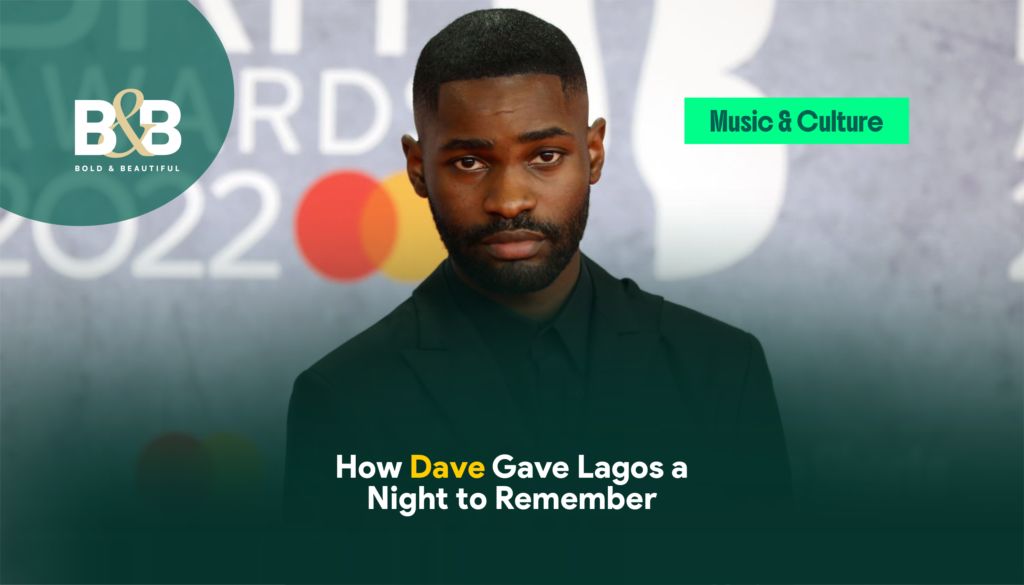
Lagos has seen international stars arrive with spectacular production, elaborate stagecraft and promises of unforgettable nights. But when Dave brought his The Boy Who Played the Harp tour to the Wole Soyinka Centre for Culture and Creative Arts on 16 and 17 October, the significance ran deeper than another name on the concert calendar. These were the British-Nigerian rapper’s first headline performances in Nigeria, and the final shows of a global tour that had taken his music across continents. For an artist whose Nigerian heritage sits alongside the experiences that shaped him in South London, Lagos offered a different kind of stage: one where the music could meet a part of his story that audiences elsewhere could only imagine.

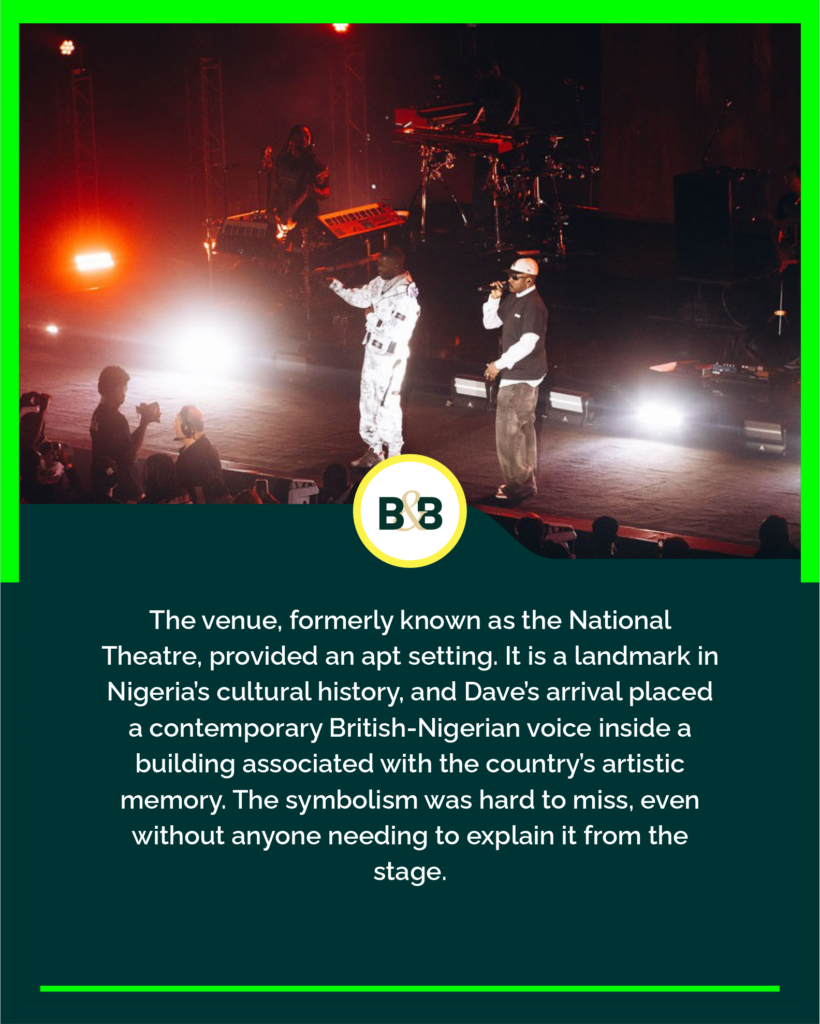
By the final night, anticipation had become its own form of entertainment. Fans gathered to hear the songs they had lived with through headphones, car speakers, parties and late-night playlists, now waiting for the person behind them to appear in front of them. The venue, formerly known as the National Theatre, provided an apt setting. It is a landmark in Nigeria’s cultural history, and Dave’s arrival placed a contemporary British-Nigerian voice inside a building associated with the country’s artistic memory. The symbolism was hard to miss, even without anyone needing to explain it from the stage.
When Dave finally appeared, he opened with “History”, his collaboration with James Blake, according to reports from the concert. It was a telling choice. His music has always made room for reflection alongside bravado, and his reputation rests as much on the precision of his writing as on his ability to command a crowd. Songs such as “Clash” and “Verdansk” brought other sides of his catalogue into the room, giving the performance movement without reducing it to a procession of familiar hooks. The audience had come to hear the records, but the live setting gave those records a different charge: voices from the crowd answering the voice on stage.
The night became even more memorable when Burna Boy joined Dave for “Location”, their collaboration that already carries a history of its own. The appearance connected two artists whose careers have travelled different routes while meeting in the same musical space. For the crowd, it was the kind of surprise that can turn a strong concert into a story people retell long after the lights come up. Oxlade also joined Dave to perform “Intoxicated”, bringing another Nigerian voice into the evening. These moments were not simply celebrity cameos. They made the show feel rooted in the musical relationships that had helped connect Dave’s work to listeners across Nigeria.
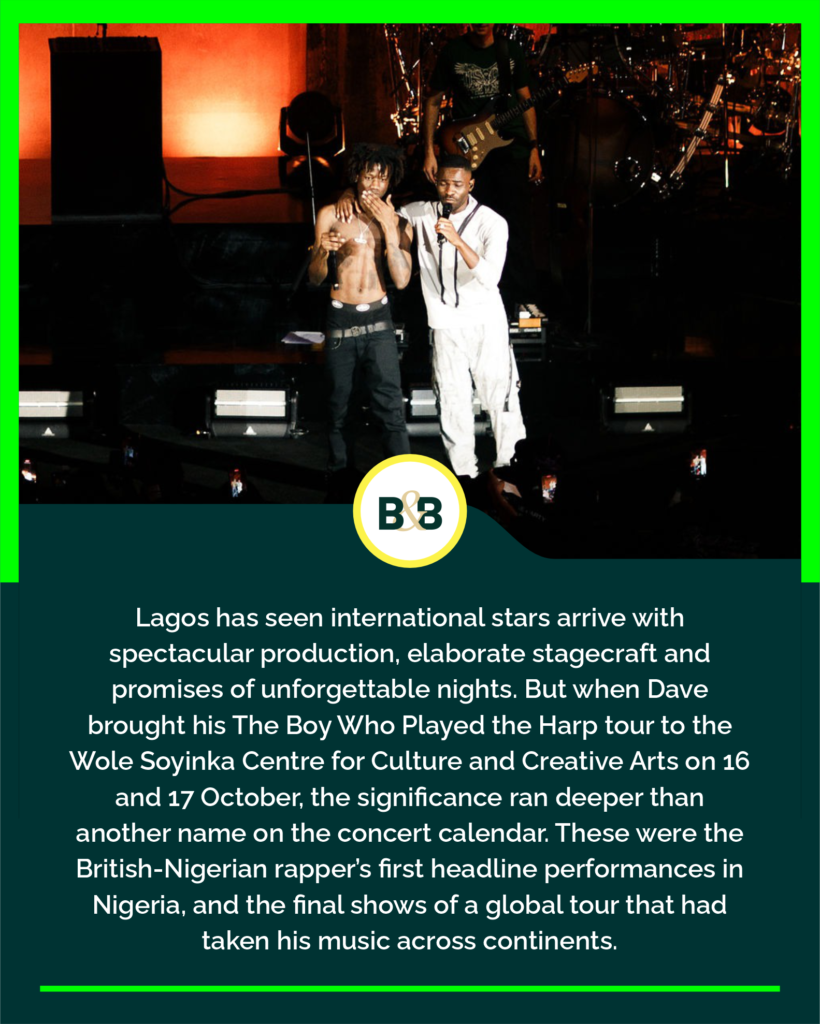
There was also room for the next generation. Zaylevelten, the Lagos-born rapper from Ikorodu, performed as an opening act and later joined Dave on stage. His presence mattered because a concert of this scale can do more than celebrate an established career; it can put emerging talent in front of people who might not otherwise encounter their work. Nigerian music has grown through such exchanges between local scenes and global platforms. The value lies not in the assumption that one appearance will transform a career, but in the possibility that a wider audience leaves with a new name to follow.
Dave’s connection to Nigeria has never depended solely on the location of a performance. His catalogue has reached Nigerian listeners through collaborations, streaming and the shared cultural references that travel between the country and its diaspora. Yet performing in Lagos gave that relationship a physical setting. On the final night, Dave also spoke about Nigeria’s hardships and the forces he believes contribute to its divisions, bringing a more serious note into a concert built around music. It was a reminder that a homecoming can carry questions as well as celebration, particularly when an artist’s public identity crosses national borders.
What made the two dates significant was the combination of personal history and professional achievement. Dave arrived in Lagos with a body of work that had established him as one of British rap’s most accomplished contemporary storytellers. He left after closing a tour with his first headline shows in the country of his family’s heritage. That distinction gives the performances a place in his career beyond the usual tour statistics. It also reflects a broader shift in African music and diaspora culture: audiences increasingly want to experience the artists they follow internationally, while artists are finding new meaning in performing before people connected to their roots.
By the time the final show ended in the early hours of Sunday, 18 October, Lagos had witnessed more than a visiting star delivering his set. Dave had brought together his British upbringing, Nigerian heritage, musical collaborations and the audience that had waited to see him perform at home. Burna Boy and Oxlade supplied headline-making surprises; Zaylevelten represented a younger local scene; the songs carried the emotional weight of a career built on storytelling. The night belonged to the music, but its lasting significance lay in the connection around it. For Dave, Lagos was the closing point of a global tour. For the fans who filled the venue, it was the chance to see an artist whose story crosses borders stand before them and make that distance feel smaller.


