
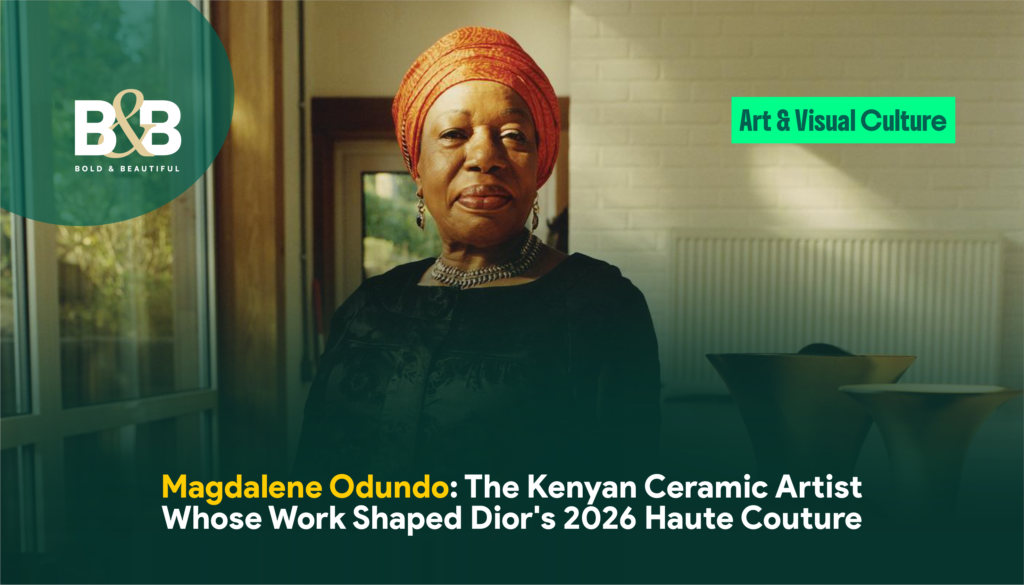
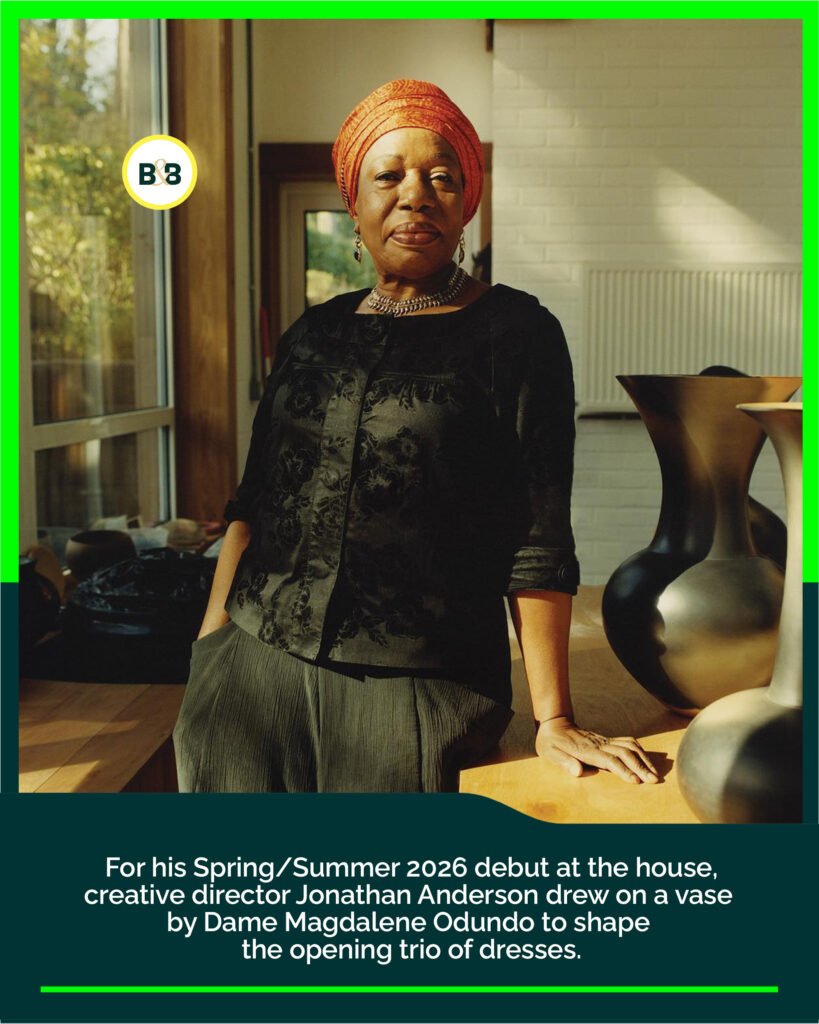
A ceramic vessel made by a Kenyan-born artist found an unexpected expression in Paris this January, translated into silk, tulle and sculptural volume on the Dior haute couture runway. For his Spring/Summer 2026 debut at the house, creative director Jonathan Anderson drew on a vase by Dame Magdalene Odundo to shape the opening trio of dresses. Their rounded, balloon-like silhouettes carried the distinctive curves of her ceramic forms into a different material and scale. It was a striking meeting of two disciplines, but Odundo’s work had already spent decades commanding attention in its own right.
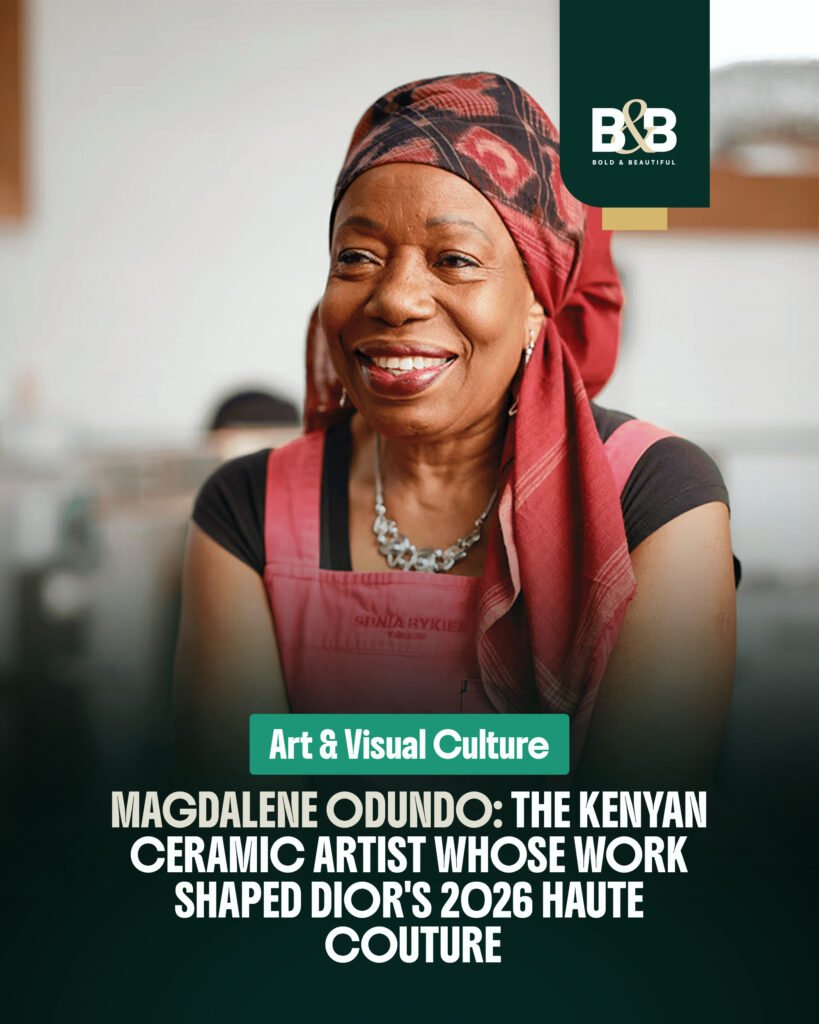
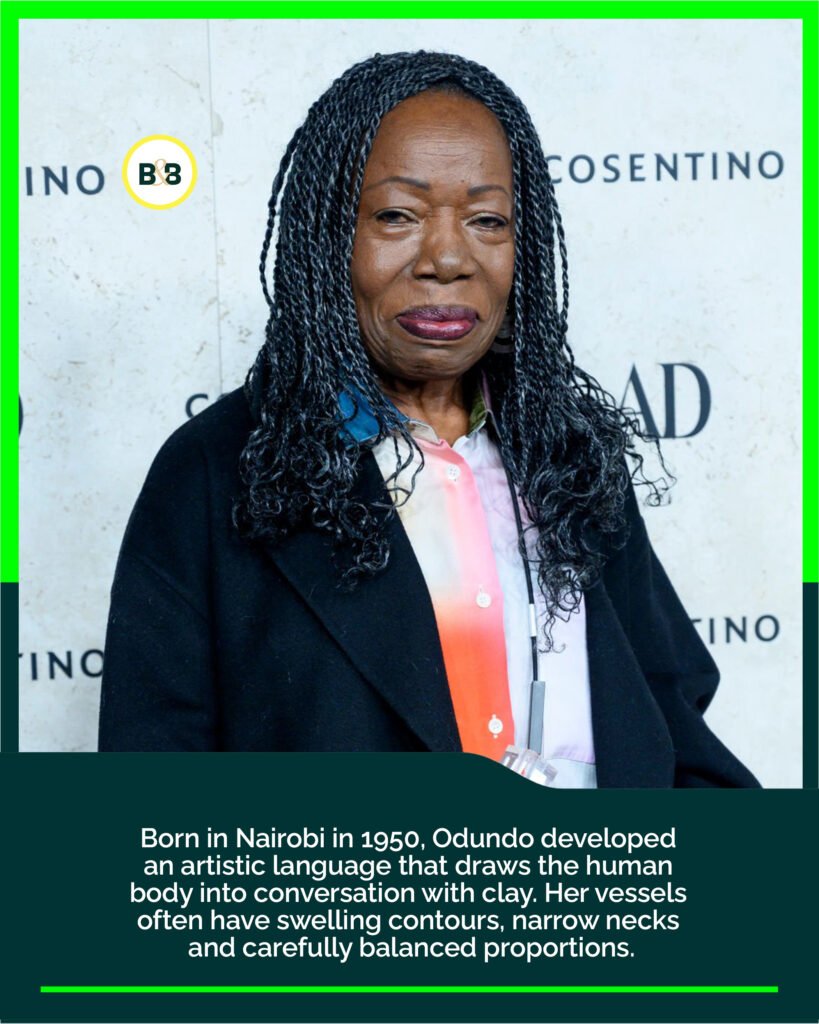
Born in Nairobi in 1950, Odundo developed an artistic language that draws the human body into conversation with clay. Her vessels often have swelling contours, narrow necks and carefully balanced proportions. Some recall the posture of a dancer; others suggest the shape of a torso or the movement of a figure. Their surfaces, polished to a deep lustre, shift between rich red-orange and near-black. Although her work carries references to pottery traditions across several cultures, the finished objects remain unmistakably hers. The Fitzwilliam Museum describes them as works that appear both ancient and modern, each with its own character.
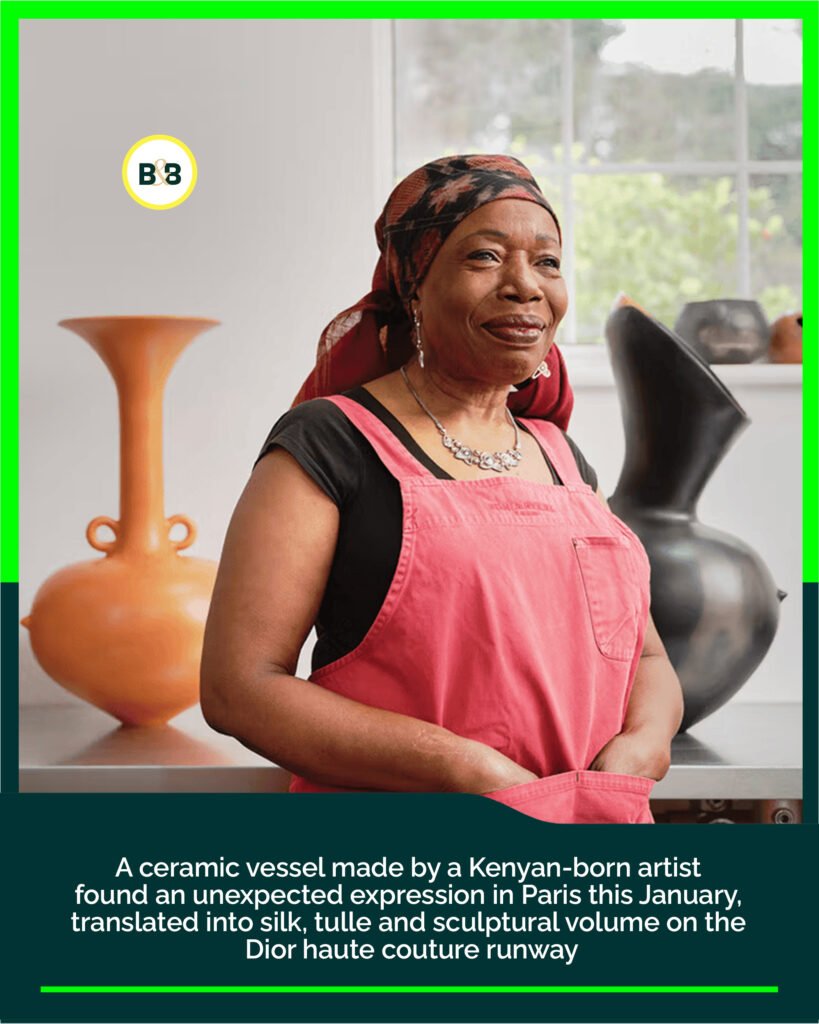
The process behind these forms is as distinctive as their appearance. Odundo builds her vessels by hand, gradually shaping and pulling clay upwards before scraping the surface smooth with a gourd. Rather than relying on conventional glaze, she applies a refined clay slip, burnishes the surface with stones and polishing tools, and fires the pieces several times. The atmosphere and conditions of each firing help determine whether the finished vessel takes on a glowing red-orange or a deep black surface. The result is a practice that requires patience, technical control and an acceptance of the transformations that occur inside the kiln.
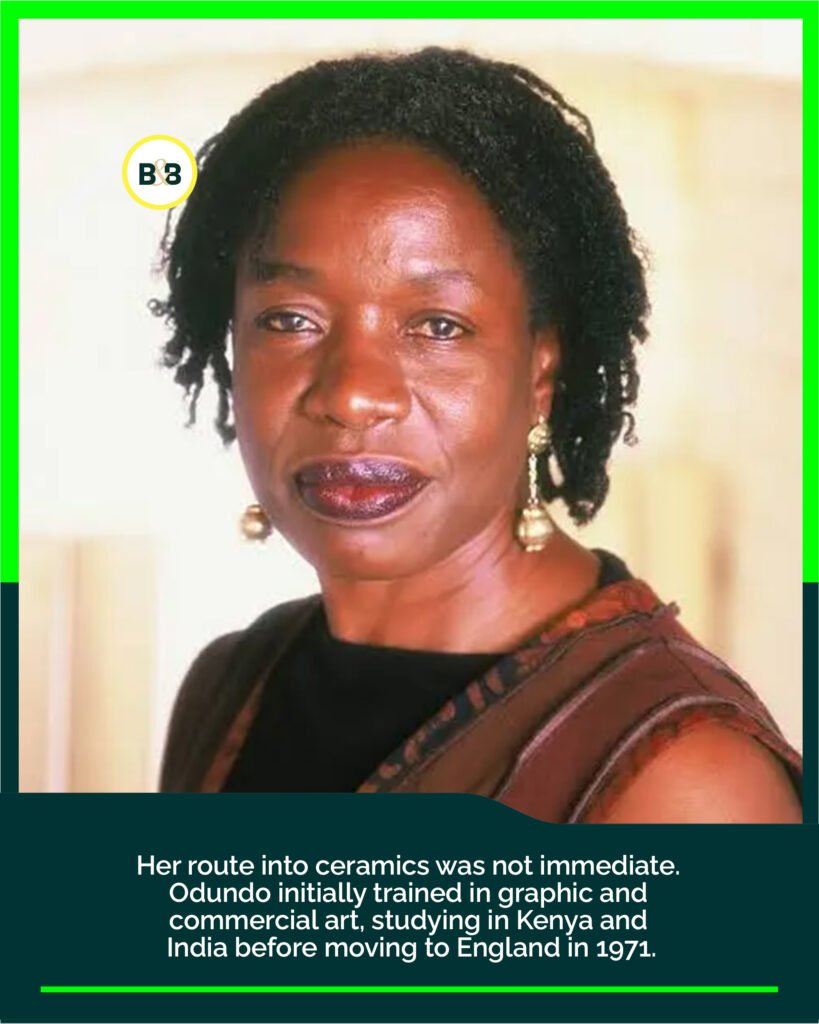
Her route into ceramics was not immediate. Odundo initially trained in graphic and commercial art, studying in Kenya and India before moving to England in 1971. At Cambridge School of Art, she intended to pursue graphic art, but her pottery teacher, Zoë Ellison, introduced her to clay. That encounter redirected her education towards ceramics. She went on to study at West Surrey College of Art and Design and later completed a master’s degree at the Royal College of Art in 1982. A year before beginning her degree in ceramics, she had already started exploring the medium that would define her career.
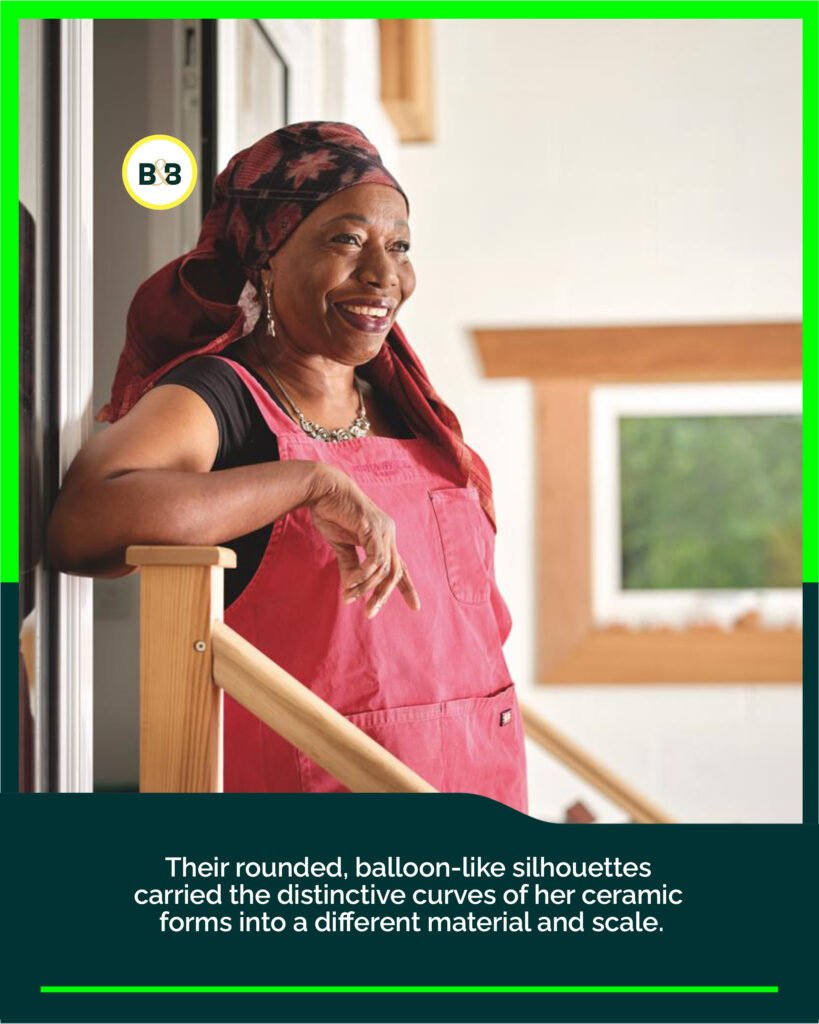
Nigeria also occupies an important place in that development. In 1974, Odundo travelled to the Abuja Pottery Training Centre in Suleja, where she apprenticed with local potters and studied hand-building techniques. She subsequently returned to Kenya to investigate traditional pottery practices, particularly those maintained by women. These experiences became part of a much wider artistic enquiry. Her influences include ceremonial vessels from Kenya and Nigeria, wood carving from the Congo, ancient ceramics from Cyprus, Japan and Peru, British studio pottery, modernist sculpture and historical costume. Her work resists being confined to a single national or cultural reference; it reflects an artist who has spent a lifetime examining how objects carry memory, identity and knowledge across borders.
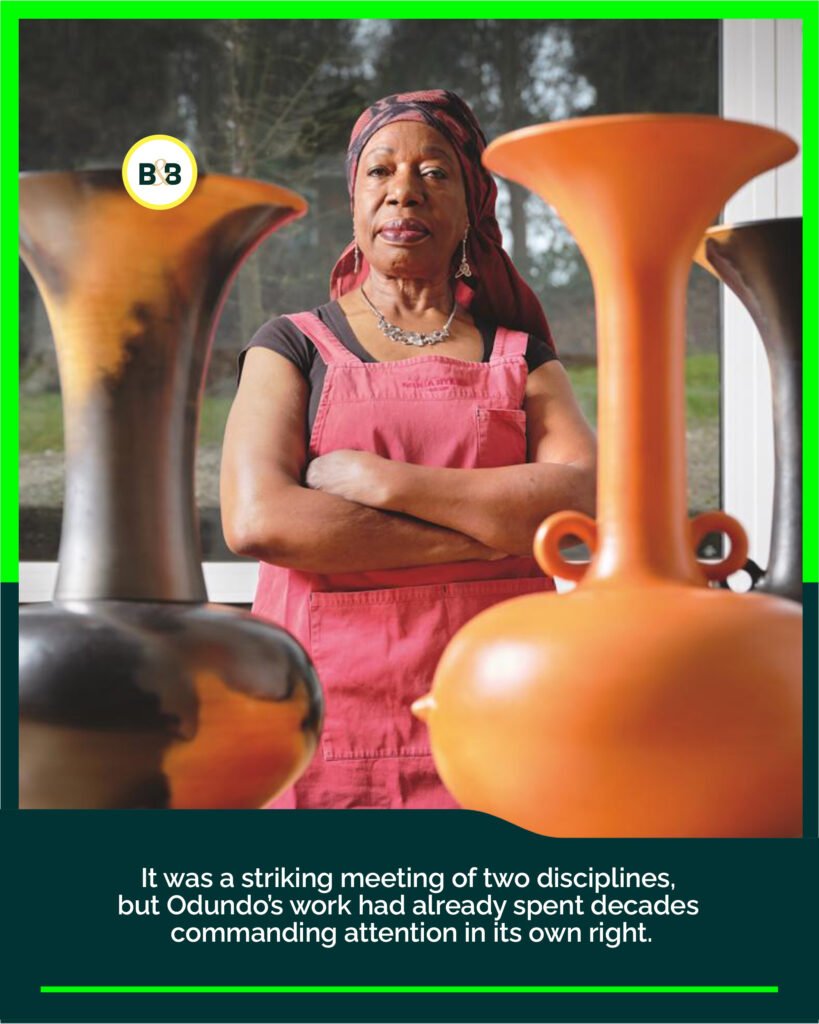
That breadth has taken Odundo into some of the world’s leading art institutions. Her work has been exhibited internationally and is represented in almost 50 museum collections, according to the Fitzwilliam Museum. She was included in the 2022 Venice Biennale’s The Milk of Dreams exhibition, where her vessels were presented within a wider exploration of the body, transformation and artistic imagination. In 2019, The Journey of Things, a major exhibition of her work and selected objects that informed her practice, travelled between The Hepworth Wakefield and the Sainsbury Centre. Her contribution to art and arts education was recognised with a Dame Commander of the Order of the British Empire (DBE) in 2020.
Anderson’s interest in Odundo’s work predates his appointment at Dior. He is a longtime friend, admirer and collector of the artist’s ceramics. In 2021, he spoke to British GQ about a vessel he owned, describing its acquisition as a personal milestone and connecting the object to his relationship with Odundo. For his couture debut, the reference became more direct: the Dior presentation at the Musée Rodin placed designs from the collection in conversation with ceramics by Odundo and works by Christian Dior. The exchange gave her sculpture a place within the visual discussion of haute couture, rather than treating it as a passing decorative reference.
Odundo’s influence on Dior offers a compelling view of how ideas travel between creative disciplines. A form developed through years of studying clay, cultural histories and the human figure became a starting point for garments made by one of the world’s most established fashion houses. Yet the significance of her work does not depend on its appearance on a runway. Her vessels have their own artistic authority, shaped by a practice that brings together material intelligence, cultural research and an unusually disciplined eye for form. Dior offered a new audience a reason to look. The work itself gives them every reason to stay.


