
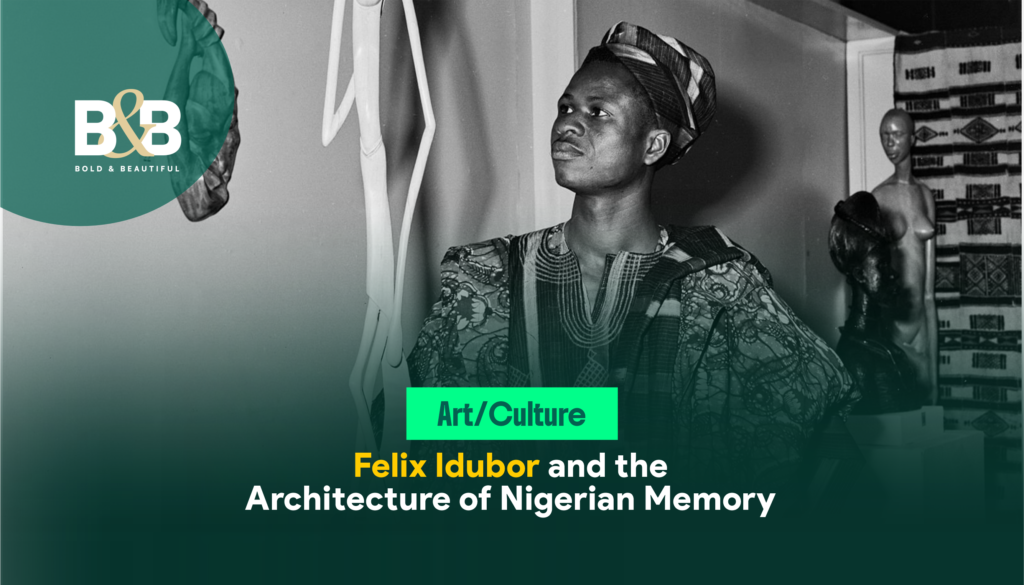
Long before sculpture became a familiar presence in Nigeria’s public spaces, Felix Idubor was already asking a more interesting question: what happens when art becomes part of the building itself?
For Idubor, sculpture was never confined to the gallery or the pedestal. It could live in an entrance, occupy a wall, define a civic space or become part of the architecture through which people moved every day. His work created a conversation between sculpture and structure, bringing portraiture, reliefs and carved forms into environments designed for public life.
That approach was quietly radical.
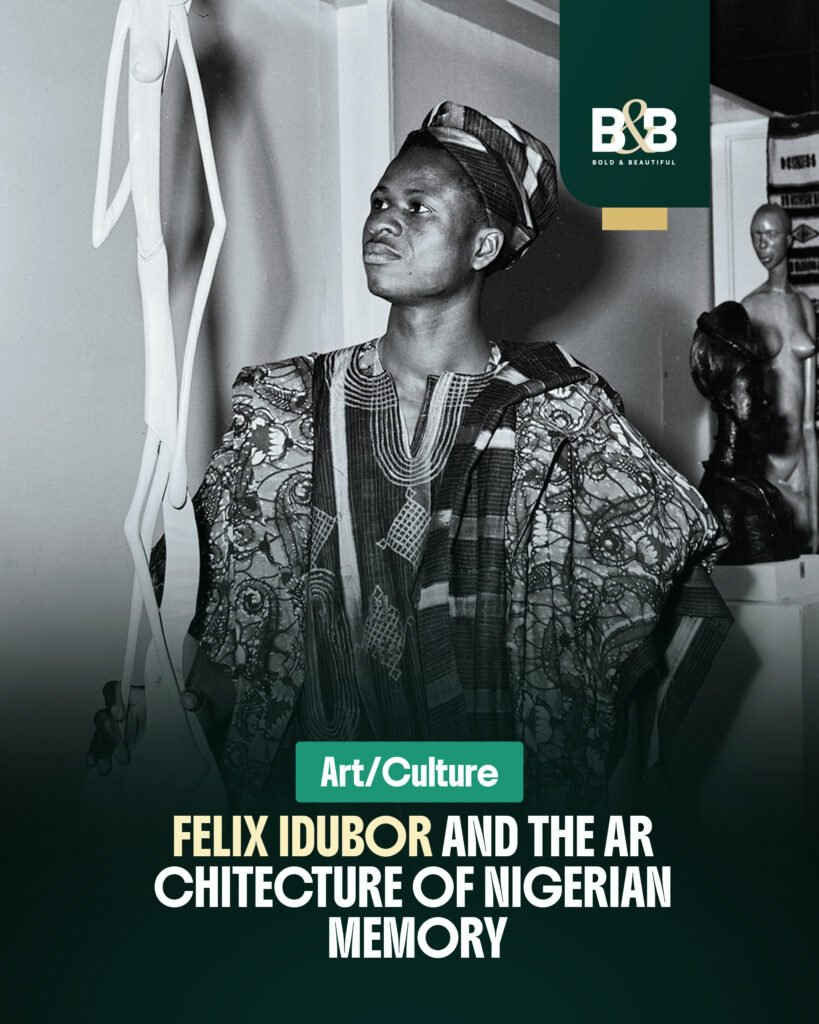
At a time when Nigeria was developing its own visual language in the years surrounding independence, Idubor belonged to a generation of artists determined to demonstrate that African creativity could exist comfortably within modern architectural spaces without surrendering its cultural character. His sculptures carried the weight of Nigerian history, people and identity into places where art was encountered not as something distant, but as part of everyday life.
The archive of the Felix Idubor Arts Foundation offers a glimpse into this relationship. Reliefs, carved doors and portrait figures reveal an artist who understood that architecture could provide more than shelter or function. It could become a canvas for memory.
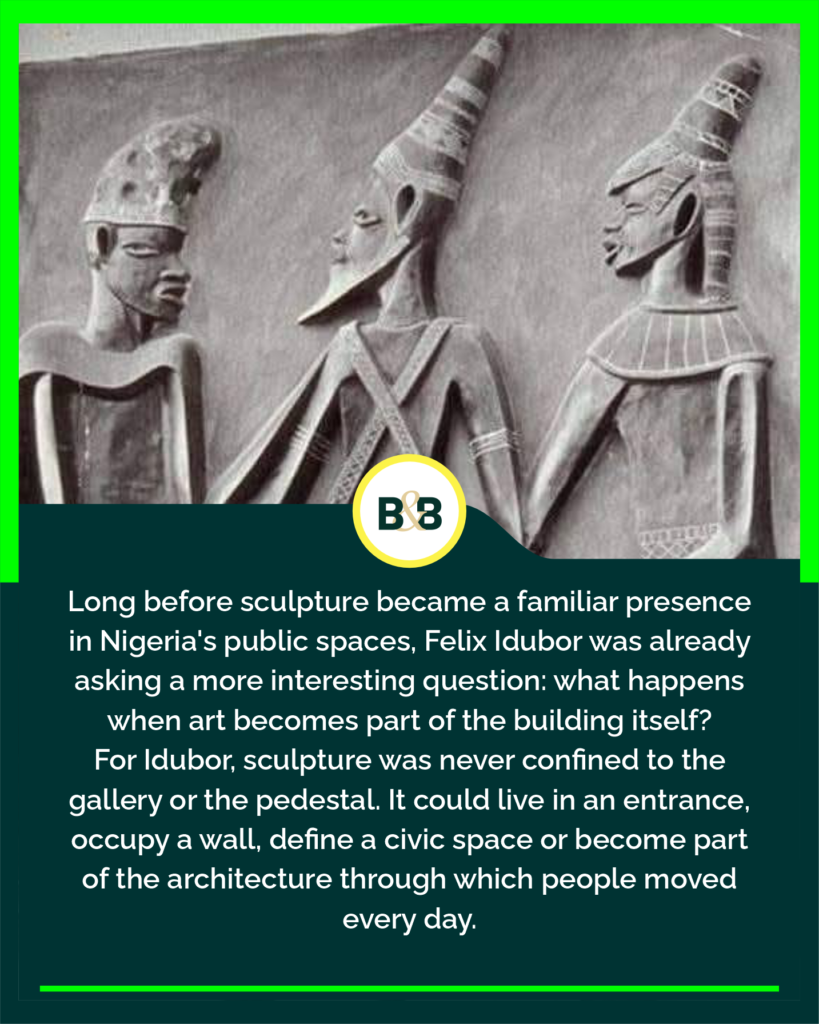
This is particularly evident in Idubor’s treatment of the human figure. His sculptural portraits were not merely decorative representations. They gave physical presence to individuals, histories and ideas, allowing identity to become embedded within the spaces people inhabited. The carved surface became a meeting point between craft and architecture, while the building itself became part of the artwork.
That distinction matters when considering Idubor’s place in Nigerian art history.
Much of the conversation around African modernism has traditionally focused on paintings, sculpture displayed in galleries and the work of individual artists. Idubor’s architectural interventions invite a broader reading. They suggest that the story of Nigerian art can also be found in buildings, civic environments and public spaces, where creative expression becomes woven into the fabric of ordinary life.
His practice also raises a question that remains remarkably relevant today: Who gets to decide what becomes part of a nation’s visual memory?
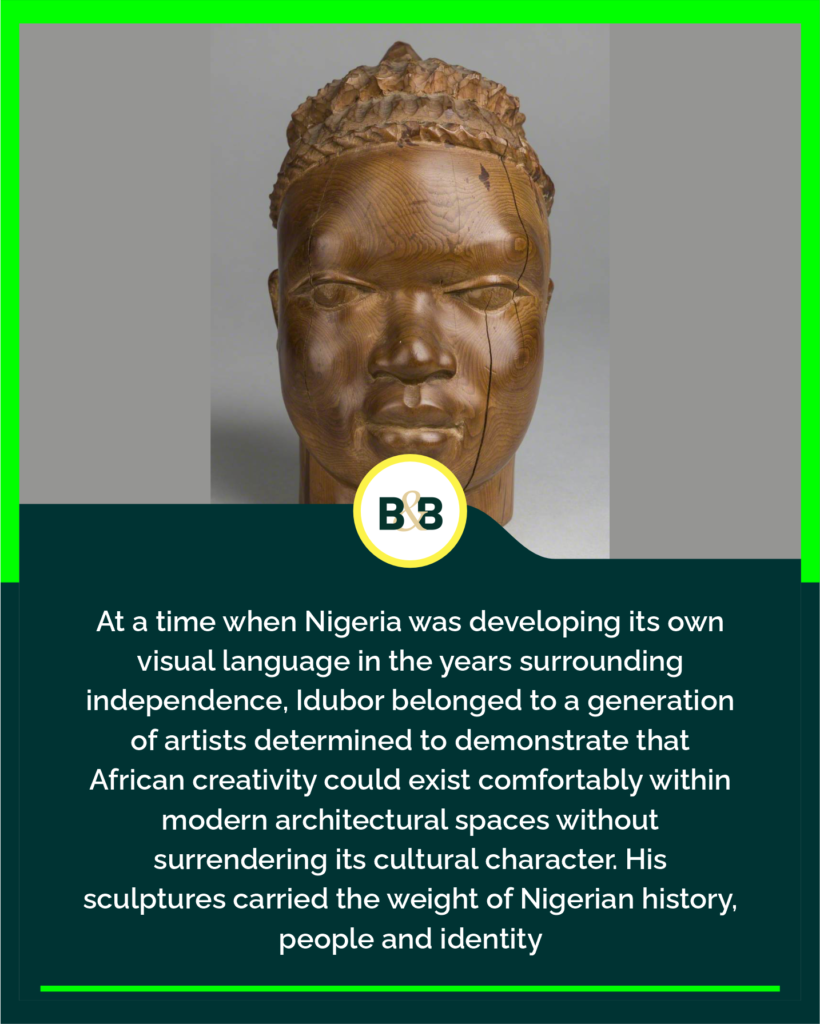
Public art can outlive its creators. A carved doorway may remain long after the conversation that produced it has disappeared. A portrait embedded within a building can continue speaking to generations who may know little about the circumstances of its creation. Architecture gives sculpture a different kind of permanence, placing art directly in the path of history.
For contemporary Nigeria, where rapid urban development is continually transforming the character of its cities, Idubor’s work offers an important lesson. Modernisation does not have to mean cultural erasure. Buildings can accommodate memory. Public spaces can carry identity. Contemporary architecture can make room for artistic traditions rather than treating them as relics of another era.
That is perhaps the most enduring quality of Felix Idubor’s sculptural architecture.
He did not simply place sculpture on buildings.
He made buildings remember.
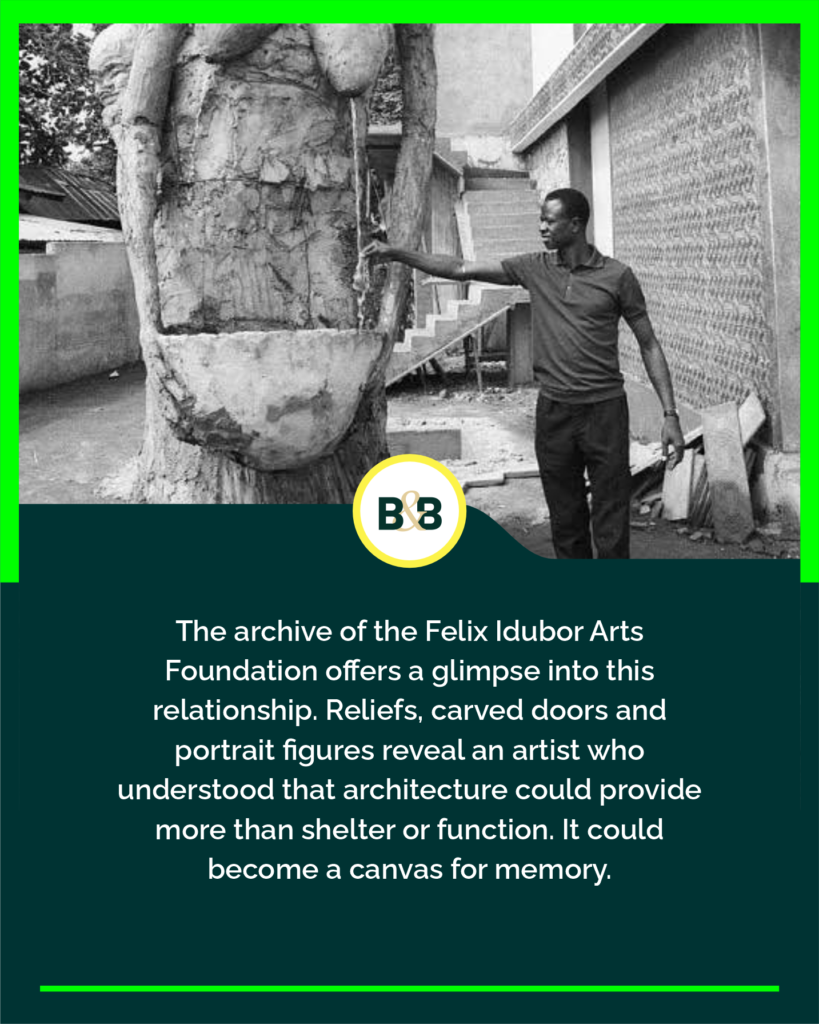
Today, revisiting the reliefs, carved doors and portrait figures preserved through the Felix Idubor Arts Foundation is an invitation to look again at the relationship between Nigerian art and the spaces that surround it. It is also a reminder that some of the country’s most significant cultural stories are not hanging on gallery walls. They are built into the places through which generations have walked.
For B&B International Magazine, that intersection of art, architecture, heritage and identity belongs to a larger conversation about how Africa preserves its past while defining its future. Felix Idubor’s work occupies an important place within that conversation: a body of work where sculpture became architecture, architecture became memory, and memory became part of the public landscape.