

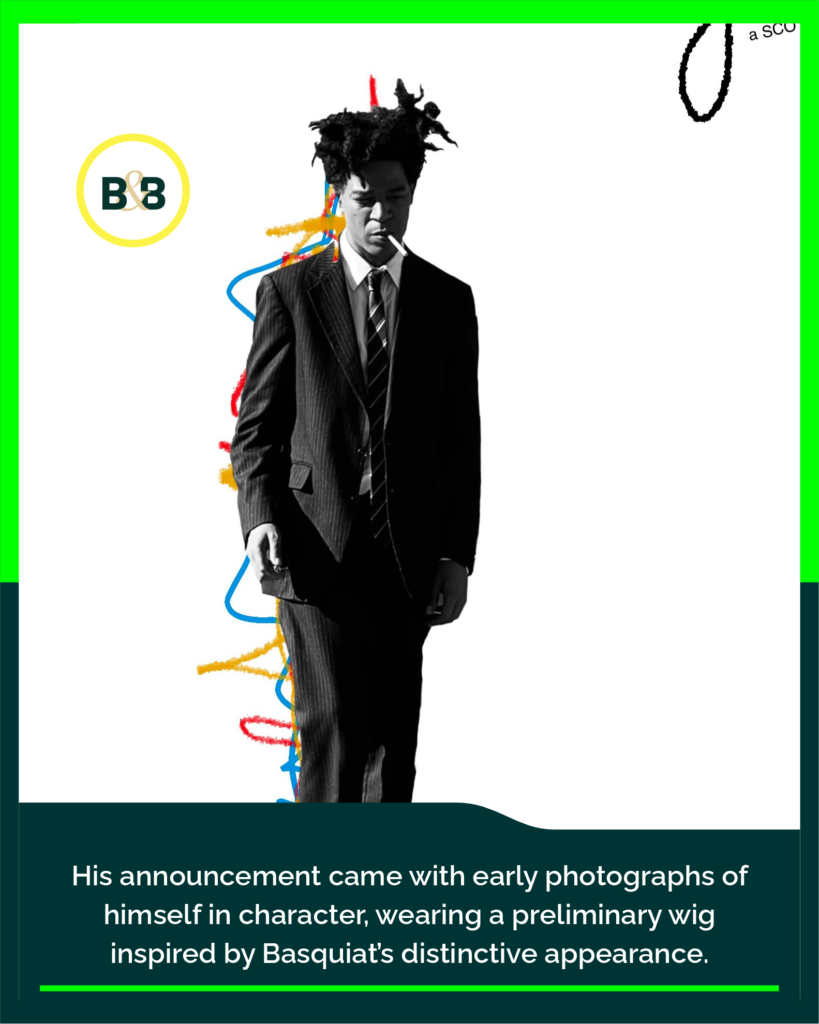
For years, people imagined Kid Cudi playing Jean-Michel Basquiat. No film materialised, so the rapper, actor and filmmaker decided to stop waiting for somebody else to make it happen. On 21 October, Cudi announced JEAN, a biographical film about the late New York artist that he will write, direct and star in, with filming scheduled to begin in 2027. His announcement came with early photographs of himself in character, wearing a preliminary wig inspired by Basquiat’s distinctive appearance. The look is still being refined, he made clear, but the intention is serious. If the industry would not give him the opportunity to tell this story, he would create the opportunity himself.

Cudi, born Scott Mescudi, has described Basquiat as an enduring influence throughout his career. The artist’s life and work occupy a distinctive place in modern American culture: a Brooklyn-born Black artist who moved from the streets and the cryptic graffiti tag SAMO into the international fine-art establishment, challenging expectations about who could occupy its galleries and command its attention. Basquiat’s paintings fused expressive figures, fragmented text, references to Black history, popular culture and power. Their raw energy helped make him one of the defining artists of 1980s New York. His story carries obvious cinematic possibilities, but its complexity also makes it a demanding subject for anyone attempting to portray him.

Cudi has not approached the project as an acting assignment alone. In his announcement, he described reading books, conducting extensive research and speaking with people who knew Basquiat personally. He called writing about someone who actually existed a welcome challenge, signalling an awareness that admiration is not enough to reconstruct another person’s life on screen. The task involves decisions about what to include, whose memories to trust and how to portray a figure whose public image has sometimes overshadowed the person behind the paintings. For a film centred on an artist whose work resists easy interpretation, those decisions will matter as much as the performance.

The title, JEAN, reflects the personal nature of Cudi’s ambition. He has described the film as a love letter to Basquiat, the 1980s and New York City. That framing suggests an interest in the environment that shaped the artist, rather than a story confined to auction records, gallery openings and the mythology of genius. Basquiat emerged from a city alive with graffiti, experimental music, underground art and competing ideas about race, class and cultural ownership. He moved through those worlds while confronting an art establishment that was not built to accommodate every part of his identity. Capturing that tension will be essential if the film is to convey why his work still resonates beyond the art market.

There is already a screen history against which JEAN will be measured. Julian Schnabel’s 1996 film Basquiat, starring Jeffrey Wright, dramatised the artist’s rise and his relationships within New York’s art world. Other documentaries have examined his life, work and legacy, while additional Basquiat-related projects have been in development. Cudi therefore faces a challenge beyond resemblance: he must find a perspective that gives audiences a reason to revisit a story they may already know. His strongest advantage may be the personal connection he describes, but that connection will have to translate into a compelling screenplay, a considered performance and a film that sees Basquiat as a person rather than an icon reproduced for the camera.
The project also marks another step in Cudi’s expanding work behind the camera. He has built an acting career through appearances in films including X, Pearl and MaXXXine, while creating the animated musical project Entergalactic. He is also developing other directorial projects, including Doe and the horror thriller Wrong Number. With JEAN, the ambition is broader than inhabiting a role: Cudi is taking responsibility for the story’s writing and visual direction as well. That concentration of creative control could give the film a distinctive voice, although it also places the burden of its artistic decisions squarely on him.

The early wardrobe photographs have already opened a conversation about how Cudi will embody Basquiat. His resemblance to the artist is only one part of the question. Basquiat’s physical presence, restless intelligence, vulnerability and relationship with fame are difficult to reduce to hairstyle and clothing. The performance will need to communicate the mind behind the work, including the contradictions between artistic independence and commercial success. Cudi has said that the final look is not ready, so the images should be understood as a first glimpse rather than a finished transformation. The more consequential reveal will come when audiences see how he interprets Basquiat’s inner life.

For now, JEAN remains a film in preparation, with production expected to begin in 2027 and no release date announced. Cudi’s decision to write the role himself offers a clear lesson in creative agency: sometimes an idea survives years of discussion because nobody has yet taken responsibility for making it real. The harder work begins now. Basquiat’s legacy is too significant to be served by imitation alone, and Cudi appears to understand that the honour he describes comes with a responsibility to do the research and make difficult artistic choices. He has secured his chance to tell the story. The film will determine what he does with it.