
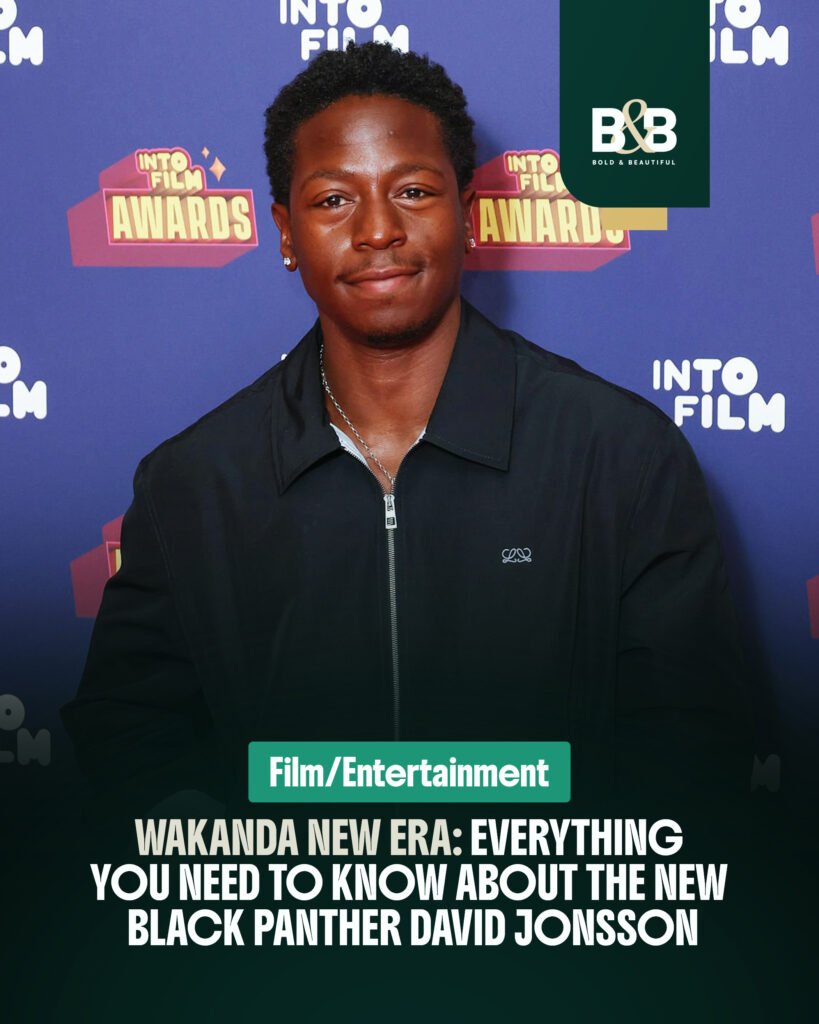
For David Jonsson, the journey to Wakanda began far from Hollywood.
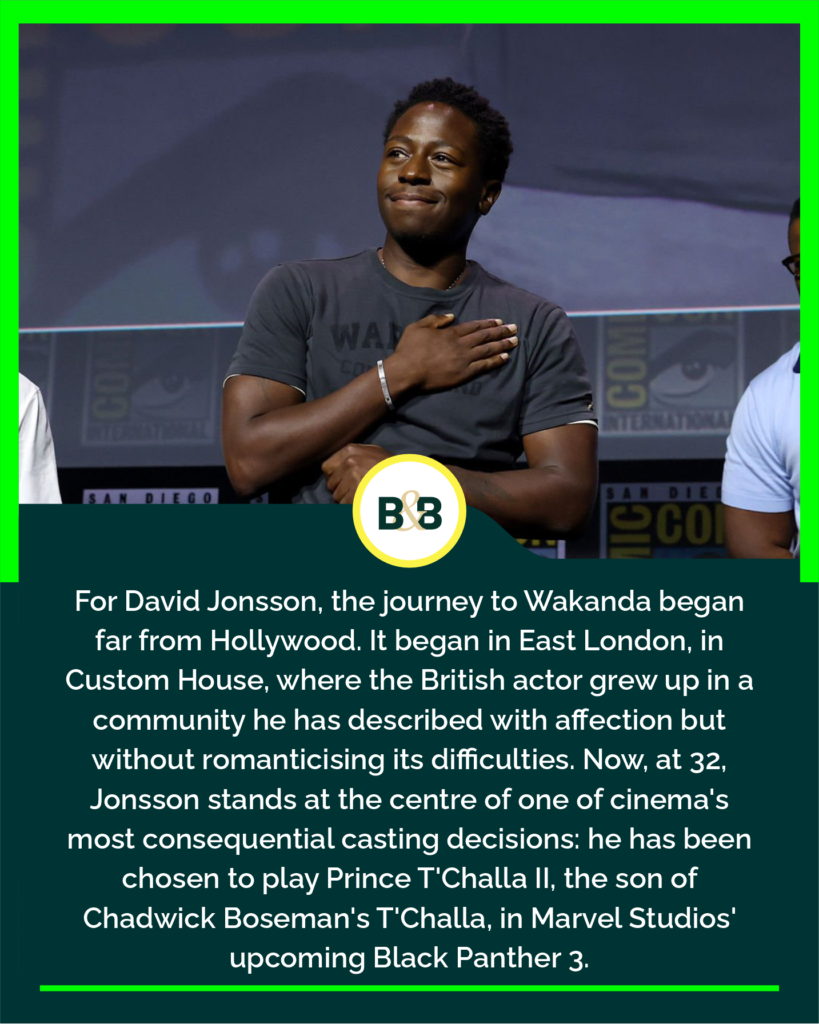
It began in East London, in Custom House, where the British actor grew up in a community he has described with affection but without romanticising its difficulties. Now, at 32, Jonsson stands at the centre of one of cinema’s most consequential casting decisions: he has been chosen to play Prince T’Challa II, the son of Chadwick Boseman’s T’Challa, in Marvel Studios’ upcoming Black Panther 3. The announcement was made by director Ryan Coogler at San Diego Comic-Con, confirming Jonsson as the actor who will carry the Black Panther mantle into its next chapter. (The Washington Post)
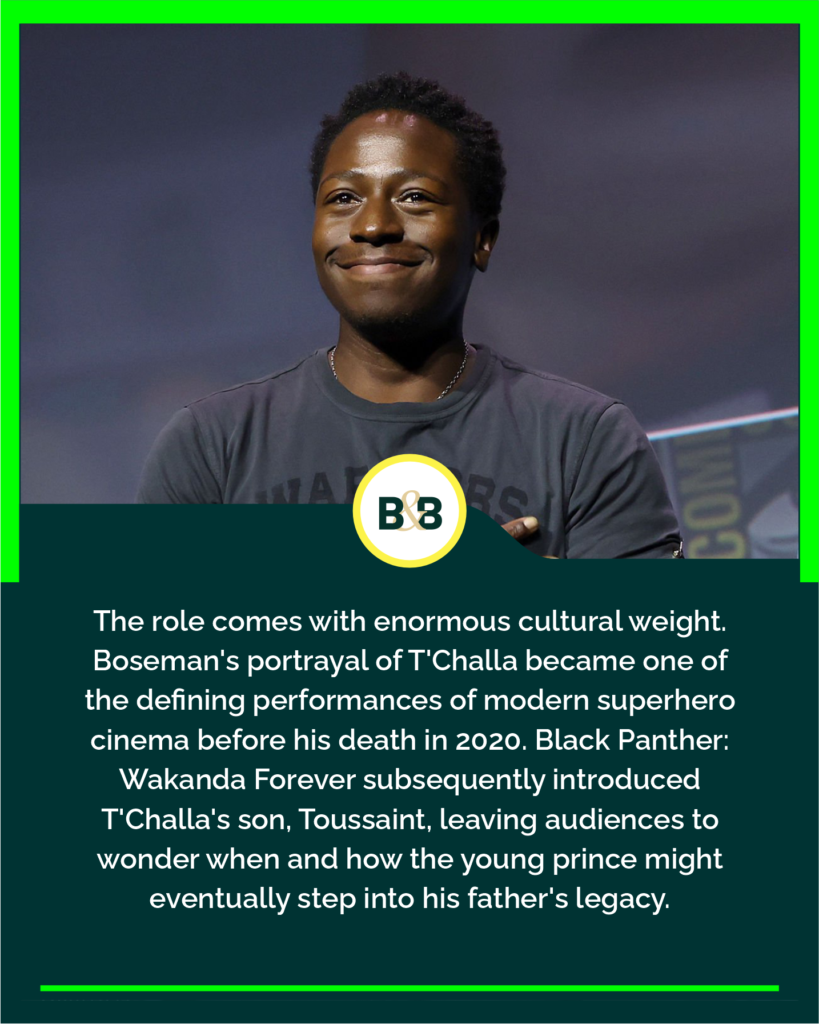
The role comes with enormous cultural weight. Boseman’s portrayal of T’Challa became one of the defining performances of modern superhero cinema before his death in 2020. Black Panther: Wakanda Forever subsequently introduced T’Challa’s son, Toussaint, leaving audiences to wonder when and how the young prince might eventually step into his father’s legacy. Jonsson is now the actor entrusted with bringing that future to life. (The Washington Post)
But before Wakanda, there was London. Before the Marvel universe, there was a young actor learning how to understand the world around him.
Here are five things worth knowing about the man behind the new Black Panther.
- He Grew Up in East London
Jonsson was born and raised in Custom House, East London, as the youngest of five children. His parents separated when he was 11, and he was raised largely by his mother, who worked as a police officer, with support from his older siblings.
His childhood gave him an early understanding of how circumstance can influence ambition. Jonsson has spoken candidly about growing up around violence and attending memorials for people from his community. The experience shaped his understanding of opportunity and the importance of refusing to allow one’s surroundings to dictate the limits of one’s imagination.
That perspective now sits quietly behind one of the biggest opportunities of his career.
From a neighbourhood where he saw first-hand how easily young lives could be defined by circumstance, Jonsson has arrived at the centre of a global franchise whose protagonist has become a symbol of Black possibility.
- His Breakthrough Came Long Before Marvel
Jonsson is not an overnight star.
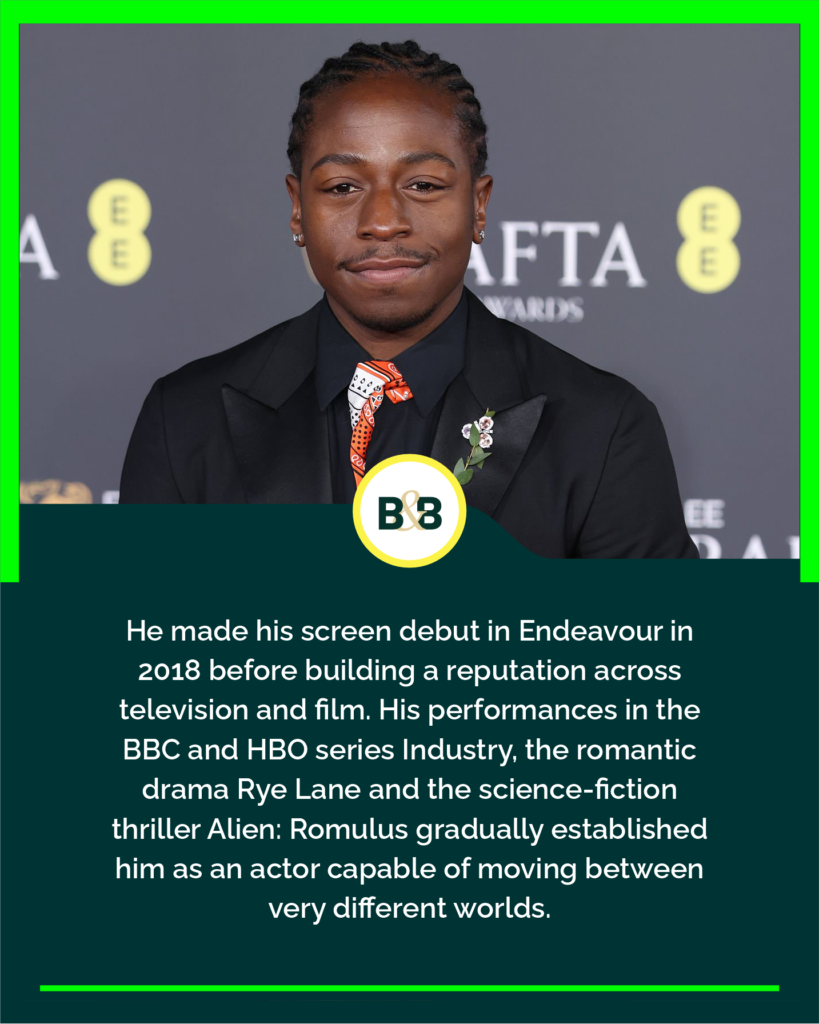
He made his screen debut in Endeavour in 2018 before building a reputation across television and film. His performances in the BBC and HBO series Industry, the romantic drama Rye Lane and the science-fiction thriller Alien: Romulus gradually established him as an actor capable of moving between very different worlds.
His performance in Rye Lane revealed his ability to carry intimacy and humour. Industry gave him the opportunity to work within a demanding ensemble drama. Then came Alien: Romulus, where a much wider international audience encountered his range. More recently, he appeared in The Long Walk, further strengthening a filmography that has expanded considerably in only a few years. (The Guardian)
That progression matters.
Marvel did not pluck an unknown actor from obscurity and place him inside Wakanda. Jonsson had already spent years developing the craft required to make audiences believe in complicated characters.
- He Already Has Major Recognition to His Name
In 2025, Jonsson won the BAFTA Rising Star Award, one of the industry’s most significant early-career honours because the winner is selected by the British public.
The award followed a run of performances that had steadily increased his profile, particularly his work in Rye Lane, Industry and Alien: Romulus. He has also received recognition from the Black British theatre community and, as part of The Long Walk ensemble, shared the Robert Altman Award at the 2026 Film Independent Spirit Awards. (The Guardian)
For an actor now preparing to lead one of the world’s most recognisable franchises, those distinctions provide useful context. Jonsson arrives in Wakanda with something more valuable than celebrity: a growing body of work that has already earned critical and public recognition.
- He Is Building a Career Behind the Camera, Too
In 2025, he launched Grey Area, a production company established with producer Sophia Gibber. Its purpose is particularly revealing: to develop stories that resist easy categorisation and explore the contradictions and emotional complexities that often make human stories worth telling.
That instinct is consistent with Jonsson’s own career. His most interesting roles have rarely depended on simple definitions of good or bad, hero or villain. He has gravitated towards characters with emotional tension and room for contradiction.
That makes his move into producing more than a side project. It suggests an actor increasingly interested in controlling which stories reach the screen and how those stories are told.
For a new generation of Black British talent, that distinction matters. Representation behind the camera can influence what gets financed, whose experiences are considered commercially viable and which narratives receive the space to develop.
- He Is Taking Over One of Cinema’s Heaviest Mantles
This is the part of Jonsson’s story that changes everything.
At Comic-Con, Ryan Coogler revealed Jonsson as the new Black Panther, with Jonsson appearing on stage alongside Coogler, Letitia Wright and Winston Duke. Marvel confirmed that Black Panther 3 will arrive in cinemas on December 15, 2028, with Coogler returning to direct. (The Washington Post)
Jonsson is not replacing Chadwick Boseman in a conventional sense. He is playing the next generation of T’Challa.
That distinction is crucial.
Boseman’s T’Challa represented the arrival of a Black superhero at the centre of a global cinematic universe. Jonsson’s T’Challa II represents what comes after that breakthrough: inheritance, responsibility and the question of what a young man does with a legacy that was already monumental before he was old enough to understand it.
That gives the casting an emotional dimension beyond the spectacle of a superhero film.
Jonsson is stepping into a character whose name already means something to millions of people.
And he will have to make it his own.
The Next Chapter Belongs to T’Challa II
The most interesting question surrounding David Jonsson is therefore not whether he can imitate Chadwick Boseman.
He cannot, and he should not.
The challenge is more demanding: Can he make audiences believe in a new T’Challa while honouring everything the character has already come to represent?
Ryan Coogler’s decision suggests he believes Jonsson can.
Marvel’s next chapter gives the actor an opportunity that very few performers receive: to enter an established cultural mythology while helping determine where that mythology goes next. For Jonsson, the journey from East London to Wakanda is not simply a career ascent. It is a passage from one kind of storytelling into another, from an actor proving what he can do to a leading man carrying a character whose significance reaches well beyond the screen.
The world will be watching.
And for David Jonsson, the real work begins now.