
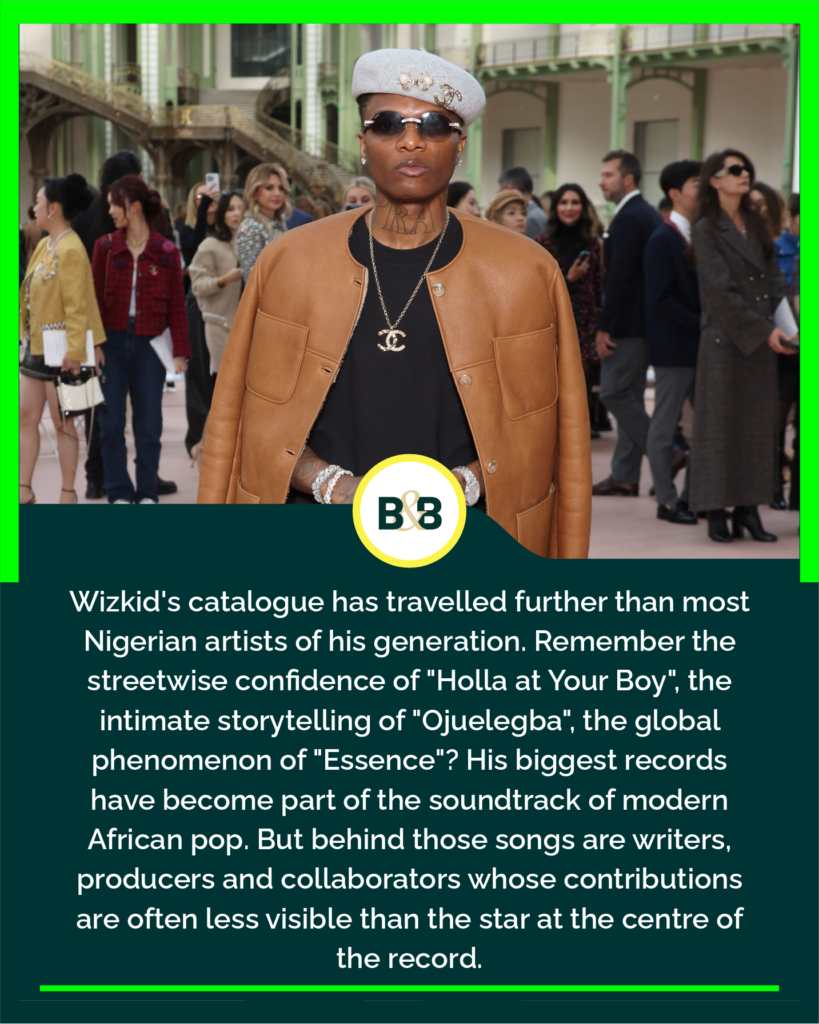
Wizkid’s catalogue has travelled further than most Nigerian artists of his generation.
Remember the streetwise confidence of “Holla at Your Boy”, the intimate storytelling of “Ojuelegba”, the global phenomenon of “Essence”? His biggest records have become part of the soundtrack of modern African pop. But behind those songs are writers, producers and collaborators whose contributions are often less visible than the star at the centre of the record.

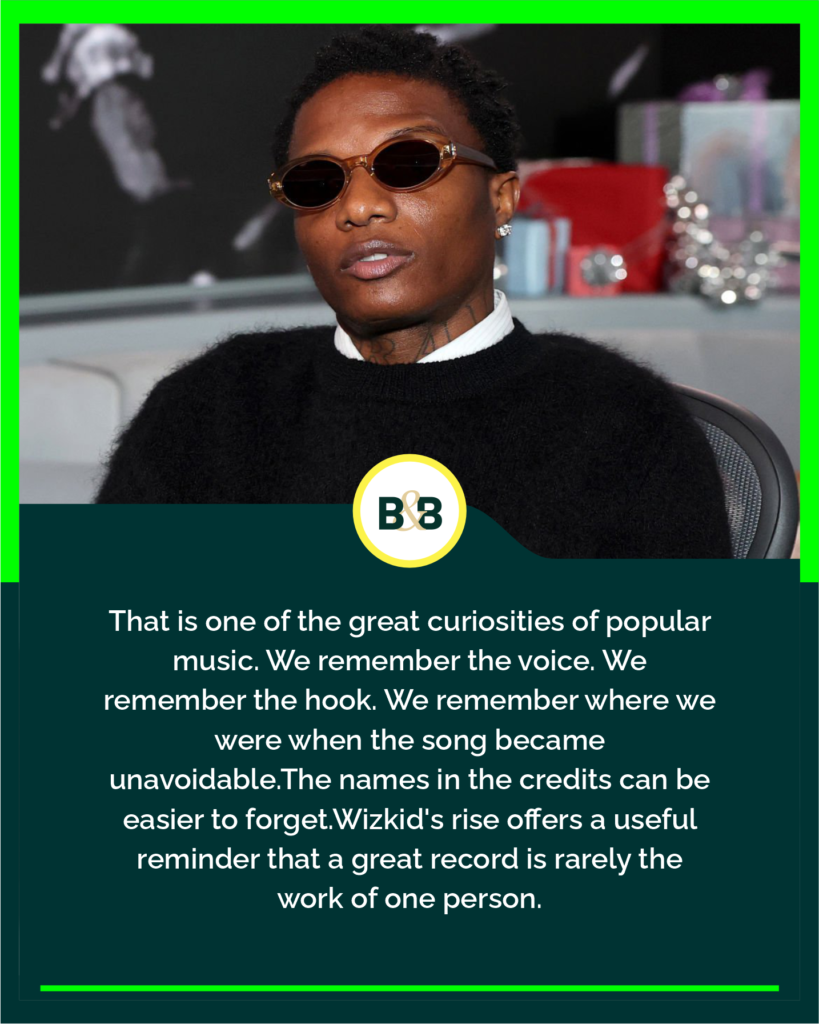
That is one of the great curiosities of popular music. We remember the voice. We remember the hook. We remember where we were when the song became unavoidable.
The names in the credits can be easier to forget.
Wizkid’s rise offers a useful reminder that a great record is rarely the work of one person.
“Holla at Your Boy”
The Writers: Wizkid, Ifieya Clement Kponu and Veedee Kote Ikenze
“Holla at Your Boy”, the record that helped introduce Wizkid to a much wider Nigerian audience, arrived on his 2011 debut album, Superstar.
The song’s composition and lyrics credits list Ayodeji Ibrahim Balogun (Wizkid), Ifieya Clement Kponu and Veedee Kote Ikenze. DJ Klem is credited as producer, with VeeDee as co-producer. (Apple Music – Web Player)
The record captured an early Wizkid at his most youthful: confident, flirtatious and completely comfortable over a beat designed for radio and the dancefloor.
It was more than a hit. It was an introduction.
Before the international collaborations, the Grammy recognition and the sold-out arenas, there was a young artist finding the sound that would eventually carry his name around the world.
“Ojuelegba”
The Writer: Wizkid
The Producer: Legendury Beatz
“Ojuelegba” is where the conversation becomes more personal.
Released on Ayo in 2014, the song took its name from the Lagos neighbourhood that formed part of Wizkid’s own story. Its lyrics looked back at struggle, work, prayer and ambition, turning a specific place into a universal story about trying to make something of yourself.
The official credits list Wizkid as the songwriter, with Legendury Beatz handling production. (Apple Music – Web Player)
That distinction is important.
The song’s emotional power belongs to Wizkid’s writing and delivery, while Legendury Beatz provided the musical environment in which the story could breathe.
Then came the remix.
Drake and Skepta joined Wizkid, giving “Ojuelegba” another life and exposing its Lagos-centred story to an even wider audience. The collaboration would also become part of the chain of events that connected Wizkid to Drake’s “One Dance”. (Wikipedia)
“One Dance”
The Writers: Drake, Wizkid, Kyla Smith, Luke Reid, Noah “40” Shebib, Paul Jefferies and Errol Reid
Few records changed the scale of Wizkid’s international career more dramatically than Drake’s “One Dance”.
The song’s writing credits include Aubrey Graham (Drake), Ayodeji Balogun (Wizkid), Kyla Smith, Luke Reid, Noah Shebib, Paul Jefferies and Errol Reid. Production credits include Nineteen85, with Noah “40” Shebib and Wizkid credited as co-producers. (MusicBrainz)
That list tells a larger story about contemporary songwriting.
“One Dance” was built across different musical traditions and creative backgrounds. Kyla’s earlier recording “Do You Mind” provided the sampled foundation, while Drake, Wizkid and the production team reshaped those elements into something that could dominate mainstream global pop.
The result was a worldwide No. 1.
For Wizkid, it was a turning point. He had already established himself as one of Nigeria’s biggest stars. “One Dance” introduced his voice to an audience that extended far beyond the Afrobeats ecosystem.
The world was beginning to hear him differently.
“Come Closer”
The Writers: Wizkid and Drake
The Producer: Sarz
By 2017, the relationship between Wizkid and Drake had evolved into something more substantial.
“Come Closer”, released on Sounds From the Other Side, was credited to Ayodeji Balogun and Aubrey Graham as writers, with Nigerian producer Sarz behind the production. (Wikipedia)
Interestingly, Drake’s presence became part of the mythology around the record even though the official video ultimately arrived without a Drake appearance.
Musically, “Come Closer” represented the increasingly international direction of Wizkid’s catalogue. Yet it still carried the rhythmic instincts that made his music recognisable.
The record demonstrated that collaboration did not have to mean compromise.
Wizkid could enter a global pop environment and still sound like himself.
“Joro”
The Writers: Wizkid and Onozutu Ezra Enesi
The Producer: Northboi
Released in 2019, “Joro” brought Wizkid back into a more intimate and distinctly Afrobeats space.
The official credits list Ayodeji Balogun and Onozutu Ezra Enesi as songwriters, with Northboi credited as producer. (Apple Music – Web Player)
The record is deceptively simple.
Its appeal comes from repetition, melody and rhythm rather than an overloaded arrangement. It is the kind of song that feels almost casual until you realise how effectively it stays in your head.
Northboi’s production gives Wizkid space to glide across the rhythm, while the writing keeps the focus on romance, desire and devotion.
“Joro” became another reminder that Wizkid’s international evolution had not required him to abandon the formula that made him successful at home.
“Essence”
The Writers: Wizkid, Tems, Uzezi Oniko, Okiemute Oniko and Richard Isong
The Producers: P2J and Legendury Beatz
Then came “Essence”, and the conversation changed again.
Released on Made in Lagos in 2020, the song brought together Wizkid, Tems, Uzezi Oniko, Okiemute Oniko and Richard Isong as credited songwriters. P2J and Legendury Beatz are credited as producers, with Leandro Hidalgo credited for mixing. (Apple Music – Web Player)
This is where the collaborative architecture of a modern Afrobeats hit becomes especially clear.
Wizkid’s voice provides the centre of gravity. Tems brings a vocal presence that became inseparable from the record’s identity. P2J and Legendury Beatz construct the musical world around them. Uzezi Oniko, Okiemute Oniko and Richard Isong are part of the songwriting framework that helped turn the idea into a finished record.
Nothing about “Essence” sounds crowded.
That is precisely the point.
The record feels effortless because the people behind it knew how much to leave out.
Its success was enormous. “Essence” became the first Nigerian song to chart on the Billboard Hot 100, while its global reception helped move Wizkid and Tems into an even larger international conversation. (Pitchfork)
The song eventually became more than a hit.
It became a reference point for the global expansion of Afrobeats. That collaborative instinct is part of the story behind Wizkid’s longevity.
His evolution has never depended solely on changing his sound. It has also depended on knowing which musicians, producers and writers can add something distinctive to it.
The Hit Is Bigger Than the Star
There is a tendency to discuss African music through its most recognisable performers.
That makes sense commercially. Artists occupy the covers. Their names sell the records.

But the modern African music industry is increasingly being built by a much wider creative class: songwriters, producers, engineers, musicians, composers, publishers and executives whose fingerprints can be found throughout the music travelling from Lagos, Accra, Johannesburg and Nairobi to London, New York and beyond.
Wizkid’s catalogue offers a particularly compelling case study.
His biggest records are not simply evidence of his talent. They are evidence of what happens when distinctive artists meet equally distinctive creative collaborators.
The voice may belong to Wizkid.
But the story behind the hit belongs to many more people.
And perhaps that is the part of Afrobeats’ global rise that deserves greater attention: the world is discovering not only African stars, but an entire African songwriting and production ecosystem capable of creating records that can live anywhere.