
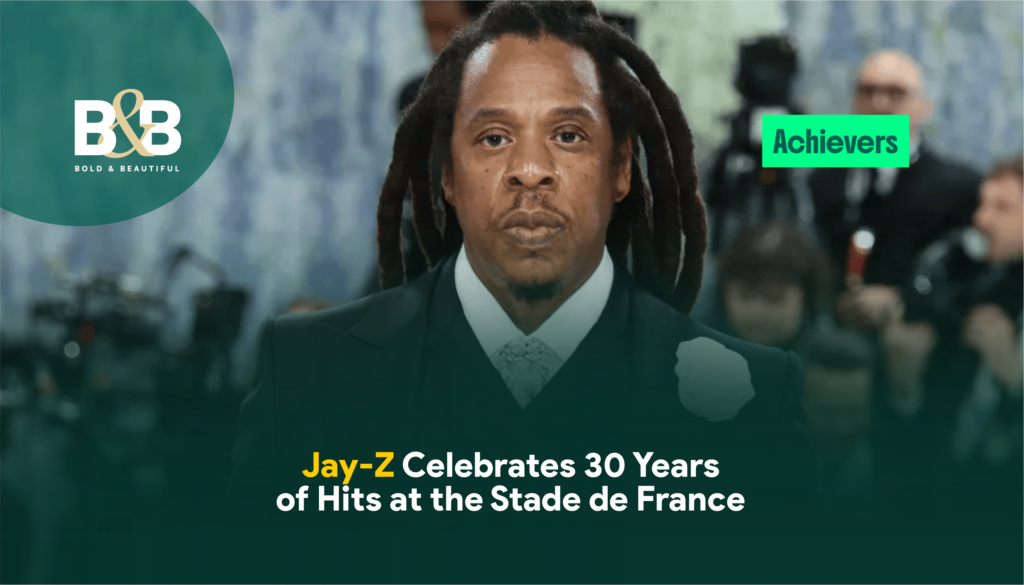
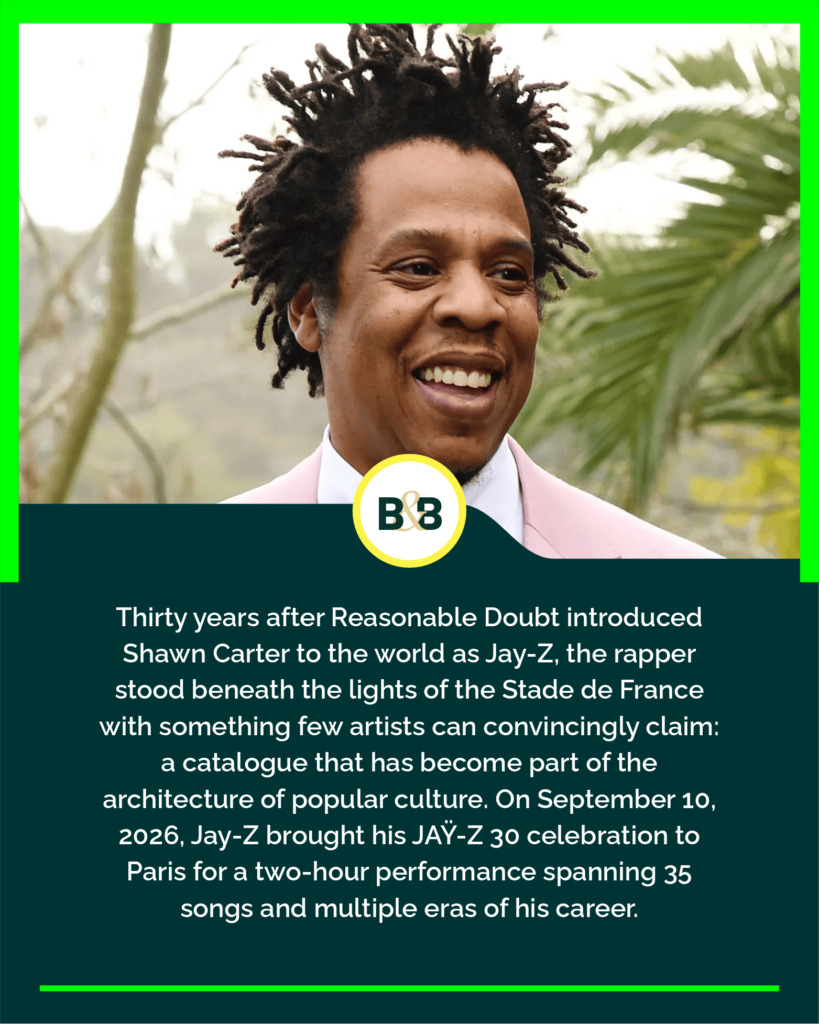
Thirty years after Reasonable Doubt introduced Shawn Carter to the world as Jay-Z, the rapper stood beneath the lights of the Stade de France with something few artists can convincingly claim: a catalogue that has become part of the architecture of popular culture. On September 10, 2026, Jay-Z brought his JAŸ-Z 30 celebration to Paris for a two-hour performance spanning 35 songs and multiple eras of his career. At 56, he delivered the evening with the economy of an artist who no longer needs to prove that he belongs in the room.
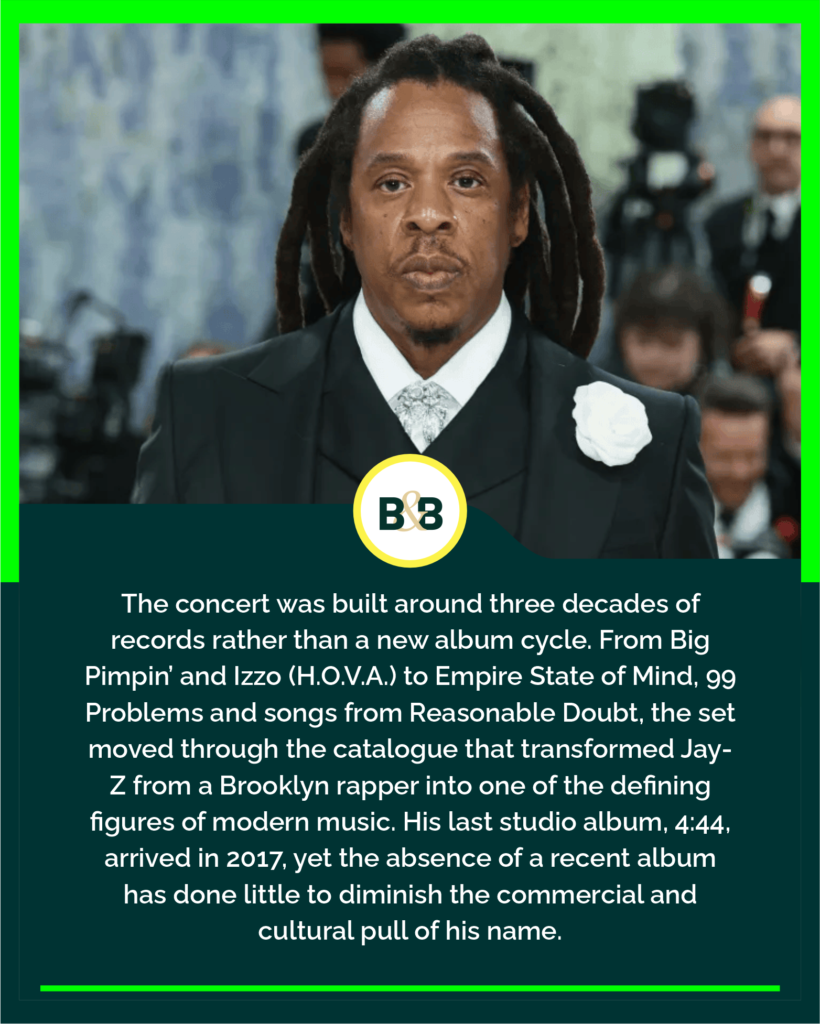
The concert was built around three decades of records rather than a new album cycle. From Big Pimpin’ and Izzo (H.O.V.A.) to Empire State of Mind, 99 Problems and songs from Reasonable Doubt, the set moved through the catalogue that transformed Jay-Z from a Brooklyn rapper into one of the defining figures of modern music. His last studio album, 4:44, arrived in 2017, yet the absence of a recent album has done little to diminish the commercial and cultural pull of his name. The Paris crowd was evidence that his music has accumulated something more durable than recency: memory.
Then came the guests. Pharrell Williams joined Jay-Z on stage, bringing their long history of collaborations into the room, while Justin Timberlake appeared for a rare live performance of Holy Grail, their 2013 collaboration. The Timberlake moment was particularly fitting for an anniversary built around Jay-Z’s ability to connect different generations and corners of pop culture. The concert was less a museum of old hits than a reminder of how many contemporary artists, sounds and careers have intersected with his own.
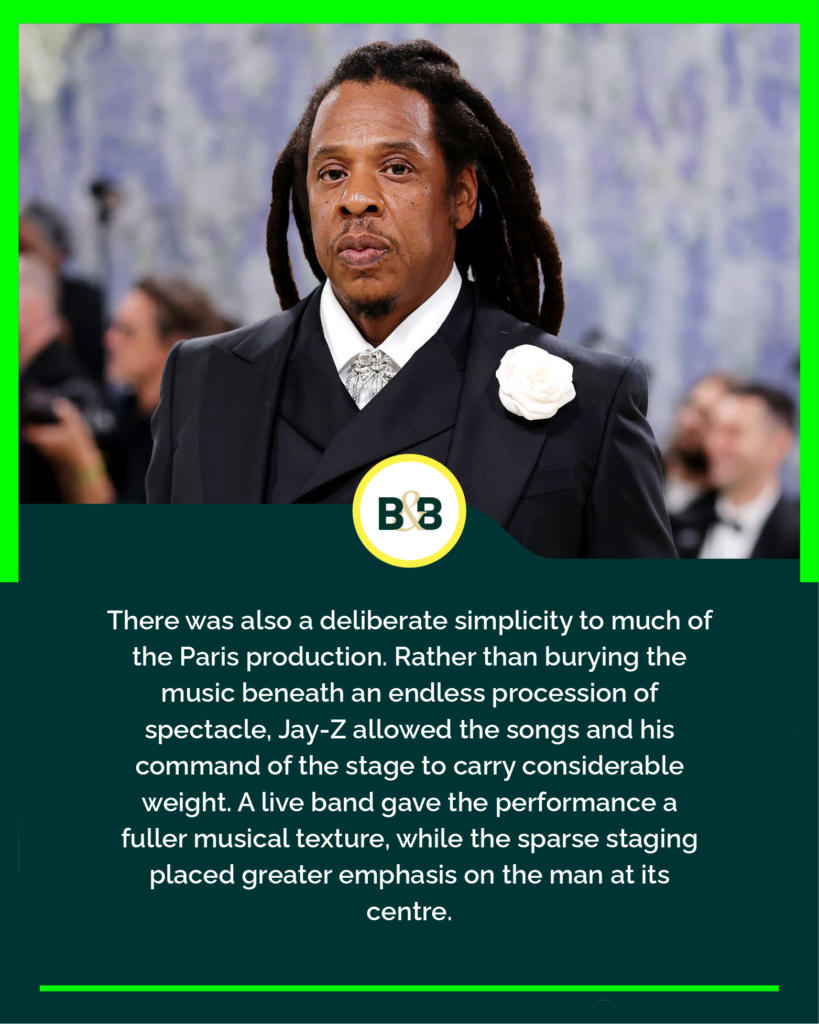
There was also a deliberate simplicity to much of the Paris production. Rather than burying the music beneath an endless procession of spectacle, Jay-Z allowed the songs and his command of the stage to carry considerable weight. A live band gave the performance a fuller musical texture, while the sparse staging placed greater emphasis on the man at its centre. Even after three decades, his appeal remains rooted in the same quality that made his earliest records so compelling: the ability to turn personal history, ambition, street economics and social observation into language people remember.
The symbolism of Paris was difficult to miss. Jay-Z has performed at the Stade de France before, but returning in 2026 as an artist celebrating three decades in the business carries a different significance. The venue has hosted some of the biggest names in global entertainment, including Beyoncé, Coldplay, The Weeknd and Bruno Mars. Jay-Z’s place on that stage reflects the international reach of hip-hop itself, a culture that began as a local expression in New York and became one of the world’s most powerful cultural exports.
What makes the JAŸ-Z 30 run particularly compelling is the distance between the artist’s present position and the world that existed when Reasonable Doubt arrived in 1996. Jay-Z has since become a businessman, investor, entrepreneur and cultural power broker whose influence extends far beyond recorded music. Yet the Paris performance made a useful distinction: the business empire may have expanded the Jay-Z story, but the music remains its foundation. The songs still work when the lights go down, the guest lists disappear and thousands of people know exactly what comes next.
At the Stade de France, Jay-Z was therefore celebrating more than an anniversary. He was measuring the extraordinary longevity of a body of work against time itself. Three decades after his debut, the records still command stadiums, the collaborations still generate surprise and the artist still possesses the rare authority to make an audience wait for the next line. Paris became another chapter in a career that has repeatedly crossed the boundaries between music, business and culture. For Jay-Z, 30 years of hits is no longer a retrospective. It is evidence of how long an idea can live when the world keeps finding new reasons to listen.