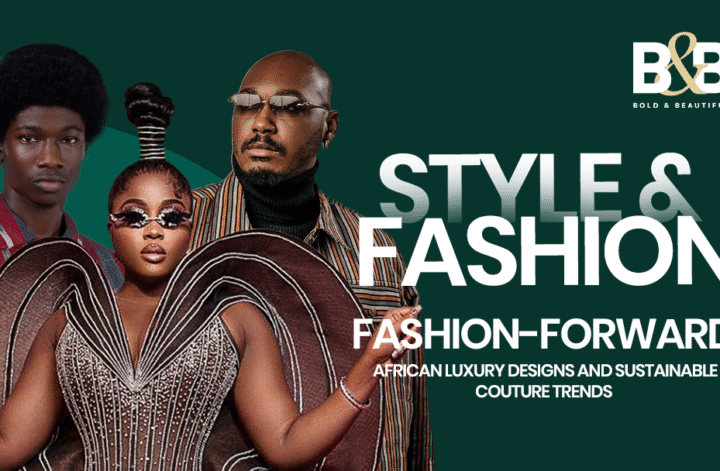

African fashion has moved beyond the question of whether the world is paying attention. The more important question now is who will capture the value.
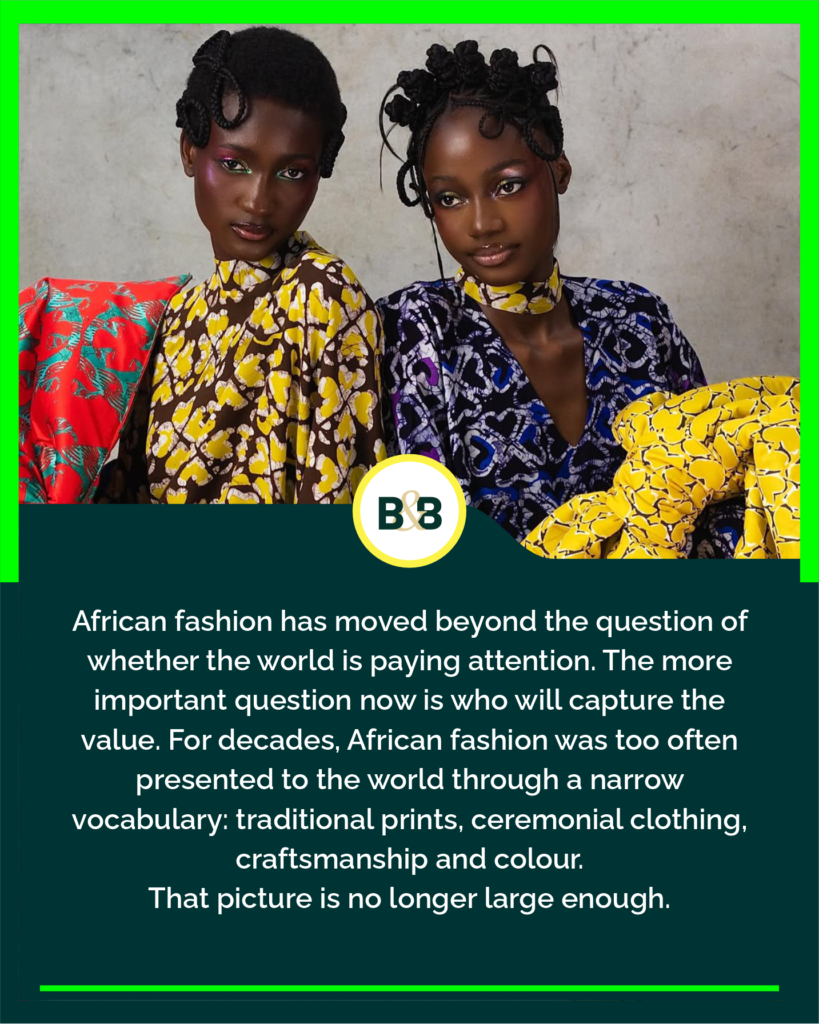
For decades, African fashion was too often presented to the world through a narrow vocabulary: traditional prints, ceremonial clothing, craftsmanship and colour.
That picture is no longer large enough.
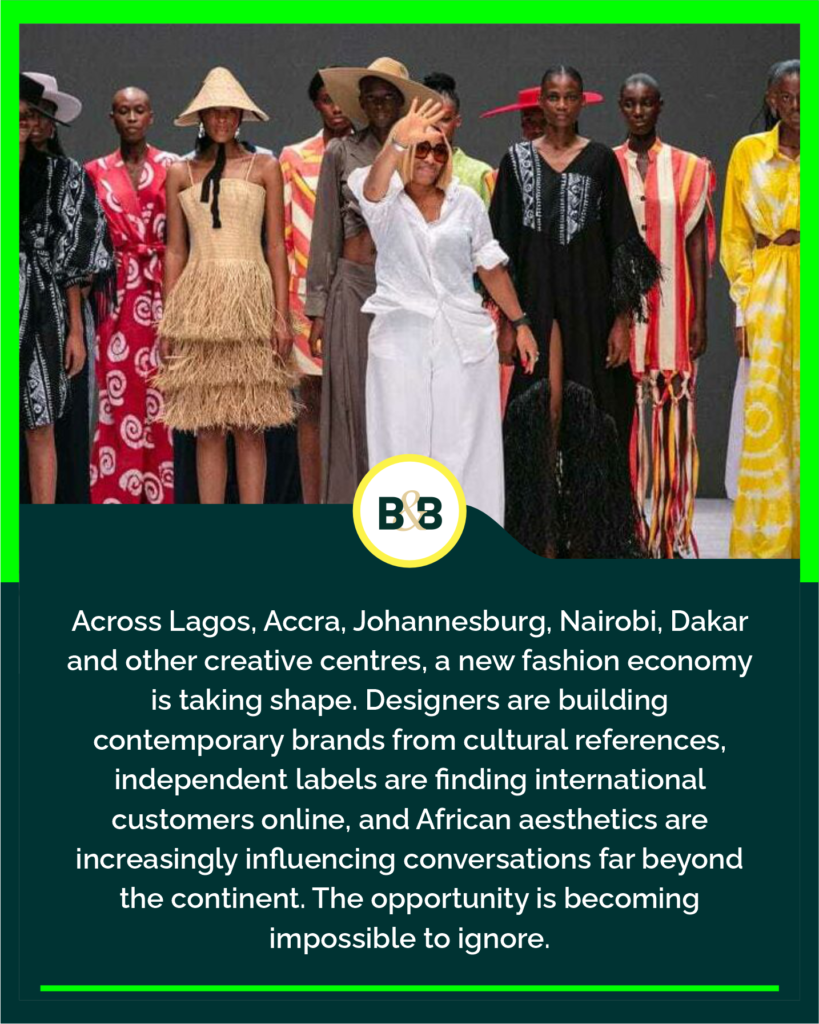
Across Lagos, Accra, Johannesburg, Nairobi, Dakar and other creative centres, a new fashion economy is taking shape. Designers are building contemporary brands from cultural references, independent labels are finding international customers online, and African aesthetics are increasingly influencing conversations far beyond the continent.
The opportunity is becoming impossible to ignore.
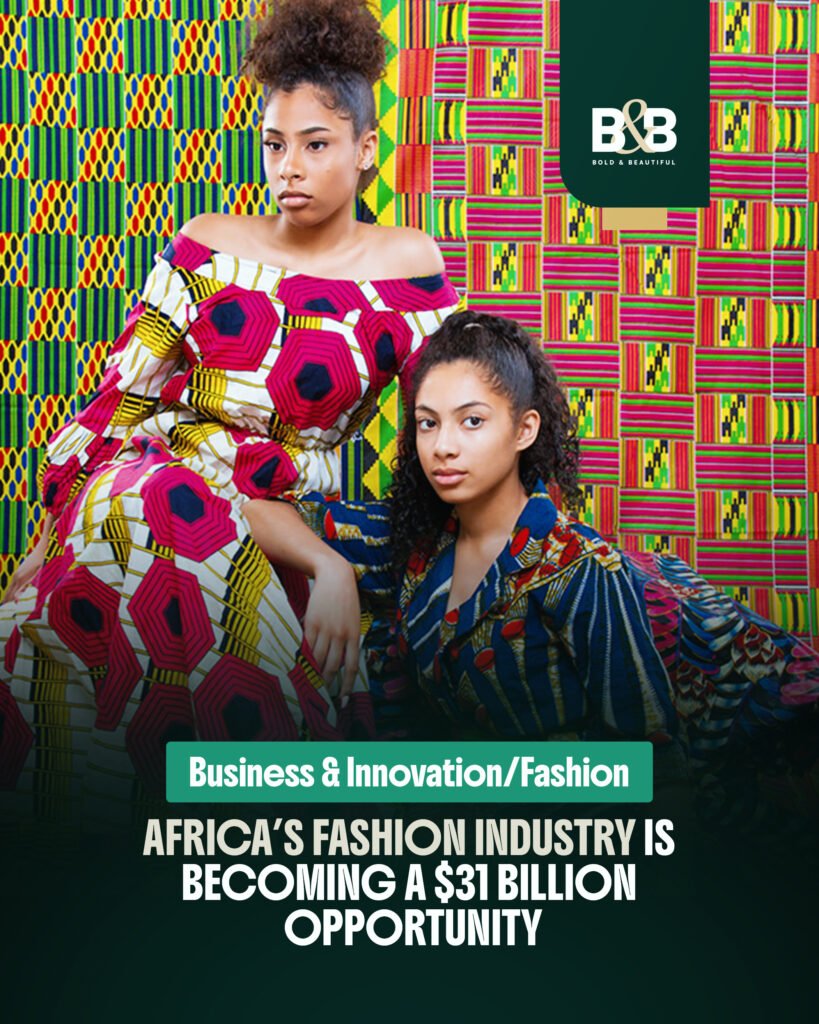
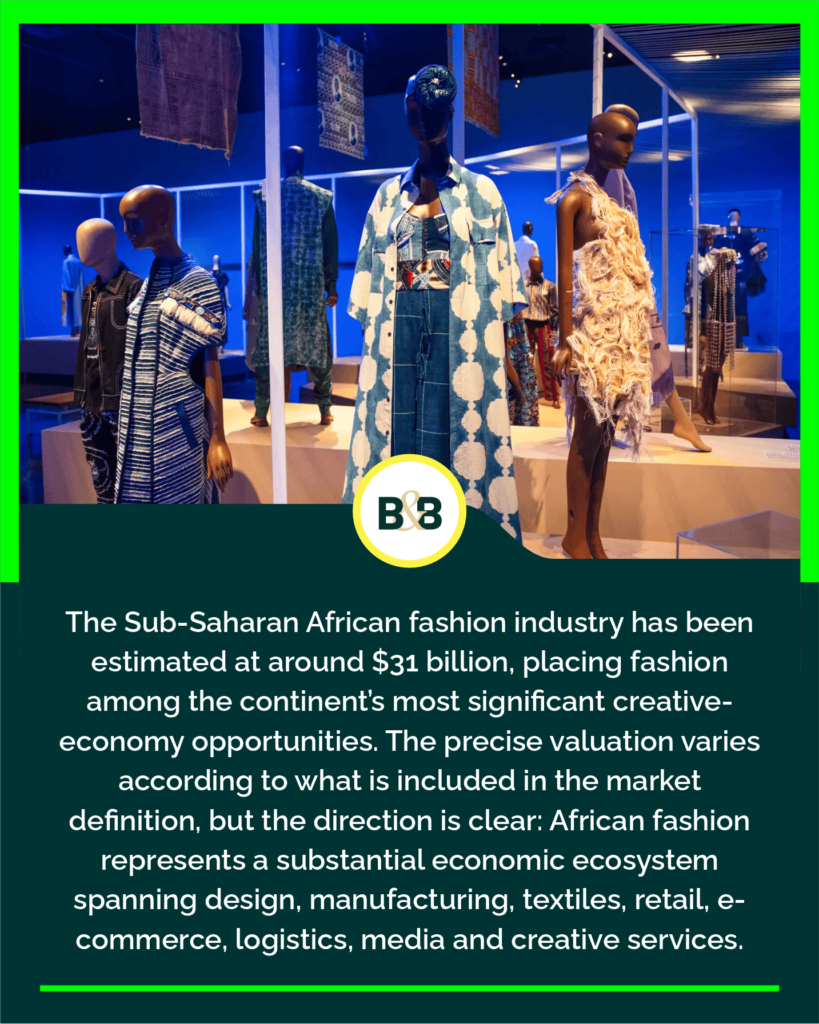
The Sub-Saharan African fashion industry has been estimated at around $31 billion, placing fashion among the continent’s most significant creative-economy opportunities. The precise valuation varies according to what is included in the market definition, but the direction is clear: African fashion represents a substantial economic ecosystem spanning design, manufacturing, textiles, retail, e-commerce, logistics, media and creative services.
And the most interesting part may be what happens next.
From Cultural Expression to Economic Power
African fashion has always been about more than clothes.
It carries history, status, identity, craftsmanship and belonging. A fabric can communicate where someone comes from. A silhouette can preserve a tradition. A contemporary designer can take an inherited technique and give it a completely different life.
What is changing is the commercial infrastructure surrounding that creativity.
The global fashion conversation is increasingly making room for African designers and brands whose work does not depend on reproducing Western aesthetics. Academic research published in 2025 noted the growing international attention around contemporary African fashion, highlighting creative activity in cities including Lagos, Accra, Nairobi, Marrakesh and Johannesburg. (Taylor & Francis Online)
The shift matters because cultural recognition can become economic value when the ecosystem is strong enough to capture it.
That means the designer matters.
So does the manufacturer.
So does the photographer, stylist, model, pattern cutter, textile producer, retailer, logistics company, digital platform and creative director.
Fashion is an industry precisely because an entire network makes the finished garment possible.
The Internet Has Changed the Geography of African Fashion
For an emerging African designer, geography once represented a formidable barrier.
International buyers had to discover the brand. Distribution had to be established. Payments had to cross borders. Shipping was expensive. Physical retail required capital.
Digital commerce has begun to redraw that map.
African fashion businesses can now build audiences internationally before they ever establish a traditional retail footprint. Social media can introduce a Lagos label to London. An Accra designer can attract customers in New York. A Nairobi brand can build a community far beyond Kenya.
The opportunity is particularly significant because African e-commerce is expanding, although infrastructure, payments, logistics and differences in digital access remain serious challenges. Research into African e-commerce has identified clear economic opportunities while also pointing to substantial disparities between markets.
The technology, therefore, is not the whole solution.
The infrastructure around it matters just as much.
The World Is Buying the Story
There is another reason African fashion has become increasingly influential: consumers are not purchasing aesthetics alone.
They are buying stories.
The appeal of contemporary African fashion often lies in the relationship between heritage and modernity. Designers are taking traditional materials, techniques, references and silhouettes and placing them within contemporary wardrobes.
That tension creates something valuable.
It gives the product a point of view.
And fashion without a point of view is easily replaced.
The strongest African brands understand that cultural identity is not a limitation on global appeal. It can be the source of it.
The international rise of African fashion has already been visible through designers, celebrity endorsements, global collaborations and major fashion platforms. Recent reporting has highlighted how African designers are increasingly moving from regional recognition into international fashion conversations. (The Guardian)
But $31 Billion Does Not Mean $31 Billion in African Pockets
This is where the conversation needs greater honesty.
A large market does not automatically create prosperity for the people producing the creativity.
African designers continue to face challenges involving manufacturing capacity, access to capital, infrastructure, logistics, intellectual property protection and international distribution. UNESCO has similarly identified inadequate investment as a major constraint on the continent’s fashion industry, despite its significant potential to create employment and empower young people and women. (AP News)
The uncomfortable question is therefore not simply:
How large can African fashion become?
It is:
How much of the value created by African fashion will remain within African economies?
That is the real opportunity.
If African countries remain primarily consumers of imported fashion while exporting raw materials, creative talent and cultural inspiration, the economic transformation will remain incomplete.
The bigger ambition is to build the factories, textile industries, distribution networks, financing systems and digital platforms capable of keeping more of the value chain on the continent.
The Next Fashion Billionaires May Not Be Designers
This is where the story becomes particularly interesting for investors.
The obvious opportunities sit in fashion labels.
The less obvious opportunities sit underneath them.
Textile manufacturing.
Garment production.
Fashion technology.
E-commerce.
Warehousing.
Cross-border payments.
Logistics.
Creative education.
Sustainable materials.
Retail infrastructure.
Data.
These businesses may ultimately prove just as important as the labels appearing on international runways.
Global fashion itself is undergoing a structural shift, with brands confronting changing consumer behaviour, disrupted supply chains and increasing pressure to create more efficient routes to customers. McKinsey’s recent fashion research also points to technology-enabled discovery and more sophisticated e-commerce experiences as important areas of opportunity. (McKinsey & Company)
Africa enters this transformation with a young population, powerful cultural capital and an expanding generation of digitally connected consumers.
That combination deserves serious attention.
The Real Runway Is Economic
African fashion does not need another declaration that it is “the next big thing”.
It needs capital.
It needs infrastructure.
It needs stronger manufacturing.
It needs intellectual property protection.
It needs fashion schools connected to industry.
It needs retailers willing to take African brands seriously.
It needs African consumers to believe that buying local can mean buying exceptional.
And it needs international partners prepared to invest without reducing African creativity to a trend.
The $31 billion conversation is therefore bigger than fashion.
It is a conversation about who owns African creativity once that creativity becomes commercially valuable.
The continent has never lacked ideas.
What it needs now is the machinery to turn those ideas into durable businesses.
Because African fashion has already proved that it can command attention.
The next chapter is proving that it can command value.