

The most successful global artists often spend years trying to protect a formula that works. DJ Snake has built his career by doing the opposite. From Parisian clubs to some of the world’s largest festival stages, the French-Algerian producer has consistently followed unfamiliar paths, collaborating across genres, cultures and continents long before the music industry began celebrating borderless creativity. More than a decade after breaking into the global mainstream, curiosity remains the principle shaping his next move.
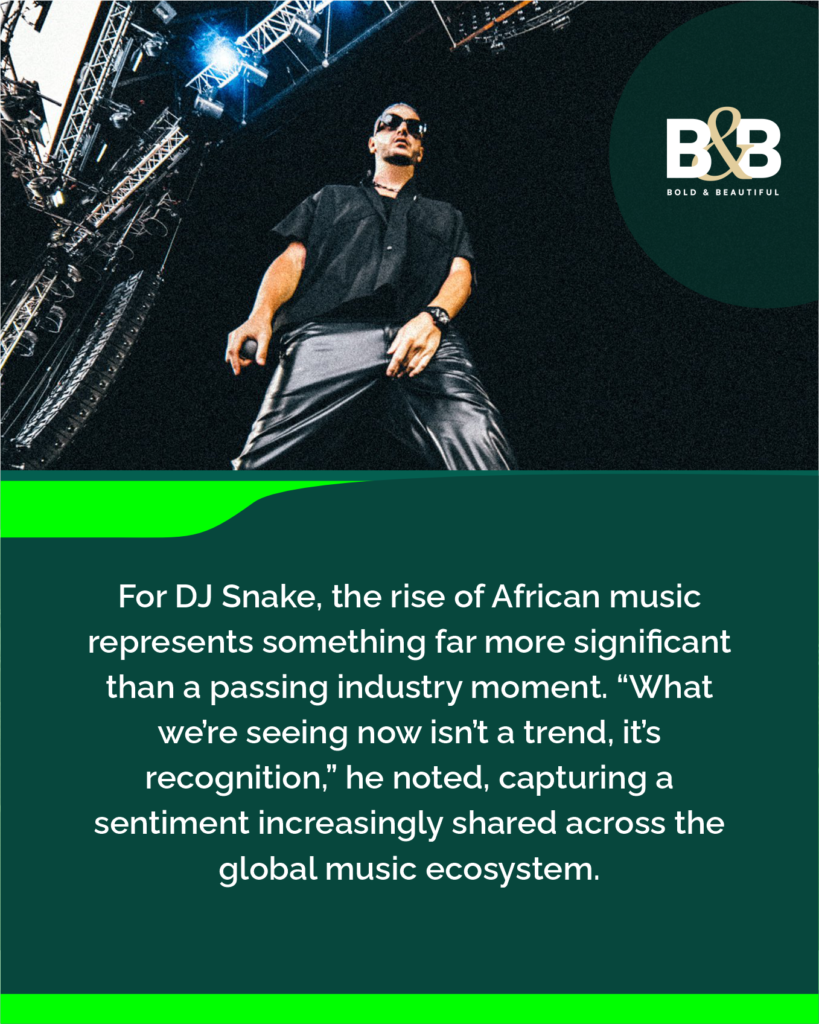
That mindset was evident in his recent conversation with Billboard Africa, where he reflected on music’s shifting geography and the growing influence of African artists on the international stage. For DJ Snake, the rise of African music represents something far more significant than a passing industry moment. “What we’re seeing now isn’t a trend, it’s recognition,” he noted, capturing a sentiment increasingly shared across the global music ecosystem. African artists are no longer being introduced to international audiences. They are actively shaping global culture, influencing sounds, aesthetics and conversations at the highest level.

His connection to the continent has moved beyond observation. During Ultra South Africa, DJ Snake used his platform to spotlight Zimbabwean artist Bantu, bringing him onstage in Johannesburg in a moment that reflected his longstanding interest in discovering and amplifying emerging talent. It was a gesture consistent with a career defined by collaboration rather than hierarchy. Whether working with artists from Latin America, the Middle East, Europe or Africa, DJ Snake has repeatedly demonstrated a willingness to engage with local cultures as creative partners rather than distant inspirations.

That approach has helped sustain a career that continues to evolve despite the industry’s rapid changes. While many producers become associated with a single sound or era, DJ Snake has remained remarkably adaptable. His catalogue moves comfortably between electronic music, hip-hop, pop, Afro-influenced rhythms and global dance records.
The forthcoming chapter of Nomad appears set to continue that tradition, reflecting an artist whose creative identity is built around exploration rather than repetition.
What makes DJ Snake’s journey particularly relevant today is the lesson embedded within it. At a time when algorithms increasingly reward familiarity, he continues to pursue the unknown. The willingness to remain curious, to engage with new sounds and new communities, has become one of his most valuable creative assets.
As African music commands greater international attention and cultural influence, artists like DJ Snake are helping create meaningful exchanges rather than superficial connections. The result is a career that remains globally relevant because it has never stopped learning from the world around it.