
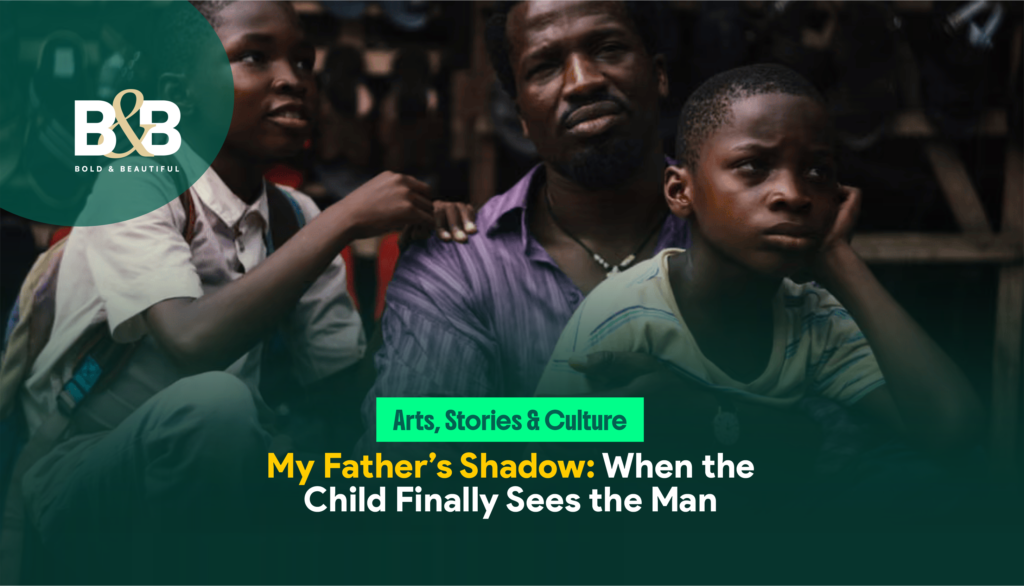
Half melancholic, half haunting, wholly human and it has a Shadow too.
(Caveat: I have tried as much as possible to keep this largely spoiler-free, especially around the film’s more important turns and revelations. But because I’m talking about the story, some context is unavoidable)
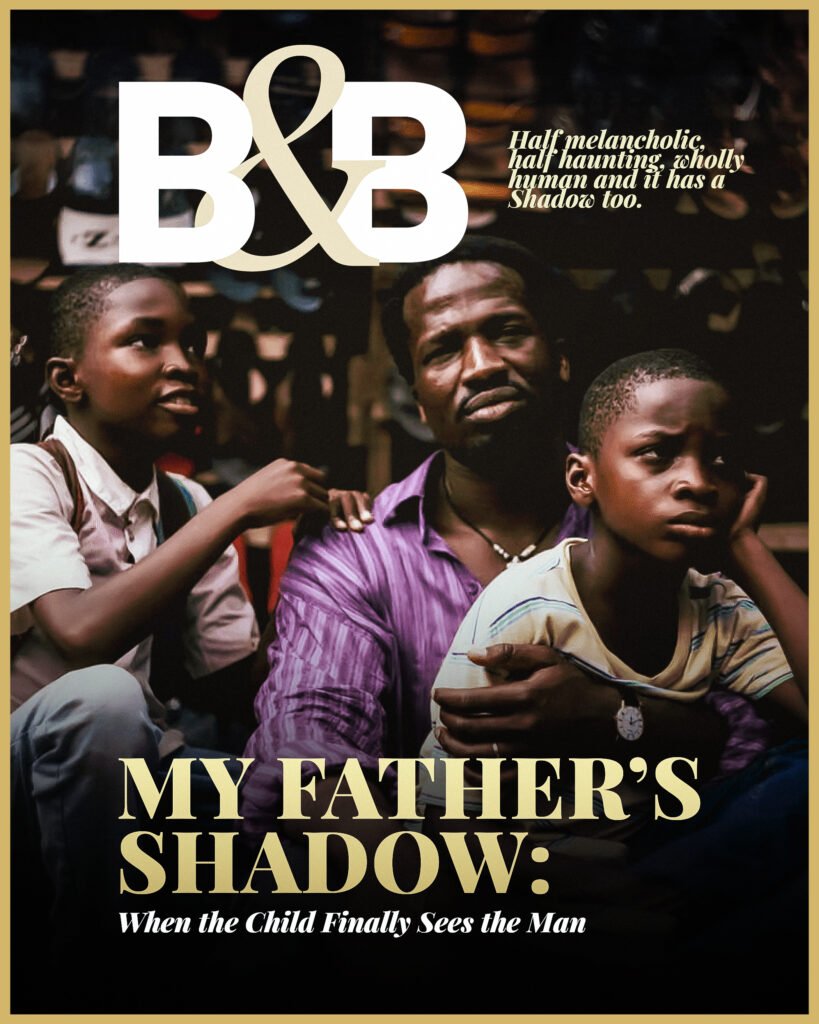
Akinola Davies Jr.’s My Father’s Shadow (2025) is the kind of film that does not announce what it is doing. Just takes you by the hand and walks you into it.
It is an intimate, beautifully observed arthouse film, but what stayed with me most was the way it develops its characters without relying on the usual machinery of character development. There is no grand transformation, no dramatic backstory, no convenient speech explaining who these people are.
Instead, Davies Jr. gives us one day.
One road trip. One father and his two sons.
And, slowly, almost without us noticing, the film takes apart the image of the father the boys have carried in their heads.
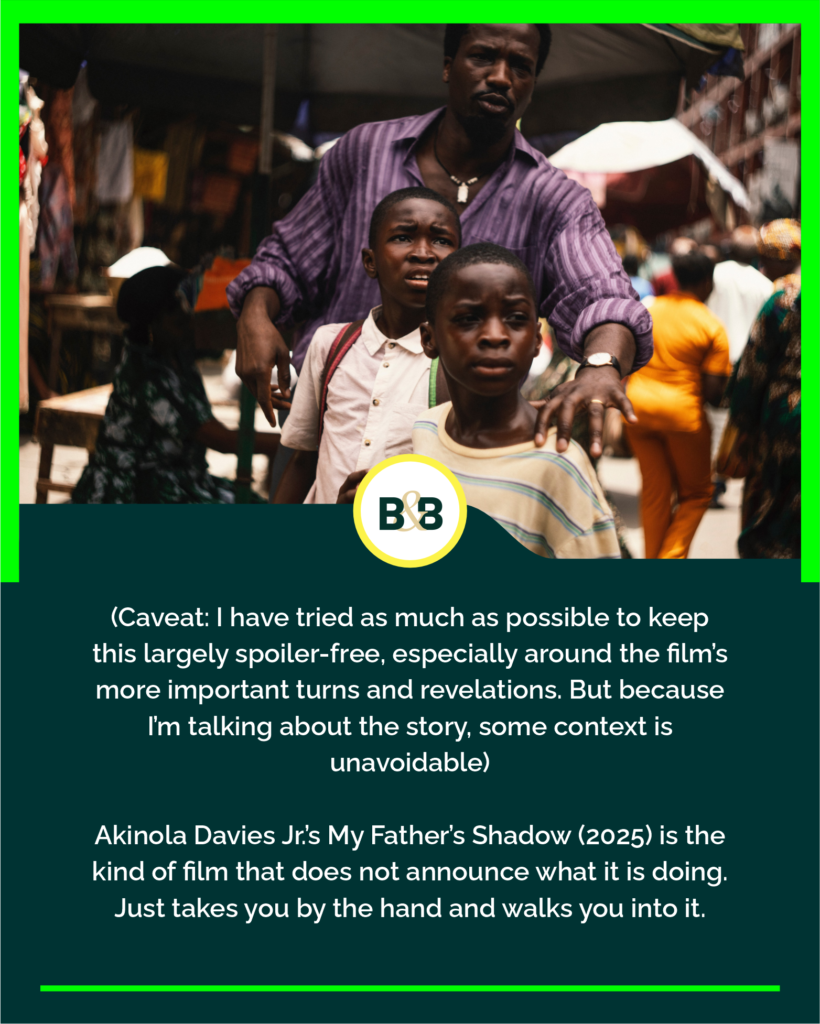
The central idea is simple and painfully human: at some point, every child has to discover that their parents are not the larger-than-life people childhood made them out to be. They are people. Fragile people. Complicated people. People who were once young and confused themselves, who made mistakes, lost things, wanted things, failed at things and sometimes had no idea what they were doing.
The journey from rural Nigeria into a politically tense Lagos becomes the journey from childhood mythology into uncomfortable reality.
And that is where My Father’s Shadow really got me and got to me.
The Inciting Incident and Character Setup
The Status Quo: Young brothers Akin and Remi live a quiet, unhurried life in the countryside. Their father, Folarin (Ṣọpẹ́ Dìrísù), has largely been a distant figure, away in Lagos and therefore existing in their minds almost more as an idea than a person.
To his sons, their father is Dad, but he is also something bigger.
A provider.
A grown man who knows things.
Someone who belongs to that mysterious adult world children don’t fully understand.
In other words, a myth.
The Inciting Incident: Then Folarin suddenly returns and tells the boys they are going with him to Lagos to collect money someone owes him.
And just like that, their little world changes.
What initially feels like an adventure becomes something else entirely. The boys are pulled out of the safety and familiarity of home and into their father’s world, where they begin to see things they were never supposed to see from the distance of childhood.
The Episodic Journey: Deconstructing the Myth
Because almost everything happens within a single day, My Father’s Shadow does not have to spend hours explaining its characters to us.
The road does the work.
Every stop reveals something.
Every encounter removes another layer.
And as Folarin and the boys move deeper into Lagos, the image of the father begins to change.
Phase 1: The Broken Bus (The Cracks in the Shadow)
The Development: Early in the journey, their bus breaks down amid the fuel shortage and growing political crisis surrounding the 1993 election. They have no choice but to find another way forward.

The Thematic Reveal: It is a small moment, but it matters.
For the boys, this is perhaps the first time their father looks less than all-powerful.
Dad cannot fix the bus.
Dad cannot fix the fuel crisis.
Dad cannot control what is happening around them.
There is something almost cruel about the timing. The country is beginning to fall apart around them, and the boys are beginning to discover that their father cannot hold the world together either.
That is one of the quiet things I love about the film: the political crisis is never merely background noise. The country outside and the family inside are slowly revealing the same thing.
Everything is more fragile than it looks.
Phase 2: The Metropolis and the Motorbikes (The Chaos of Reality)
The Development: When they eventually reach the city, the boys ride on motorbikes and begin moving through Folarin’s Lagos.
And this is where the mythology really starts to crack.
The Thematic Reveal: Akin and Remi watch their father deal with friends, acquaintances and business associates.
But they are no longer simply watching their father.
They are watching a man.
A man trying to get money.
A man asking.
A man negotiating.
A man hustling.
A man who does not have everything figured out.
That distinction is everything.
There is something almost heartbreaking about watching children discover that the person they thought had all the answers is also just trying to survive.
The provider becomes a hustler.
The authority figure becomes vulnerable.
The man they imagined as completely self-sufficient suddenly needs other people.
And perhaps this is one of the hardest things about growing up: discovering that your parents were improvising too.
Phase 3: The Abandoned Fairground (The Ghosts of the Past)
The Development: At some point, Folarin takes his sons to an abandoned amusement park, a place that feels almost frozen in time.
The Thematic Reveal: This might be the film’s most quietly beautiful metaphor.
The amusement park is dead.
The rides are rusting.
Whatever excitement once lived there has disappeared.
And Folarin’s reaction to the place tells us more about him than any exposition could.
For a moment, he is not the father trying to provide for his children. He is simply a man standing in front of the ruins of something.
A dream, perhaps.
A version of himself.
A life that did not quite happen.
The boys see something in him they have probably never had reason to look for before: regret.
And I think this is where the film becomes bigger than a story about children discovering their father’s flaws.
They are also discovering that adults have ghosts.
That people carry abandoned versions of themselves.
That sometimes the person standing in front of you is carrying the weight of everything they once hoped they would become.
Phase 4: The Bar and the Results (The Broken Man)
The Development: Eventually, the three find themselves in a city bar, surrounded by people anxiously waiting for the military regime’s election results.
Outside, Nigeria is holding its breath.
Inside, Folarin’s carefully constructed image is coming apart.
Pieces of his private life begin to surface, including hints of trauma and infidelity.
The Thematic Reveal: This is where the film’s two stories almost become one.
The country is politically unstable.
The family is emotionally unstable.
Everyone is waiting to find out what happens next.
And Folarin, who had seemed so large in the eyes of his children at the beginning of the day, is suddenly just a broken man sitting in a bar.
Not a monster.
Not a hero.
Not the perfect father.
Just a man with his own failures, wounds, desires and contradictions.
The shadow has changed.
At the beginning, it belonged to a larger-than-life father.
By the end, it belongs to an ordinary human being.
And there is something deeply painful about watching a child make that discovery in real time.
The Final Circle: Stepping Out of the Shadow
By the time the day comes to an end, the family has travelled much further than the physical distance between the countryside and Lagos.
The Initial Mindset: At the beginning of the day, Akin and Remi look at their father with the uncomplicated awe children often have for their parents.
He is provider.
Protector.
Authority.
Almost untouchable.
The Final Mindset: By nightfall, they have seen the other side.
His financial desperation.
His vulnerability.
His mistakes.
His secrets.
His inability to protect them from a world that is itself falling apart.
The film does not turn this discovery into hatred.
It does not tell us that seeing someone’s flaws should make us love them less.
If anything, the opposite happens.
The boys’ awe gives way to something more mature.
Something quieter.
Something more human.
They have stopped seeing their father as a god, but perhaps that is precisely when they can begin to see him properly.
As a man.
A flawed man.
A wounded man.
A man trying, sometimes badly, to navigate a country and a life that are both asking more of him than he knows how to give.
-What it really means to step out of someone’s shadow.
It is not to reject them.
It is to finally see them.
It understands that growing up is not simply discovering that your parents are flawed. It is discovering that they were human all along.
And perhaps, somewhere along the way, you become human enough to forgive them for not being the people you once imagined them to be.
The Film Has a Shadow Too!
Here is where I found myself having a slightly complicated relationship with My Father’s Shadow.
Perhaps, unintentionally, the film becomes a reflection of its own title.
There is something haunting about it, but sometimes it feels less like a fully realised film and more like a shadow of the film it could have been.
The ingredients are all there.
There is so much sitting inside this story.
Maybe too much.
And yet, for me, the film occasionally feels like it is standing at the edge of something much bigger without quite stepping into it.
I kept waiting for certain emotional beats to go further. For some revelations to hurt more. For certain relationships to become more complicated. For the political atmosphere to collide more violently with the personal story. For the father to become even more unknowable before becoming human again.
Instead, the film often chooses restraint.
And restraint can be beautiful. In fact, it is one of the reasons the film feels so intimate. But there were moments when I wondered whether the restraint was serving the story or simply keeping the story at a distance.
That is the strange thing about My Father’s Shadow: I could see exactly what it was reaching for, and I admired the reach, but I was not always convinced by the distance it maintained.
It is almost as though the film itself is living under a shadow.
A shadow cast by its enormous potential.
The kind of potential you can feel in the room even when it isn’t fully materialised on screen.
There are films that leave you thinking, I wish this had been shorter.
This one occasionally left me thinking, I wish this had gone further.
And perhaps that is partly because the film gives you just enough to imagine the larger, messier, more emotionally devastating story that might have existed underneath it.
That doesn’t make My Father’s Shadow a failure. Far from it.
If anything, it makes the experience more interesting for me. Because I would rather watch a film that leaves me wondering about what it could have become than one that gives me everything and leaves nothing to think about.
But potential is also a funny thing.
At some point, potential has to become the thing itself.
And for all the beauty, intelligence and tenderness in My Father’s Shadow, I sometimes felt I was watching the shadow of something extraordinary rather than the extraordinary thing itself.
Perhaps that is the most ironic thing about the film.
A film about children discovering the distance between the person they imagined and the person standing in front of them may itself leave the audience confronting the distance between the film we imagined and the film we actually got.