
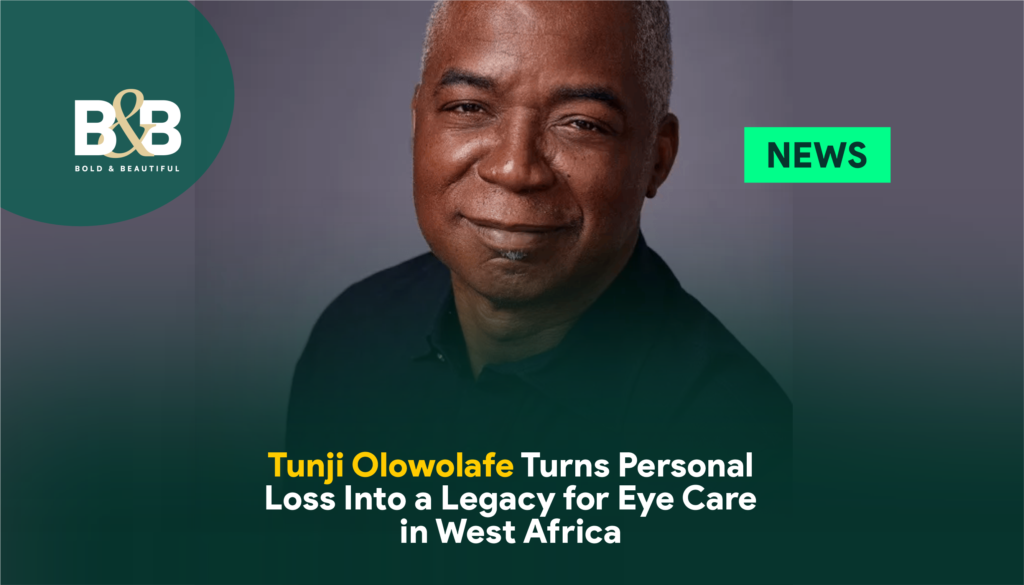
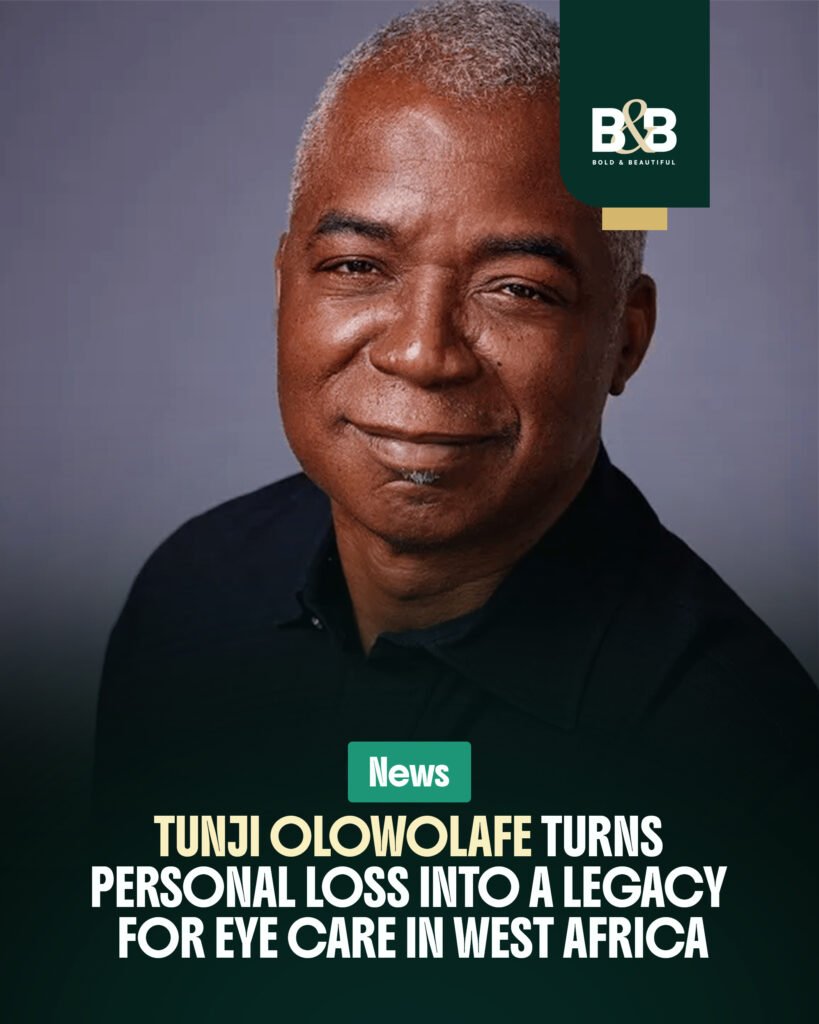
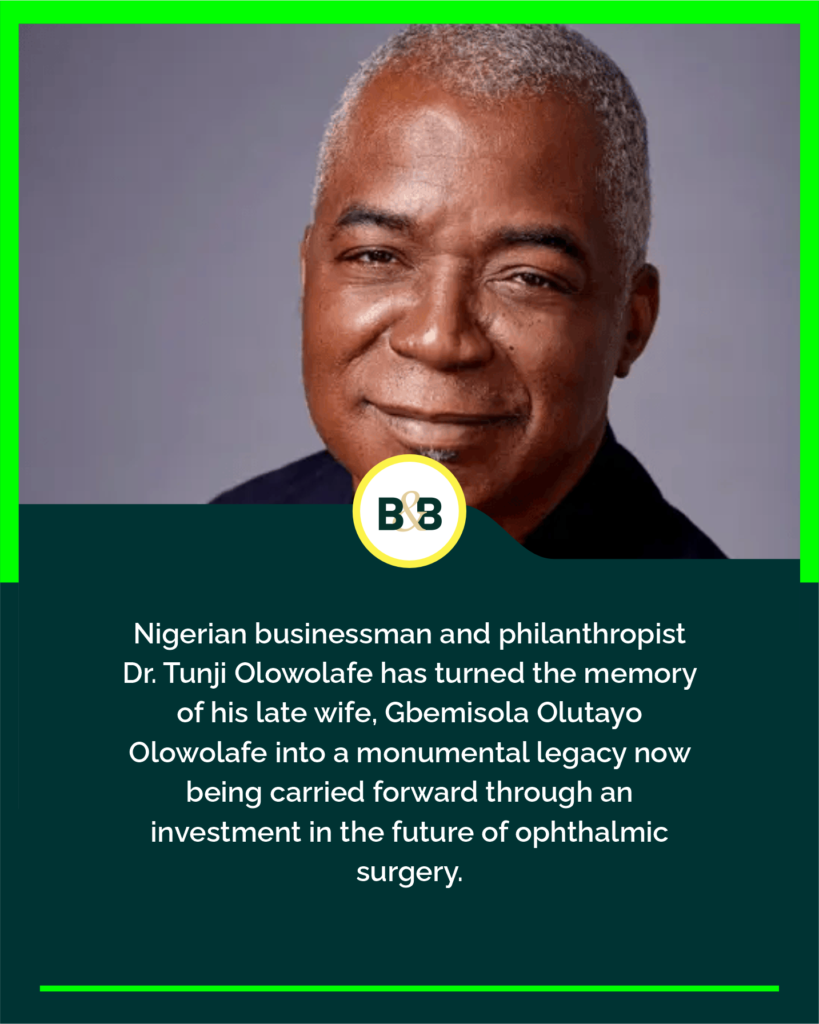
Nigerian businessman and philanthropist Dr. Tunji Olowolafe has turned the memory of his late wife, Gbemisola Olutayo Olowolafe into a monumental legacy now being carried forward through an investment in the future of ophthalmic surgery.
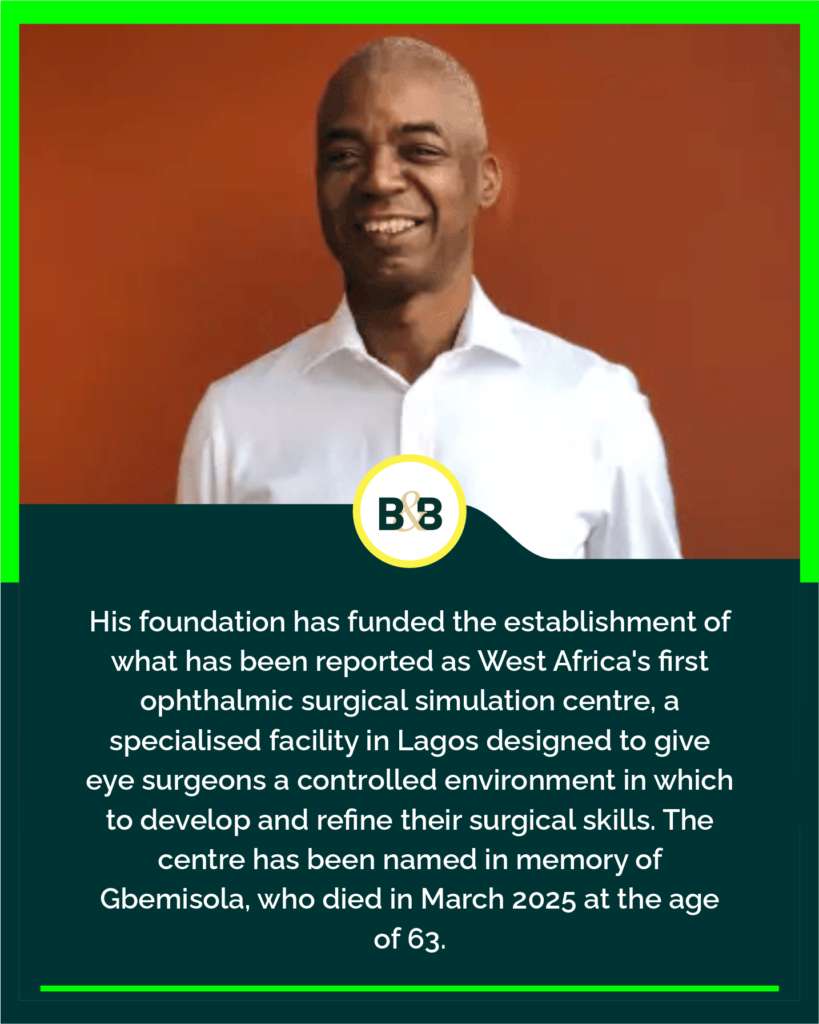
His foundation has funded the establishment of what has been reported as West Africa’s first ophthalmic surgical simulation centre, a specialised facility in Lagos designed to give eye surgeons a controlled environment in which to develop and refine their surgical skills. The centre has been named in memory of Gbemisola, who died in March 2025 at the age of 63. (Billionaires.Africa)
It is a striking way to remember someone.
Rather than allowing grief to remain only a private experience, Olowolafe has attached it to something with the potential to serve people he may never meet.
A Memorial Built Around Medicine
The significance of the project becomes clearer against Olowolafe’s own background.
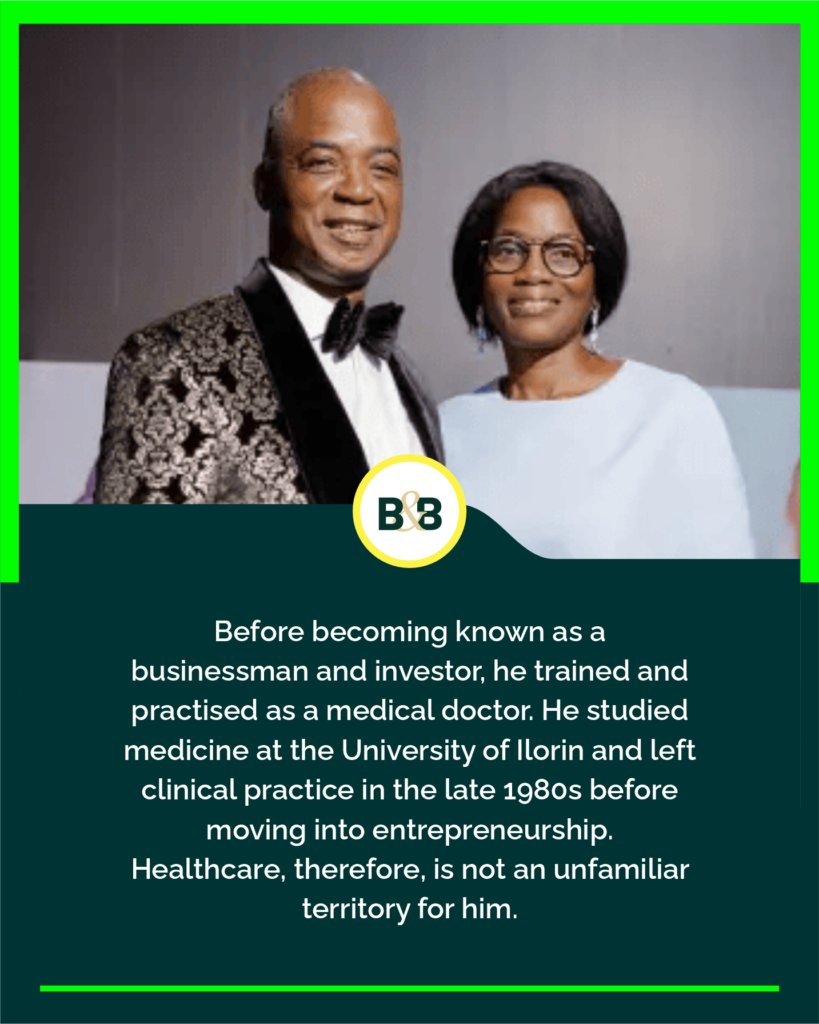
Before becoming known as a businessman and investor, he trained and practised as a medical doctor. He studied medicine at the University of Ilorin and left clinical practice in the late 1980s before moving into entrepreneurship. (Tunji Olowolafe)
Healthcare, therefore, is not an unfamiliar territory for him.
The new simulation facility brings that earlier professional world into his philanthropic work, creating a bridge between medicine, technology, training and public impact.
For ophthalmology, simulation can be particularly valuable. Surgical training requires precision, repetition and confidence, yet opportunities to practise complex procedures in real clinical settings are naturally limited. A simulation environment allows practitioners and trainees to develop technical skills without placing patients at risk during the learning process.
That makes the investment about more than equipment.
It is an investment in how the next generation of surgeons learns.
Remembering Gbemisola
The personal story behind the centre gives the project another dimension.
Gbemisola Olowolafe was remembered by her family as a woman whose life was defined by faith, generosity, service and concern for others. Following her death on 11 March 2025, tributes described her as a devoted wife, mother and grandmother whose influence extended beyond her immediate family. (The Guardian Nigeria)
Her legacy has since been reflected in several initiatives.
In March 2026, the Tunji Olowolafe Foundation announced a ₦1 billion commitment to sponsor 1,000 Nigerian students at Miva Open University over five years, an initiative created in her memory and inspired by her belief in education as a tool for expanding opportunity. (News Agency of Nigeria)
The eye-surgery simulation centre follows the same philosophy, but in a different field.
Education becomes clinical training.
Memory becomes infrastructure.
And philanthropy becomes an investment in people who will eventually serve others.
Why Surgical Simulation Matters
The importance of a facility like this extends beyond its walls.
A surgeon’s skill is built through knowledge, observation and practice. Simulation adds another layer by allowing practitioners to rehearse procedures, develop hand-eye coordination and become familiar with surgical techniques in an environment specifically designed for learning.
For a region working to strengthen specialist healthcare capacity, that matters.
Africa’s healthcare challenge is not simply about constructing hospitals or purchasing medical equipment. It is also about developing the skilled professionals capable of using sophisticated technology and delivering specialised care.
Training infrastructure is therefore part of healthcare infrastructure.
That is the larger significance of Olowolafe’s investment.
From Philanthropy to Capacity Building
There is an important distinction between giving money to solve an immediate problem and investing in the people who will continue solving problems long after the donation has been made.
The latter takes patience.
A surgical simulator does not perform an operation. A scholarship does not graduate a student. A training centre does not become a surgeon.
People do.
The value of these investments lies in what they enable people to become.
That approach is increasingly relevant to African philanthropy, where conversations around impact are moving beyond traditional charitable giving towards education, healthcare capacity, technology, research and institutions that can continue creating value.
Olowolafe’s recent philanthropic initiatives fit within that broader shift.
The Gbemisola Olowolafe Miva Scholarship is designed to remove financial barriers to university education, while the ophthalmic simulation centre addresses a different part of the development equation: specialist professional training. (News Agency of Nigeria)
Together, they point towards a model of legacy built around access, knowledge and capacity.
A Different Definition of Legacy
There is something quietly powerful about the choice of name.
Every surgeon who trains at the centre will know that it carries the name of a woman whose life ended before she could see the institution completed.
Every skill developed there has the possibility of reaching a patient somewhere in West Africa.
Every successful procedure performed by someone who trained there may become part of a chain that leads back, eventually, to the decision to build the facility.
That is how memory can travel.
Not simply through photographs or anniversaries, but through the lives changed by what someone chooses to leave behind.
The loss of his wife has clearly not erased the desire to build. It has given that desire another purpose. And perhaps that is the most meaningful form of remembrance: to turn what you miss into something that helps someone else live better.