
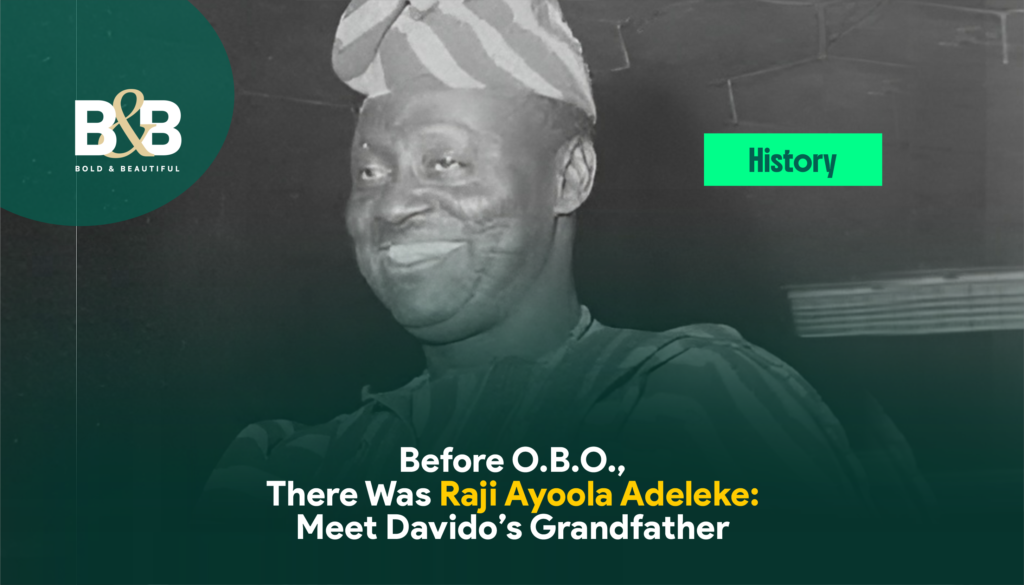
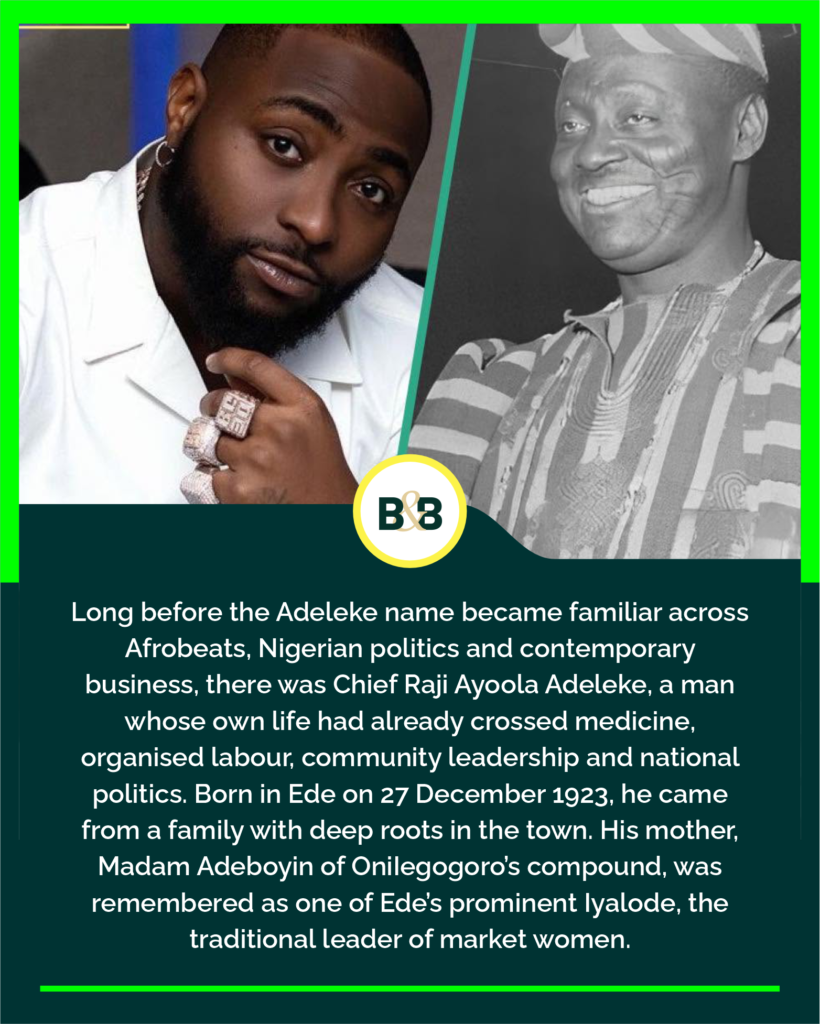
Long before the Adeleke name became familiar across Afrobeats, Nigerian politics and contemporary business, there was Chief Raji Ayoola Adeleke, a man whose own life had already crossed medicine, organised labour, community leadership and national politics. Born in Ede on 27 December 1923, he came from a family with deep roots in the town. His mother, Madam Adeboyin of OniIegogoro’s compound, was remembered as one of Ede’s prominent Iyalode, the traditional leader of market women. The family’s public story, therefore, did not begin with fame. It began with community standing.
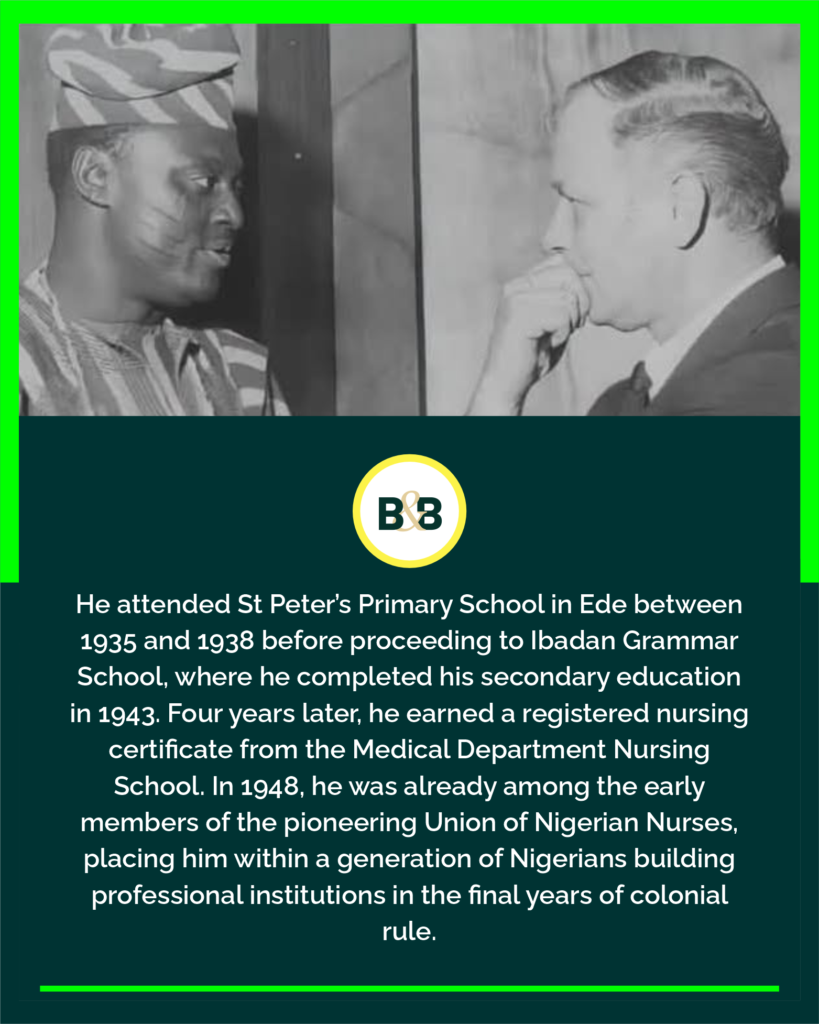
Adeleke’s early path was far removed from the political office that would eventually define one chapter of his life. He attended St Peter’s Primary School in Ede between 1935 and 1938 before proceeding to Ibadan Grammar School, where he completed his secondary education in 1943. Four years later, he earned a registered nursing certificate from the Medical Department Nursing School. In 1948, he was already among the early members of the pioneering Union of Nigerian Nurses, placing him within a generation of Nigerians building professional institutions in the final years of colonial rule.
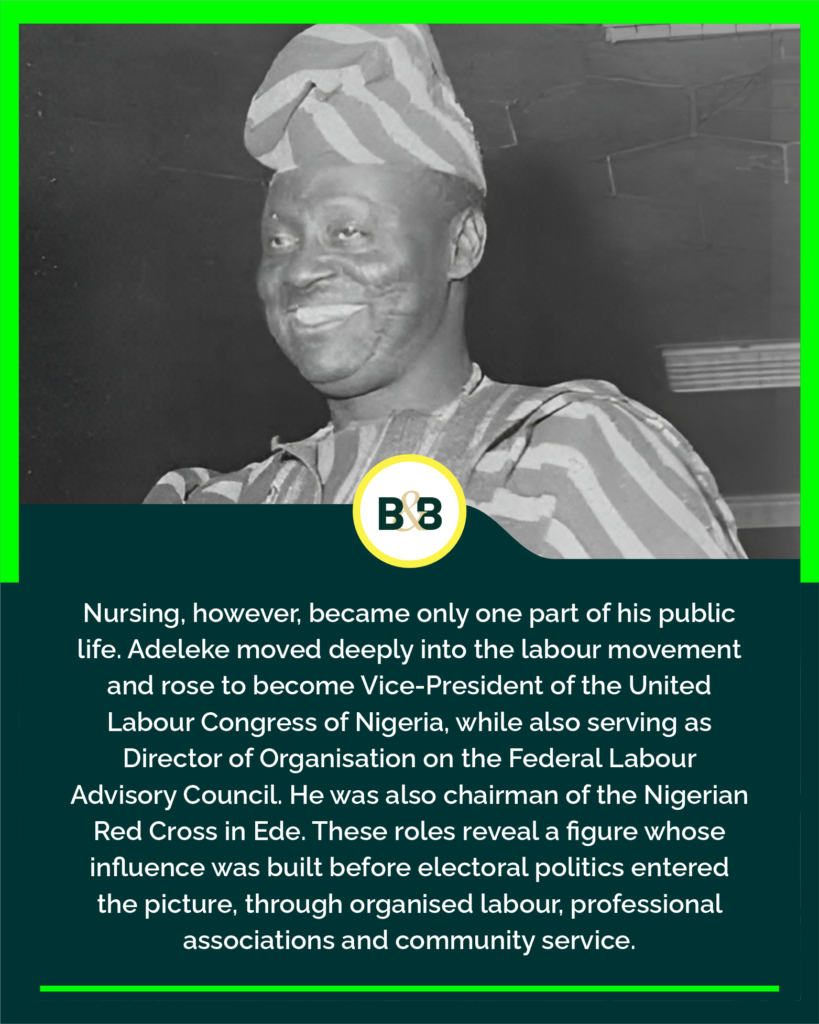
Nursing, however, became only one part of his public life. Adeleke moved deeply into the labour movement and rose to become Vice-President of the United Labour Congress of Nigeria, while also serving as Director of Organisation on the Federal Labour Advisory Council. He was also chairman of the Nigerian Red Cross in Ede. These roles reveal a figure whose influence was built before electoral politics entered the picture, through organised labour, professional associations and community service. His later political career did not arrive from nowhere; it grew out of years spent inside institutions that dealt directly with working people and public welfare.
In 1976, Ede conferred on him the traditional title of Balogun of Ede. Three years later, he entered the Second Republic’s National Assembly, winning election to the Senate under the Unity Party of Nigeria. He represented the old Oyo State Senatorial District 11, a constituency covering areas including Ede, Osogbo, Irepodun, Ifelodun, Odo Otin and Ila Orangun. At the time, Osun State did not yet exist as a separate state. His Senate years, from 1979 to 1983, placed an Ede-born labour activist at the centre of Nigeria’s return to civilian democratic government.
Yet perhaps the most revealing part of Adeleke’s story lies in what happened beyond the Senate chamber. He married twice, and his second wife, Esther Nnena Adeleke, was from Enugu. Their marriage brought together Yoruba and Igbo family histories at a time when Nigeria was still carrying the scars of the civil war. Their son Adedeji, born in Enugu in 1957, would later build a career in business and education. Adeleke University’s official biography identifies Raji Ayoola and Esther Nnena as Adedeji’s parents, preserving that connection in the institution their son eventually founded in Ede.
The family story then moved into a new generation and, eventually, into several very different expressions of influence. His son Isiaka Adetunji Adeleke became Osun State’s first civilian governor from 1992 to 1993 and later served in the Senate. Another son, Ademola Adeleke, followed a political path of his own, first entering the Senate and later becoming Governor of Osun State. Adedeji took a different route, developing his business interests and establishing Adeleke University in Ede. The family’s trajectory illustrates how one generation’s public life can create several distinct paths for the generations that follow.
And then there is the grandson whose name would eventually travel far beyond Nigerian politics: David Adedeji Adeleke, known globally as Davido. Davido is the son of Adedeji Adeleke, making Chief Raji Ayoola Adeleke his paternal grandfather. It is a remarkable family arc: a nurse and labour organiser from Ede became a Second Republic senator; his children moved into politics, business and education; and one of his grandchildren became one of Africa’s most internationally recognised music stars. The connections are familial, but the achievements belong to different people and different eras.
That is why an old photograph of Raji Ayoola Adeleke carries more than the curiosity of discovering Davido’s grandfather. It opens a window into an earlier Nigeria, when professional associations were taking shape, organised labour was becoming a significant force and the country was negotiating the difficult transition from colonial rule to self-government and, later, civilian democracy. The man in the photograph was not famous because of the grandson history would eventually give him. He had already lived a consequential life. Before the Adeleke name became a global pop-culture phenomenon, Raji Ayoola Adeleke had already given it a history.