

.
Who Says It’s Too Late?
.
African Business Builders & The Long Game
.
—-
.
At 25, Aliko Dangote was not the man whose name would eventually become synonymous with African industry. There was no $20-billion refinery project, no sprawling conglomerate stretching across the continent, no global billionaire ranking attached to his name. There was simply a young Nigerian businessman trying to make a business work. Dangote had returned from Al-Azhar University in Cairo in 1977 at 21 and, with a loan from his family, began trading commodities including rice, sugar and cement. Four years later, he had established the company that would evolve into Dangote Group.
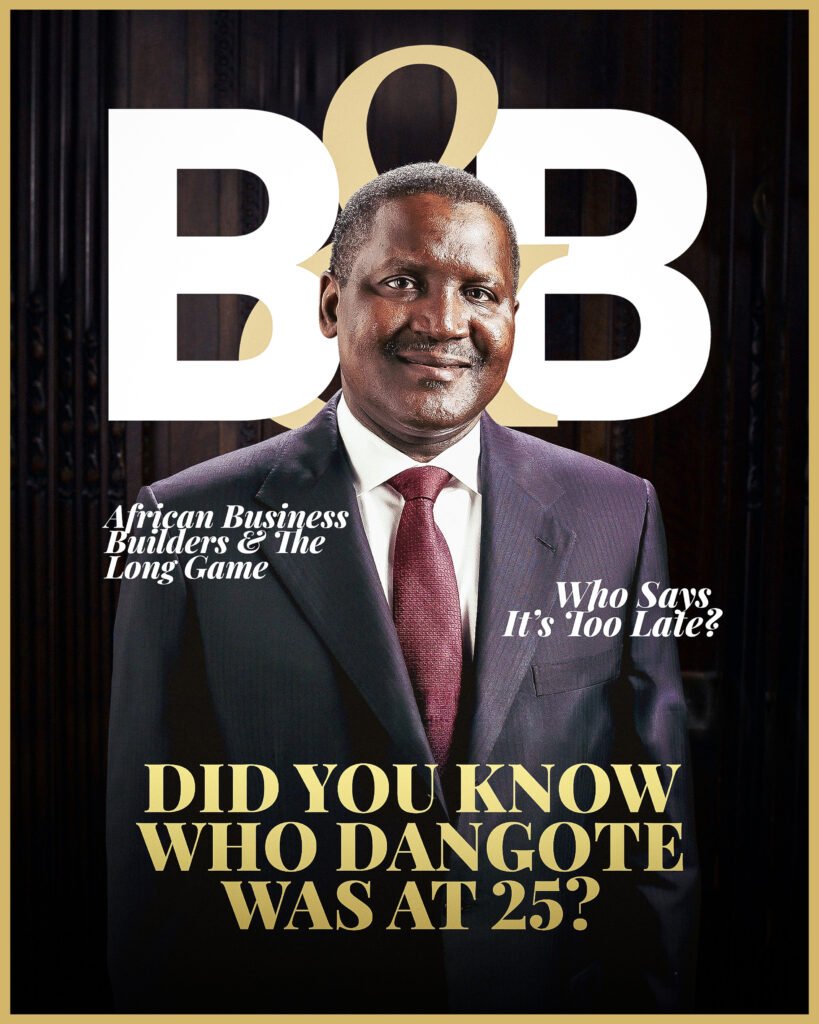
That distinction matters because success stories are usually told backwards. We meet Dangote today and then look for evidence that the man we see was always destined to become him. But history rarely works that neatly. At 25, he was still early in the experiment. His business was primarily a trading operation, not the manufacturing giant it would become. The transformation from trading commodities to producing the things Africa consumed would take years of capital deployment, risk, infrastructure and strategic reinvention. Bloomberg’s timeline places his decisive shift towards manufacturing in the late 1990s, meaning much of the empire was still ahead of him when he was already well into his adult life.
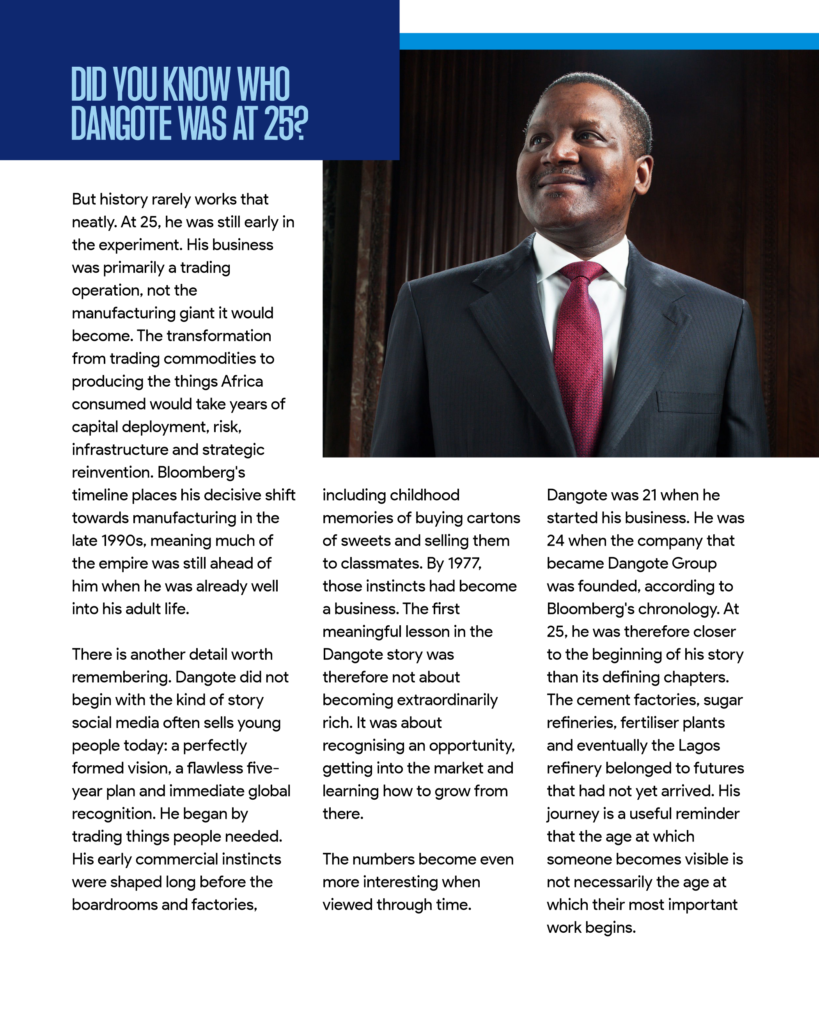
There is another detail worth remembering. Dangote did not begin with the kind of story social media often sells young people today: a perfectly formed vision, a flawless five-year plan and immediate global recognition. He began by trading things people needed. His early commercial instincts were shaped long before the boardrooms and factories, including childhood memories of buying cartons of sweets and selling them to classmates. By 1977, those instincts had become a business. The first meaningful lesson in the Dangote story was therefore not about becoming extraordinarily rich. It was about recognising an opportunity, getting into the market and learning how to grow from there.
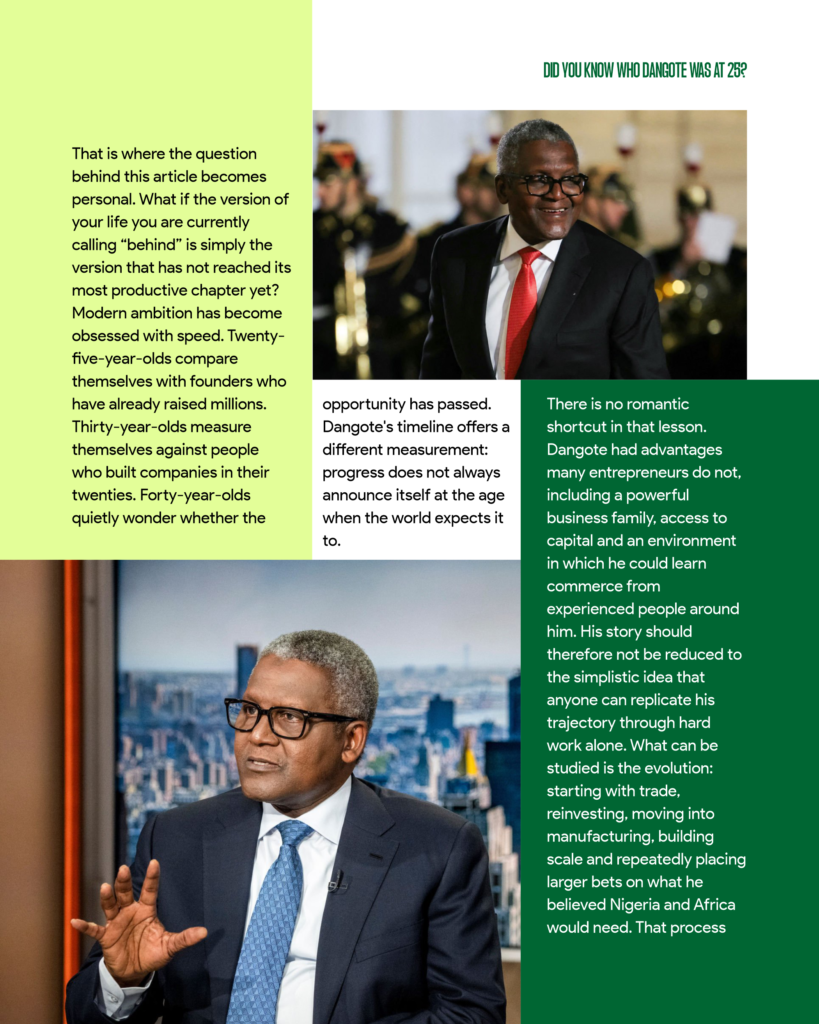
The numbers become even more interesting when viewed through time. Dangote was 21 when he started his business. He was 24 when the company that became Dangote Group was founded, according to Bloomberg’s chronology. At 25, he was therefore closer to the beginning of his story than its defining chapters. The cement factories, sugar refineries, fertiliser plants and eventually the Lagos refinery belonged to futures that had not yet arrived. His journey is a useful reminder that the age at which someone becomes visible is not necessarily the age at which their most important work begins.
That is where the question behind this article becomes personal. What if the version of your life you are currently calling “behind” is simply the version that has not reached its most productive chapter yet? Modern ambition has become obsessed with speed. Twenty-five-year-olds compare themselves with founders who have already raised millions. Thirty-year-olds measure themselves against people who built companies in their twenties. Forty-year-olds quietly wonder whether the opportunity has passed. Dangote’s timeline offers a different measurement: progress does not always announce itself at the age when the world expects it to.
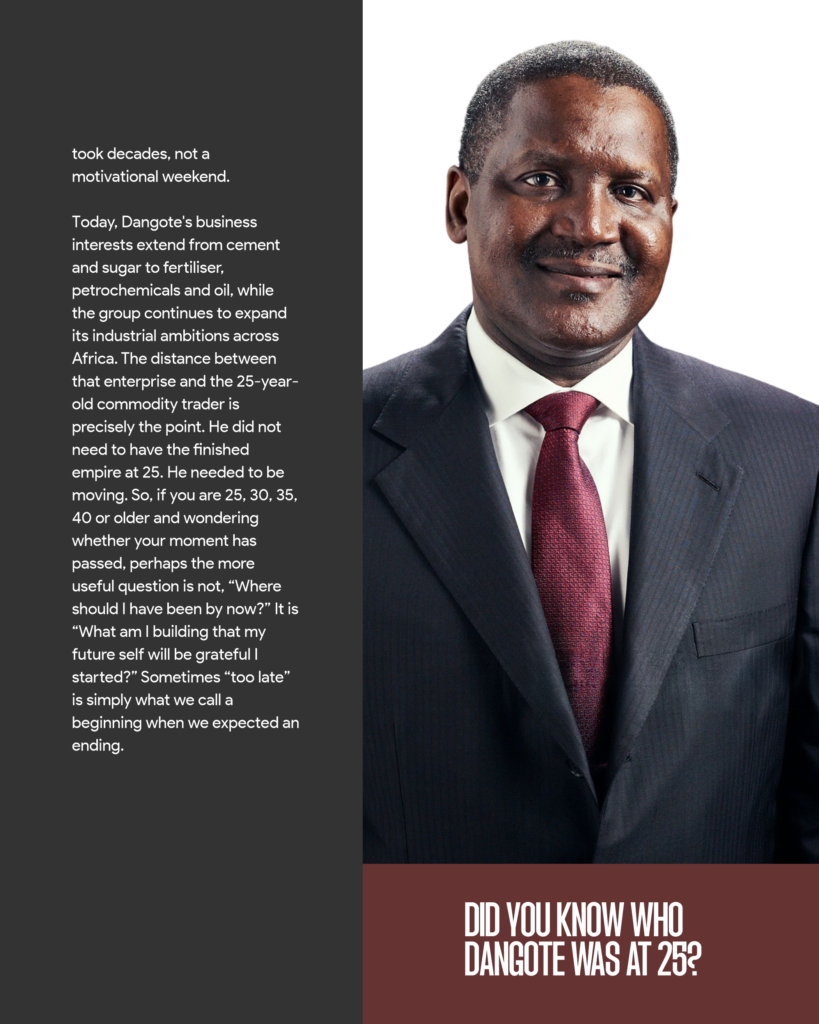
There is no romantic shortcut in that lesson. Dangote had advantages many entrepreneurs do not, including a powerful business family, access to capital and an environment in which he could learn commerce from experienced people around him. His story should therefore not be reduced to the simplistic idea that anyone can replicate his trajectory through hard work alone. What can be studied is the evolution: starting with trade, reinvesting, moving into manufacturing, building scale and repeatedly placing larger bets on what he believed Nigeria and Africa would need. That process took decades, not a motivational weekend.
Today, Dangote’s business interests extend from cement and sugar to fertiliser, petrochemicals and oil, while the group continues to expand its industrial ambitions across Africa. The distance between that enterprise and the 25-year-old commodity trader is precisely the point. He did not need to have the finished empire at 25. He needed to be moving. So, if you are 25, 30, 35, 40 or older and wondering whether your moment has passed, perhaps the more useful question is not, “Where should I have been by now?” It is “What am I building that my future self will be grateful I started?” Sometimes “too late” is simply what we call a beginning when we expected an ending.