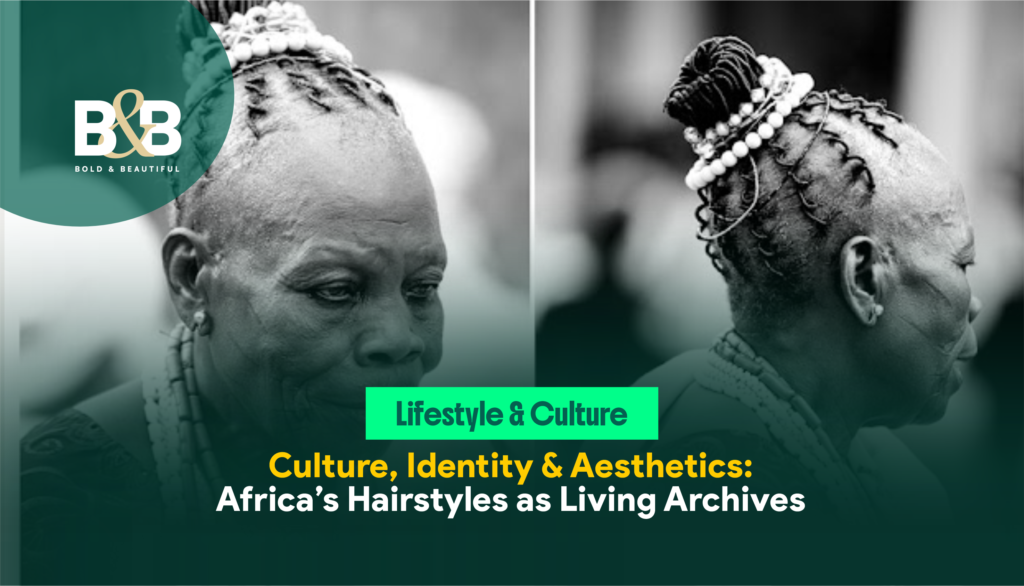
Before a photograph, before a passport, before a written record could tell the world who someone was, hair could do part of the work. Across Africa, the head has long been treated as a place where identity could be arranged, displayed and recognised. A hairstyle could speak about age, status, gender, marriage, community or occasion without a single word being spoken. The mistake is to look at an old African hairstyle and see decoration. Many of them were closer to language.
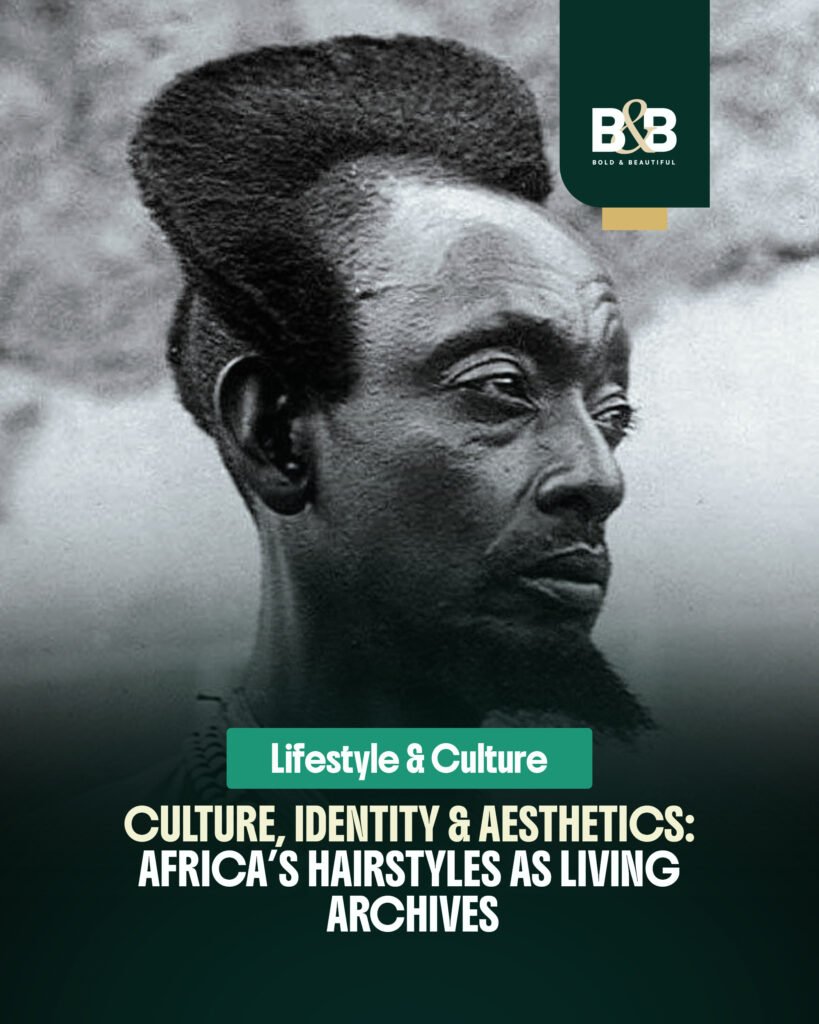
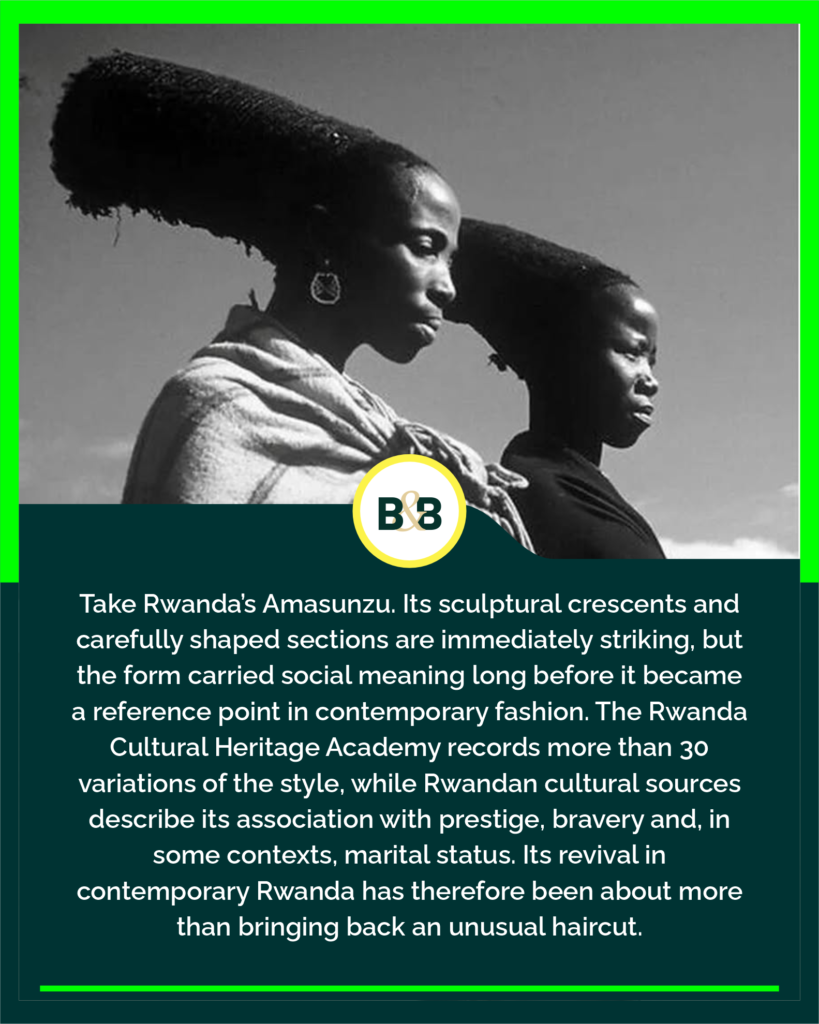
Take Rwanda’s Amasunzu. Its sculptural crescents and carefully shaped sections are immediately striking, but the form carried social meaning long before it became a reference point in contemporary fashion. The Rwanda Cultural Heritage Academy records more than 30 variations of the style, while Rwandan cultural sources describe its association with prestige, bravery and, in some contexts, marital status. Its revival in contemporary Rwanda has therefore been about more than bringing back an unusual haircut. It has reopened a connection with a visual vocabulary that once belonged naturally to everyday life.
Travel west and the vocabulary changes. Among Fulbe communities, elaborate coiffures, braids and ornamentation developed their own traditions, with hair becoming part of a broader language of beauty, identity and belonging. In Guinea, the connection is preserved even in objects that are now held in museums. The Metropolitan Museum of Art’s famous Baga D’mba headdress carries an intricately braided coiffure associated with Fulbe women of the Futa Jallon, linking the image of the headdress to the ancestral homeland of the Baga. Hair, in this context, becomes a geographical memory.
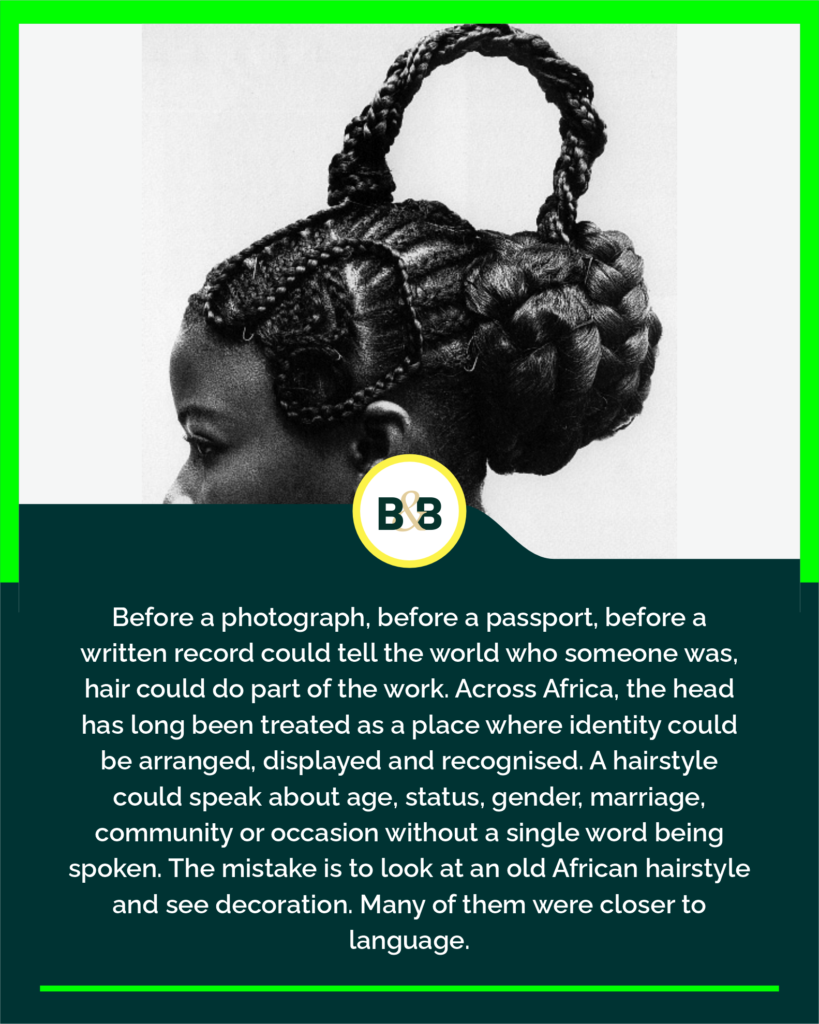
The same principle appears across the continent in different forms. Nigerian traditional hairdressing, for example, has historically carried information about ethnicity, social position, age, marital status and religious affiliation. Among Yoruba communities, elaborate styles could accompany particular stages of life and social occasions. In other societies, beads, shells, extensions, shaving patterns and sculptural forms could transform the head into something closer to an insignia. There was no single African hairstyle or universal meaning. There were thousands of local systems, each shaped by its own history.
That diversity is precisely why the history of African hair deserves better documentation. Colonialism did not simply redraw political borders. It also disrupted systems of value. European standards of appearance were frequently elevated above African forms, while indigenous aesthetics were dismissed, discouraged or recast as evidence of backwardness. Hair that had once communicated dignity or belonging could become something a person was expected to conceal in order to enter a school, workplace, church or institution shaped by someone else’s idea of respectability.
The consequences did not disappear with independence. They can still be seen whenever natural African hair is treated as unprofessional, traditional styling is described as excessive or African beauty is measured against standards developed elsewhere. Yet the contemporary return to braids, locs, natural textures, sculptural cuts and heritage-inspired styling is doing something deeper than reviving old photographs. A new generation of Africans is taking ownership of the visual language again, sometimes wearing ancestral forms faithfully and sometimes transforming them into entirely new expressions.
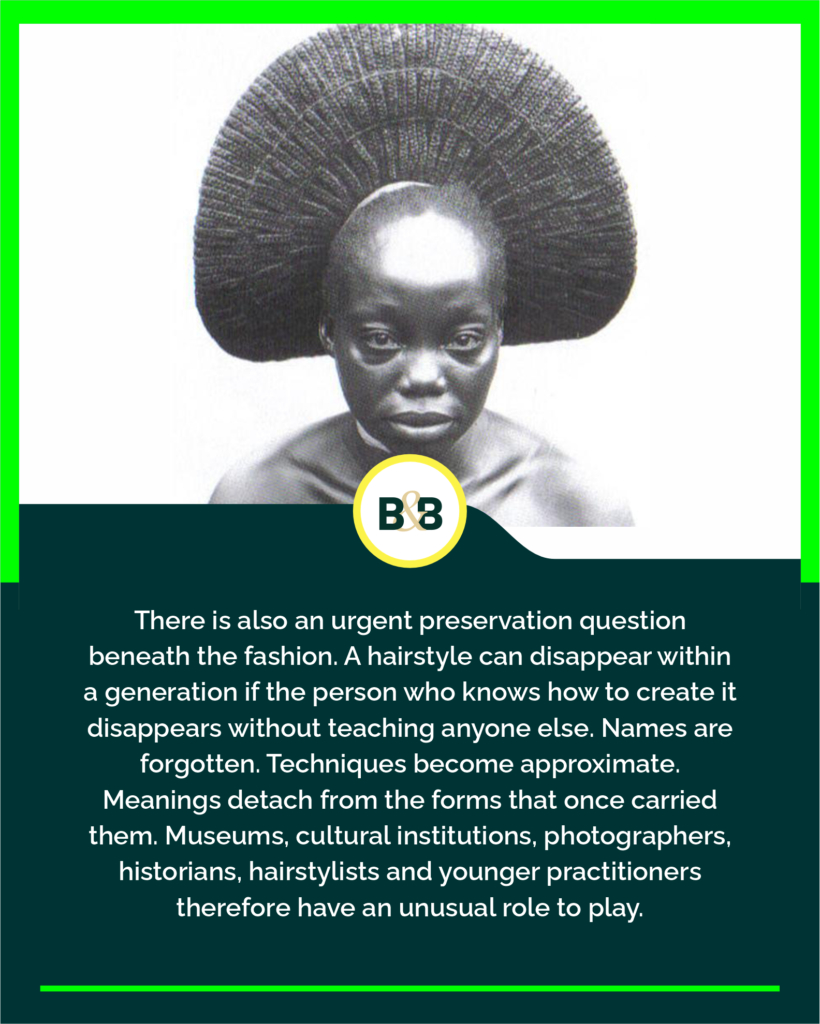
There is also an urgent preservation question beneath the fashion. A hairstyle can disappear within a generation if the person who knows how to create it disappears without teaching anyone else. Names are forgotten. Techniques become approximate. Meanings detach from the forms that once carried them. Museums, cultural institutions, photographers, historians, hairstylists and younger practitioners therefore have an unusual role to play. Documenting the technique matters. Recording the vocabulary matters. Asking older generations what a style meant before contemporary fashion stripped it of its context matters even more.
African hair deserves to be approached as culture, craft, history and design at the same time. It belongs in museums, archives, fashion schools, documentaries, classrooms and contemporary studios. It belongs in conversations about African identity without being reduced to nostalgia. Because these hairstyles have never been frozen objects from a distant past. They have always changed with the people who wear them. The braid, the cut, the twist, the crown and the sculpted form can carry memory forward while making something new. Sometimes, the history of a people is sitting on their head.